Foram encontradas 314 questões.
I - O Plano Plurianual deve definir as prioridades do governo durante o período que vai do primeiro ao quarto ano de um mandato presidencial.
II - As prioridades dispostas no Plano Plurianual são estabelecidas com base em Projeto de Lei Orçamentária Anual (LOA), anteriormente aprovado pelo Congresso Nacional.
III - A Lei Orçamentária autoriza as despesas, de acordo com a estimativa de receitas e a previsão de arrecadação, definindo que o Poder Executivo deve submeter ao Congresso Nacional projeto de lei de crédito adicional, caso necessite incorrer em despesas acima do limite que está previsto na LOA.
IV - A Lei de Diretrizes Orçamentárias (LDO) é uma lei ordinária, válida apenas para um exercício.
Estão corretas APENAS as afirmativas
Provas

I - O processamento dos dados relativos à preparação da elaboração orçamentária é realizado no SIDOR.
II - A abrangência do SIAFI não inclui as unidades gestoras brasileiras, situadas no exterior.
III - A Guia da Previdência Social - GPS - pode ser utilizada, no SIDOR, para efetuar as retenções de valores de terceiros ao INSS.
IV - O mecanismo de funcionamento da tabela de eventos possibilita fazer, no SIAFI, lançamentos contábeis em mais de uma unidade gestora.
Está correto APENAS o que se afirma em
Provas
I - A inclusão de dispositivo estranho à previsão da receita e à fixação da despesa na lei orçamentária anual fere o princípio da universalidade.
II - O princípio da unidade estabelece que o montante da despesa não deve ultrapassar a receita prevista para o período.
III - A vedação da apropriação de receitas de impostos a despesas específicas, salvo as exceções constitucionais, caracteriza o denominado princípio da não afetação das receitas.
IV - O princípio da publicidade prescreve que o conteúdo orçamentário deve ser divulgado por meio de veículos oficiais de comunicação, para o conhecimento público e para a eficácia de sua validade.
Estão corretos APENAS os itens
Provas
I - O processo pelo qual o auditor se certifica de que as demonstrações financeiras representam adequadamente, em todos os aspectos relevantes, a posição patrimonial e financeira da empresa, por meio da emissão de parecer, caracteriza a auditoria externa.
II - O exercício da auditoria interna é privativo de contabilista registrado no Conselho Regional de Contabilidade da jurisdição.
III - A principal característica da auditoria interna é a independência, ou seja, não possui vínculo com a empresa auditada.
IV - O parecer do auditor independente pode ser classificado em: sem ressalva, com ressalva, adverso ou com abstenção de opinião.
Está correto SOMENTE o que se afirma em
Provas
Provas
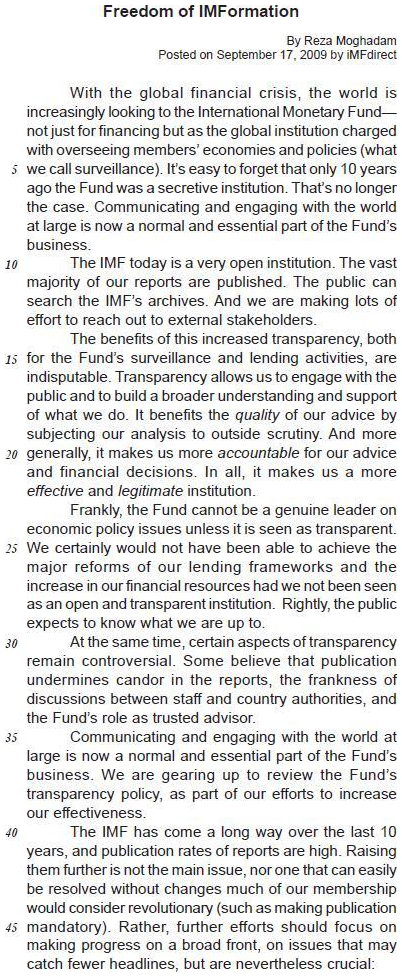
Freedom of IMFormation
By Reza Moghadam
Posted on September 17, 2009 by iMFdirect
With the global financial crisis, the world is increasingly looking to the International Monetary Fund- not just for financing but as the global institution charged with overseeing members' economies and policies (what we call surveillance). It's easy to forget that only 10 years ago the Fund was a secretive institution. That's no longer the case. Communicating and engaging with the world at large is now a normal and essential part of the Fund's business.
The IMF today is a very open institution. The vast majority of our reports are published. The public can search the IMF's archives. And we are making lots of effort to reach out to external stakeholders.
The benefits of this increased transparency, both for the Fund's surveillance and lending activities, are indisputable. Transparency allows us to engage with the public and to build a broader understanding and support of what we do. It benefits the quality of our advice by subjecting our analysis to outside scrutiny. And more generally, it makes us more accountable for our advice and financial decisions. In all, it makes us a more effective and legitimate institution.
Frankly, the Fund cannot be a genuine leader on economic policy issues unless it is seen as transparent. We certainly would not have been able to achieve the major reforms of our lending frameworks and the increase in our financial resources had we not been seen as an open and transparent institution. Rightly, the public expects to know what we are up to.
At the same time, certain aspects of transparency remain controversial. Some believe that publication undermines candor in the reports, the frankness of discussions between staff and country authorities, and the Fund's role as trusted advisor.
Communicating and engaging with the world at large is now a normal and essential part of the Fund's business. We are gearing up to review the Fund's transparency policy, as part of our efforts to increase our effectiveness.
The IMF has come a long way over the last 10 years, and publication rates of reports are high. Raising them further is not the main issue, nor one that can easily be resolved without changes much of our membership would consider revolutionary (such as making publication mandatory). Rather, further efforts should focus on making progress on a broad front, on issues that may catch fewer headlines, but are nevertheless crucial:
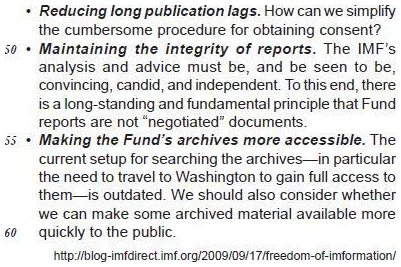
- Reducing long publication lags. How can we simplify the cumbersome procedure for obtaining consent?
- Maintaining the integrity of reports. The IMF's analysis and advice must be, and be seen to be, convincing, candid, and independent. To this end, there is a long-standing and fundamental principle that Fund reports are not "negotiated" documents.
- Making the Fund's archives more accessible. The current setup for searching the archives-in particular the need to travel to Washington to gain full access to them-is outdated. We should also consider whether we can make some archived material available more quickly to the public.
http://blog-imfdirect.imf.org/2009/09/17/freedom-of-imformation/
The wordplay in the title refers to the fact that the
Provas
Freedom of IMFormation
By Reza Moghadam
Posted on September 17, 2009 by iMFdirect
With the global financial crisis, the world is increasingly
looking to the International Monetary Fund- not just for financing but
as the global institution charged with overseeing members' economies and
policies (what we call surveillance). It's easy to forget that only 10
years ago the Fund was a secretive institution. That's no longer the
case. Communicating and engaging with the world at large is now a normal
and essential part of the Fund's business.
The IMF
today is a very open institution. The vast majority of our reports are
published. The public can search the IMF's archives. And we are making
lots of effort to reach out to external stakeholders.
The benefits of this increased transparency, both for the Fund's
surveillance and lending activities, are indisputable. Transparency
allows us to engage with the public and to build a broader understanding
and support of what we do. It benefits the quality of our advice
by subjecting our analysis to outside scrutiny. And more generally, it
makes us more accountable for our advice and financial decisions. In
all, it makes us a more effective and legitimate institution.
Frankly, the Fund cannot be a genuine leader on economic policy
issues unless it is seen as transparent. We certainly would not have
been able to achieve the major reforms of our lending frameworks and the
increase in our financial resources had we not been seen as an open and
transparent institution. Rightly, the public expects to know what we
are up to.
At the same time, certain aspects of
transparency remain controversial. Some believe that publication
undermines candor in the reports, the frankness of discussions between
staff and country authorities, and the Fund's role as trusted advisor.
Communicating and engaging with the world at large is now a
normal and essential part of the Fund's business. We are gearing up to
review the Fund's transparency policy, as part of our efforts to
increase our effectiveness.
The IMF has come a long way over the last 10 years, and publication rates of reports are high. Raising them
further is not the main issue, nor one that can easily be resolved
without changes much of our membership would consider revolutionary
(such as making publication mandatory). Rather, further efforts should
focus on making progress on a broad front, on issues that may catch
fewer headlines, but are nevertheless crucial:
- Reducing long publication lags. How can we simplify the cumbersome procedure for obtaining consent?
- Maintaining the integrity of reports. The IMF's analysis and advice must be, and be seen to be, convincing, candid, and independent. To this end, there is a long-standing and fundamental principle that Fund reports are not "negotiated" documents.
- Making the Fund's archives more accessible. The current setup for searching the archives-in particular the need to travel to Washington to gain full access to them-is outdated. We should also consider whether we can make some archived material available more quickly to the public.
http://blog-imfdirect.imf.org/2009/09/17/freedom-of-imformation/
In terms of meaning, it is correct to affirm that
Provas
" Rahim, on December 14th, 2009 at 12:41 am http://blog-imfdirect.imf.org/2009/09/17/freedom-of-imformation/ #comment-579
The comment above is in tune with Moghadam's ideas, because Rahim states that
Provas
Freedom of IMFormation
By Reza Moghadam
Posted on September 17, 2009 by iMFdirect
With the global financial crisis, the world is increasingly
looking to the International Monetary Fund- not just for financing but
as the global institution charged with overseeing members' economies and
policies (what we call surveillance). It's easy to forget that only 10
years ago the Fund was a secretive institution. That's no longer the
case. Communicating and engaging with the world at large is now a normal
and essential part of the Fund's business.
The IMF
today is a very open institution. The vast majority of our reports are
published. The public can search the IMF's archives. And we are making
lots of effort to reach out to external stakeholders.
The benefits of this increased transparency, both for the Fund's
surveillance and lending activities, are indisputable. Transparency
allows us to engage with the public and to build a broader understanding
and support of what we do. It benefits the quality of our advice
by subjecting our analysis to outside scrutiny. And more generally, it
makes us more accountable for our advice and financial decisions. In
all, it makes us a more effective and legitimate institution.
Frankly, the Fund cannot be a genuine leader on economic policy
issues unless it is seen as transparent. We certainly would not have
been able to achieve the major reforms of our lending frameworks and the
increase in our financial resources had we not been seen as an open and
transparent institution. Rightly, the public expects to know what we
are up to.
At the same time, certain aspects of
transparency remain controversial. Some believe that publication
undermines candor in the reports, the frankness of discussions between
staff and country authorities, and the Fund's role as trusted advisor.
Communicating and engaging with the world at large is now a
normal and essential part of the Fund's business. We are gearing up to
review the Fund's transparency policy, as part of our efforts to
increase our effectiveness.
The IMF has come a long way over the last 10 years, and publication rates of reports are high. Raising them
further is not the main issue, nor one that can easily be resolved
without changes much of our membership would consider revolutionary
(such as making publication mandatory). Rather, further efforts should
focus on making progress on a broad front, on issues that may catch
fewer headlines, but are nevertheless crucial:
- Reducing long publication lags. How can we simplify the cumbersome procedure for obtaining consent?
- Maintaining the integrity of reports. The IMF's analysis and advice must be, and be seen to be, convincing, candid, and independent. To this end, there is a long-standing and fundamental principle that Fund reports are not "negotiated" documents.
- Making the Fund's archives more accessible. The current setup for searching the archives-in particular the need to travel to Washington to gain full access to them-is outdated. We should also consider whether we can make some archived material available more quickly to the public.
http://blog-imfdirect.imf.org/2009/09/17/freedom-of-imformation/
The only argument that CANNOT be considered supportive of publishing the IMF documents is that the
Provas
Freedom of IMFormation
By Reza Moghadam
Posted on September 17, 2009 by iMFdirect
With the global financial crisis, the world is increasingly looking to the International Monetary Fund- not just for financing but as the global institution charged with overseeing members' economies and policies (what we call surveillance). It's easy to forget that only 10 years ago the Fund was a secretive institution. That's no longer the case. Communicating and engaging with the world at large is now a normal and essential part of the Fund's business.
The IMF today is a very open institution. The vast majority of our reports are published. The public can search the IMF's archives. And we are making lots of effort to reach out to external stakeholders.
The benefits of this increased transparency, both for the Fund's surveillance and lending activities, are indisputable. Transparency allows us to engage with the public and to build a broader understanding and support of what we do. It benefits the quality of our advice by subjecting our analysis to outside scrutiny. And more generally, it makes us more accountable for our advice and financial decisions. In all, it makes us a more effective and legitimate institution.
Frankly, the Fund cannot be a genuine leader on economic policy issues unless it is seen as transparent. We certainly would not have been able to achieve the major reforms of our lending frameworks and the increase in our financial resources had we not been seen as an open and transparent institution. Rightly, the public expects to know what we are up to.
At the same time, certain aspects of transparency remain controversial. Some believe that publication undermines candor in the reports, the frankness of discussions between staff and country authorities, and the Fund's role as trusted advisor.
Communicating and engaging with the world at large is now a normal and essential part of the Fund's business. We are gearing up to review the Fund's transparency policy, as part of our efforts to increase our effectiveness.
The IMF has come a long way over the last 10 years, and publication rates of reports are high. Raising them further is not the main issue, nor one that can easily be resolved without changes much of our membership would consider revolutionary (such as making publication mandatory). Rather, further efforts should focus on making progress on a broad front, on issues that may catch fewer headlines, but are nevertheless crucial:
- Reducing long publication lags. How can we simplify the cumbersome procedure for obtaining consent?
- Maintaining the integrity of reports. The IMF's analysis and advice must be, and be seen to be, convincing, candid, and independent. To this end, there is a long-standing and fundamental principle that Fund reports are not "negotiated" documents.
- Making the Fund's archives more accessible. The current setup for searching the archives-in particular the need to travel to Washington to gain full access to them-is outdated. We should also consider whether we can make some archived material available more quickly to the public.
http://blog-imfdirect.imf.org/2009/09/17/freedom-of-imformation/
The expression in boldtype and the item in parenthesis are semantically equivalent in
Provas
Caderno Container