Foram encontradas 100 questões.
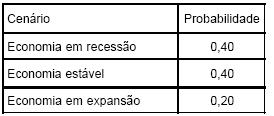
Um investidor aplica em um fundo de ações e espera os rendimentos seguintes, dependentes do cenário econômico vigente:

Com base em sua experiência passada, a distribuição de probabilidades do cenário econômico seria:
Provas

- Estatística InferencialEstimadoresPropriedades Assintóticas
- Séries TemporaisAnálise de Séries TemporaisARMA: Modelo Autorregressivo de Médias Móveis
A evolução de uma série mensal de receitas, após a remoção da tendência e de efeitos sazonais, define um processo fracamente estacionário que obedece à lei de formação de um processo auto-regressivo de médias móveis ARMA(p,q). O natural p é a ordem da parte auto-regressiva e o natural q a ordem do processo de médias móveis. Sabe-se que a função de autocorrelação da série tem queda exponencial e que a função de autocorrelação parcial não se anula na defasagem ("lag") de ordem 2, mas se anula a partir da defasagem ("lag") de ordem 3, inclusive.
Assinale a opção que dá os valores de p e q.Provas
Os registros de uma instituição financeira indicam que 90% das contas de empréstimo consideradas inadimplentes apresentaram pagamentos com mais de duas semanas de atraso em pelo menos duas prestações. Sabe-se também que 10% de todas as contas de empréstimo tornam-se inadimplentes e que 40% das contas de empréstimo integralmente liquidadas mostram pelo menos duas prestações com atraso no pagamento em mais de duas semanas. Assinale a opção que corresponde à probabilidade de que uma conta de empréstimo com duas ou mais prestações pagas com atraso de duas semanas torne-se inadimplente.
Provas
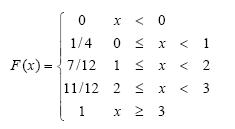
Uma variável aleatória X tem função de distribuição de probabilidades dada por
Provas
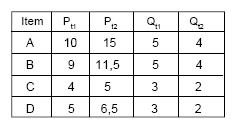
A tabela abaixo dá os valores dos preços Pti e quantidades Qti de quatro itens de consumo A, B, C e D nos tempos t1 < t2. Os preços estão em reais e as quantidades em unidades apropriadas.
Provas
Read the text below in order to answer questions 37 to 40:
Shocks to the system At the start of the year, it was not uncommon to hear businessmen saying that Brazil was enjoying its best economic conditions for a generation. The country appeared to be well on the way to a period of sustained economic expansion. Most economists were looking to another strong year of growth, with gross domestic product expanding by 4.5 per cent in 2001, on top of 4 per cent in 2000. Real interest rates were about to fall to single digits for the first time in decades. However, within just a few months, the outlook for the Brazilian economy has deteriorated dramatically. A whole series of unexpected factors are to blame. "We have been confronted by a series of shocks", admits Armínio Fraga, president of the central bank. The main cause of this turnaround has been the energy crisis. It had been well known for several years that Brazil ran the risk of power shortages because the expansion of capacity was not accompanying growth in demand, leaving the reservoirs that fuel the power stations precariously low. Yet, even with so much advance warning, the introduction of rationing still came as a surprise.Provas
Read the text below in order to answer questions 37 to 40:
Shocks to the system At the start of the year, it was not uncommon to hear businessmen saying that Brazil was enjoying its best economic conditions for a generation. The country appeared to be well on the way to a period of sustained economic expansion. Most economists were looking to another strong year of growth, with gross domestic product expanding by 4.5 per cent in 2001, on top of 4 per cent in 2000. Real interest rates were about to fall to single digits for the first time in decades. However, within just a few months, the outlook for the Brazilian economy has deteriorated dramatically. A whole series of unexpected factors are to blame. "We have been confronted by a series of shocks", admits Armínio Fraga, president of the central bank. The main cause of this turnaround has been the energy crisis. It had been well known for several years that Brazil ran the risk of power shortages because the expansion of capacity was not accompanying growth in demand, leaving the reservoirs that fuel the power stations precariously low. Yet, even with so much advance warning, the introduction of rationing still came as a surprise.Which aspect is not mentioned in the text?
Provas
Read the text below in order to answer questions 37 to 40:
Shocks to the system At the start of the year, it was not uncommon to hear businessmen saying that Brazil was enjoying its best economic conditions for a generation. The country appeared to be well on the way to a period of sustained economic expansion. Most economists were looking to another strong year of growth, with gross domestic product expanding by 4.5 per cent in 2001, on top of 4 per cent in 2000. Real interest rates were about to fall to single digits for the first time in decades. However, within just a few months, the outlook for the Brazilian economy has deteriorated dramatically. A whole series of unexpected factors are to blame. "We have been confronted by a series of shocks", admits Armínio Fraga, president of the central bank. The main cause of this turnaround has been the energy crisis. It had been well known for several years that Brazil ran the risk of power shortages because the expansion of capacity was not accompanying growth in demand, leaving the reservoirs that fuel the power stations precariously low. Yet, even with so much advance warning, the introduction of rationing still came as a surprise.Concerning the Brazilian economy, the year 2001 has been
Provas
Read the text below in order to answer questions 37 to 40:
Shocks to the system At the start of the year, it was not uncommon to hear businessmen saying that Brazil was enjoying its best economic conditions for a generation. The country appeared to be well on the way to a period of sustained economic expansion. Most economists were looking to another strong year of growth, with gross domestic product expanding by 4.5 per cent in 2001, on top of 4 per cent in 2000. Real interest rates were about to fall to single digits for the first time in decades. However, within just a few months, the outlook for the Brazilian economy has deteriorated dramatically. A whole series of unexpected factors are to blame. "We have been confronted by a series of shocks", admits Armínio Fraga, president of the central bank. The main cause of this turnaround has been the energy crisis. It had been well known for several years that Brazil ran the risk of power shortages because the expansion of capacity was not accompanying growth in demand, leaving the reservoirs that fuel the power stations precariously low. Yet, even with so much advance warning, the introduction of rationing still came as a surprise.Provas
Read the text below in order to answer questions 34 to 36:
Fed steers US rates lower by quarter point
The US Federal Reserve last night demonstrated its determination to steer the American economy away from recession when it cut its key interest rate for the seventh time this year and signalled that borrowing costs could fall again. The Fed announced it was cutting its funds rate by a quarter of a point to 3.5 per cent, its lowest for seven years, and also reduced its largely symbolic discount rate. The discount rate fell a quarter of a point to 3 per cent, matching lows seen in the early 1990's. In a statement released alongside the rate decision, the Fed reiterated its so-called "easing bias", a signal that rates are more likely to fall than rise, saying that the risks to the US economy remained "weighted mainly toward economic weakness". The Fed said: "Business profits and capital spending continue to weaken and growth abroad is slowing, weighing on the US economy".In connection with recession in the American economy, the aim of the Fed is to
Provas
Caderno Container