Foram encontradas 80 questões.

O autor inseriu no balão do último quadrinho uma fala que exemplifica o conceito de metonímia (figura de linguagem baseada numa relação de proximidade). Essa fala é:
Provas
Questão presente nas seguintes provas

A tabela mostra a classificação das ondas eletromagnéticas em função das suas frequências.
|
Região do espectro
eletromagnético
|
Faixa de
frequência (Hz)
|
| Ondas de rádio | < 3,0 × 10⁹ |
| Micro-ondas | 3,0 x 10⁹ a 3,0 x 10¹² |
| Infravermelho | 3,0 x 10¹² a 4,3 x 10¹⁴ |
| Visível | 4,3 x 10¹⁴ a 7,5 x 10¹⁴ |
| Ultravioleta | 7,5 x 10¹⁴ a 3,0 x 10¹⁷ |
| Raios X | 3,0 x 10¹⁷ a 3,0 x 10¹⁹ |
| Raios gama | > 3,0 × 10¹⁹ |
(www.if.ufrgs.br. Adaptado.)
Considere que as ondas eletromagnéticas se propagam pelo ar com velocidade 3,0 x 10⁸ m/s aproximadamente e que um radar emite ondas eletromagnéticas de comprimento 2,0 cm. As ondas emitidas por esse radar são
Provas
Questão presente nas seguintes provas
O quadro ilustra um experimento que utilizou ervilhas de cheiro, em que as plantas parentais (P) eram de linhagens puras.
| P |
ervilha lisa e amarela (P1) x ervilha rugosa e
verde (P2)
|
| F1 | 100% ervilha lisa e amarela |
| F1 x P2 | ervilha lisa e amarela x ervilha rugosa e verde |
| F2 |
25% ervilha lisa e amarela
25% ervilha lisa e verde
25% ervilha rugosa e amarela
25% ervilha rugosa e verde
|
Os resultados obtidos em F2 permitiram concluir que os genes que determinam a forma e os genes que determinam a cor das ervilhas
Provas
Questão presente nas seguintes provas
As tomografias computadorizadas envolvem sobreposição de imagens e, em algumas situações, é necessário conhecer a área da região de intersecção das imagens sobrepostas. Na figura, um triângulo equilátero ABC se sobrepõe a um círculo de centro N e raio NB = NC = NM, com M e N sendo pontos médios, respectivamente, de !$ \overline {AB} !$ e !$ \overline {BC} !$.
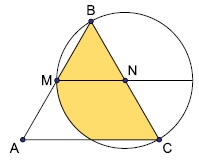
Sendo a área de triângulo equilátero de lado !$ \ell !$ é igual a !$ { \large \ell^2 \sqrt 3 \over 4} !$ e a área de círculo de raio r igual a !$ \pi r^2 !$, se o lado do triângulo ABC medir 4 cm, então, a área de intersecção entre o triângulo e o círculo, em cm2, será igual a
Provas
Questão presente nas seguintes provas
Sistemas frontais e anticiclones conseguem deslocar-se meridionalmente e atingir latitudes muito baixas ultrapassando, inclusive, a linha do equador. Suas consequências são localmente conhecidas como “friagens”.
(Marcelo E. Seluchi. “Geadas e friagens”. In: Iracema F. A. Cavalcanti
et al (org). Tempo e clima no Brasil, 2009. Adaptado.)
As friagens são caracterizadas pela ação da
Provas
Questão presente nas seguintes provas
Can plants hear?
Flora may be able to detect the
sounds of flowing water or munching insects
Pseudoscientific claims that music helps plants grow have been made for decades, despite evidence that is shaky at best. Yet new research suggests some flora may be capable of sensing sounds, such as the gurgle of water through a pipe or the buzzing of insects.
In a recent study, Monica Gagliano, an evolutionary biologist at the University of Western Australia, and her colleagues placed pea seedlings in pots shaped like an upside-down Y. One arm of each pot was placed in either a tray of water or a coiled plastic tube through which water flowed; the other arm had dry soil. The roots grew toward the arm of the pipe with the fluid, regardless of whether it was easily accessible or hidden inside the tubing. “They just knew the water was there, even if the only thing to detect was the sound of it flowing inside the pipe,” Gagliano says. Yet when the seedlings were given a choice between the water tube and some moistened soil, their roots favored the latter. She hypothesizes that these plants use sound waves to detect water at a distance but follow moisture gradients to home in on their target when it is closer.
The research, reported earlier this year in Oecologia, is not the first to suggest flora can detect and interpret sounds. A 2014 study showed the rock cress Arabidopsis can distinguish between caterpillar chewing sounds and wind vibrations – the plant produced more chemical toxins after “hearing” a recording of feeding insects. “We tend to underestimate plants because their responses are usually less visible to us. But leaves turn out to be extremely sensitive vibration detectors,” says lead study author Heidi M. Appel, an environmental scientist now at the University of Toledo.
(Marta Zaraska. www.scientificamerican.com, 17.05.2017.)
O trecho do terceiro parágrafo “But leaves turn out to be extremely sensitive vibrations detectors” indica que as folhas
Provas
Questão presente nas seguintes provas
Soluções aquosas de amônia e de soda cáustica, de iguais concentrações em mol/L,
Provas
Questão presente nas seguintes provas
Can plants hear?
Flora may be able to detect the
sounds of flowing water or munching insects
Pseudoscientific claims that music helps plants grow have been made for decades, despite evidence that is shaky at best. Yet new research suggests some flora may be capable of sensing sounds, such as the gurgle of water through a pipe or the buzzing of insects.
In a recent study, Monica Gagliano, an evolutionary biologist at the University of Western Australia, and her colleagues placed pea seedlings in pots shaped like an upside-down Y. One arm of each pot was placed in either a tray of water or a coiled plastic tube through which water flowed; the other arm had dry soil. The roots grew toward the arm of the pipe with the fluid, regardless of whether it was easily accessible or hidden inside the tubing. “They just knew the water was there, even if the only thing to detect was the sound of it flowing inside the pipe,” Gagliano says. Yet when the seedlings were given a choice between the water tube and some moistened soil, their roots favored the latter. She hypothesizes that these plants use sound waves to detect water at a distance but follow moisture gradients to home in on their target when it is closer.
The research, reported earlier this year in Oecologia, is not the first to suggest flora can detect and interpret sounds. A 2014 study showed the rock cress Arabidopsis can distinguish between caterpillar chewing sounds and wind vibrations – the plant produced more chemical toxins after “hearing” a recording of feeding insects. “We tend to underestimate plants because their responses are usually less visible to us. But leaves turn out to be extremely sensitive vibration detectors,” says lead study author Heidi M. Appel, an environmental scientist now at the University of Toledo.
(Marta Zaraska. www.scientificamerican.com, 17.05.2017.)
What is the topic mainly about?
Provas
Questão presente nas seguintes provas
Can plants hear?
Flora may be able to detect the
sounds of flowing water or munching insects
Pseudoscientific claims that music helps plants grow have been made for decades, despite evidence that is shaky at best. Yet new research suggests some flora may be capable of sensing sounds, such as the gurgle of water through a pipe or the buzzing of insects.
In a recent study, Monica Gagliano, an evolutionary biologist at the University of Western Australia, and her colleagues placed pea seedlings in pots shaped like an upside-down Y. One arm of each pot was placed in either a tray of water or a coiled plastic tube through which water flowed; the other arm had dry soil. The roots grew toward the arm of the pipe with the fluid, regardless of whether it was easily accessible or hidden inside the tubing. “They just knew the water was there, even if the only thing to detect was the sound of it flowing inside the pipe,” Gagliano says. Yet when the seedlings were given a choice between the water tube and some moistened soil, their roots favored the latter. She hypothesizes that these plants use sound waves to detect water at a distance but follow moisture gradients to home in on their target when it is closer.
The research, reported earlier this year in Oecologia, is not the first to suggest flora can detect and interpret sounds. A 2014 study showed the rock cress Arabidopsis can distinguish between caterpillar chewing sounds and wind vibrations – the plant produced more chemical toxins after “hearing” a recording of feeding insects. “We tend to underestimate plants because their responses are usually less visible to us. But leaves turn out to be extremely sensitive vibration detectors,” says lead study author Heidi M. Appel, an environmental scientist now at the University of Toledo.
(Marta Zaraska. www.scientificamerican.com, 17.05.2017.)
In the excerpt from the second paragraph “Yet when the seedlings”, the word “yet” indicates
Provas
Questão presente nas seguintes provas
Can plants hear?
Flora may be able to detect the
sounds of flowing water or munching insects
Pseudoscientific claims that music helps plants grow have been made for decades, despite evidence that is shaky at best. Yet new research suggests some flora may be capable of sensing sounds, such as the gurgle of water through a pipe or the buzzing of insects.
In a recent study, Monica Gagliano, an evolutionary biologist at the University of Western Australia, and her colleagues placed pea seedlings in pots shaped like an upside-down Y. One arm of each pot was placed in either a tray of water or a coiled plastic tube through which water flowed; the other arm had dry soil. The roots grew toward the arm of the pipe with the fluid, regardless of whether it was easily accessible or hidden inside the tubing. “They just knew the water was there, even if the only thing to detect was the sound of it flowing inside the pipe,” Gagliano says. Yet when the seedlings were given a choice between the water tube and some moistened soil, their roots favored the latter. She hypothesizes that these plants use sound waves to detect water at a distance but follow moisture gradients to home in on their target when it is closer.
The research, reported earlier this year in Oecologia, is not the first to suggest flora can detect and interpret sounds. A 2014 study showed the rock cress Arabidopsis can distinguish between caterpillar chewing sounds and wind vibrations – the plant produced more chemical toxins after “hearing” a recording of feeding insects. “We tend to underestimate plants because their responses are usually less visible to us. But leaves turn out to be extremely sensitive vibration detectors,” says lead study author Heidi M. Appel, an environmental scientist now at the University of Toledo.
(Marta Zaraska. www.scientificamerican.com, 17.05.2017.)
De acordo com o segundo parágrafo,
Provas
Questão presente nas seguintes provas
Cadernos
Caderno Container