Foram encontradas 704 questões.
Uma viga (conforme ilustração) estará submetida a uma variação de temperatura !$ \Delta !$T=50°C. Seu módulo de elasticidade é 2,1 x 10⁴ MPa e os apoios são considerados indeslocáveis e indeformáveis.
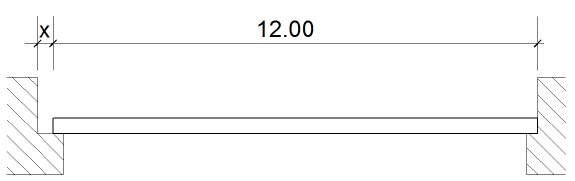
Se o coeficiente de dilatação linear é !$ \alpha !$=1,5 x 10⁻⁵ °C-1, o comprimento da junta de dilatação, para que a tensão de compressão, gerada pela dilatação seja de 15 MPa será
Provas
Questão presente nas seguintes provas

Embora mais difundido, em arquitetura, para uso de representação gráfica em duas dimensões, o AutoCAD é um software totalmente 3D. O mesmo possui recursos de modelagem em ambiente tridimensional que permite a criação de maquetes eletrônicas completas. Na área de desenho, o software exibe tanto para desenho no plano quanto para desenho em ambiente tridimensional, ícone do sistema de coordenadas, embora seja neste último que a manipulação do sistema de coordenadas é solicitada com mais frequência.
Sobre o sistema de coordenadas do AutoCAD e seu uso, é correto afirmar que
Provas
Questão presente nas seguintes provas
O código a seguir mostra um programa escrito na linguagem de programação C. Os números à esquerda representam cada linha de código fonte. Eles são meramente ilustrativos e não fazem parte do programa.
1 #include <stdio.h>
2
3 main() {
4 int **p;
5 int *q, *r;
6 int a;
7
8 p = (int **)malloc(sizeof(int *));
9 *p = (int *)malloc(sizeof(int));
10
11 a = 10;
12 r = &a;
13 **p = 11;
14 q = *p;
15 *q = 12;
16 **p = a;
17 *r = 13;
18
19 printf("%d\n", *q);
20
21 free(q);
22 free(p);
23 }
Ao executar o código, o valor impresso na saída padrão do usuário (linha 19 do programa) será
Provas
Questão presente nas seguintes provas
Que alternativa apresenta informação INCORRETA com relação aos processos de tratamento térmico dos aços?
Provas
Questão presente nas seguintes provas
Online students can't help being sociable
By Sean CoughlanBBC News education correspondent
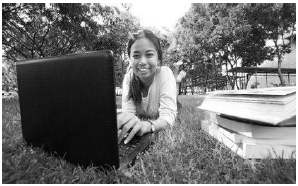
Online university students want to talk outside the computer screen
It was a revolution moving higher education from bricks to clicks… and now it's started to go back to bricks again.
Online university providers, which offered people the chance to study from home, are turning full circle by creating a network of learning centres where students can meet and study together.
Instead of demolishing the dusty old classrooms, the online university revolution is responsible for opening some new ones.
Coursera, a major California-based provider of online courses, is creating an international network of "learning hubs", where students can follow these virtual courses in real-life, bricks and mortar settings.
And there are thousands of meet-ups in cafes and libraries where students get together to talk about their online courses.
This is the latest stage in the rapid evolution of so-called Moocs - massive open online courses - where some of the world's leading universities have created digital versions of courses which are offered free over the internet.
Learning together
Coursera now has seven million registered users. That's bigger than the entire university populations of the UK and France combined. But it seems there is an irresistible social side to learning. Finding stuff out together seems to be more appealing than following a course alone.
The Coursera learning hubs are running in more than 30 cities, from Baghdad to Buenos Aires, Moscow to Mumbai and Shanghai to Santiago. The learning hubs are run by partner organisations, providing a place where students following Coursera online courses can come to study together and get help from mentors.
In Moscow, the learning hub is hosted by Digital October, a centre for technology and entrepreneurship. Yulia Lesnikova, director of educational programs, says it provides a more sociable way of following online courses.
'Like a village'
There have been four online courses so far followed in the Moscow learning hub. This includes a course about genetics created by the University of British Columbia, with students in Moscow being supported by an expert from one of Russia's oldest genetics institutes.
There is a course on gamification from the University of Pennsylvania's Wharton School of Business, with sub-titles in Russian.
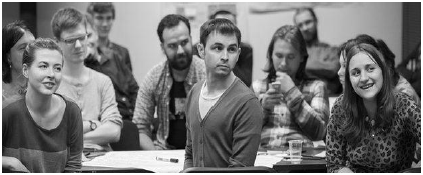
Students following an online course at the Digital October learning hub in Moscow
When students are gathered for their Mooc classes it becomes a focus for other spin-offs, such as firms wanting to recruit staff or to get students involved in developing commercial projects.
In Beijing, the learning hub has been set up with Guokr, a Chinese science-based social networking website.
Yang Liu, Guokr's education director, says studying as a group provides a way of keeping students connected. It's also introduced the word "Moocer" into China, she says.
"Learning can be very lonely, they can drop out."
It can be a more effective way of studying, she says. In a group of people there's likely to be a spread of knowledge, with students able to help one another.
"It's like a village, they form a small society."
It also allows for different types of learner to be supported. About half of the people following Coursera courses in Beijing are university students, she says.
Cutting drop-out rates
But there are also isolated individuals who like the social setting, such as older people living alone or mothers looking after children at home.
Yin Lu, responsible for Coursera's international development, says learning hubs have a wide range of local approaches. They can be based around tutors or around organised projects or else emphasise the social aspect of learning.
In India, the focus is on teacher training and professional development. It means that courses designed for students in the US or Europe are being played out in classrooms in New Delhi and Mumbai.
What has become apparent, she says, is that there is a much lower drop-out rate for students who attend a learning hub.
Moocs allow anyone to enter, with no barriers from cost or qualifications, but that also means relatively few ever finish a course. Ms Lu says that the typical completion rate for a Mooc is about 5% to 10%.
Practical projects are run alongside the online courses
For Mooc students attending learning hubs, the completion rates are between 30% and 100%, she says.
Ms Lu says it's likely that more hubs will open where there are concentrations of Coursera students.
But she says there are no plans for these learning hubs to become fully-fledged colleges, where students might take exams as well as follow courses.
"We exist to complement what universities can provide," she says. But it wouldn't be difficult to imagine the commercial possibilities if they changed their mind.
'Meet-ups'
There is something almost organic about how these digital projects have taken root in the physical world.
Moocs were meant to be the university courses of the laptop era, self-sustaining and free-standing, with students able to stop and start materials on the internet and get online support from social networking.
But you can't stop people from wanting to talk to each other, outside the computer screen.
As well as the more formal learning hubs, self-organised "meet-ups" for Coursera students have sprung up in more than 3,700 cities around the world, based around specific Coursera online courses.
For example, in London there are groups meeting in cafes at the British Library and the South Bank Centre. In Paris, there are meetings in the Pompidou Centre and in university buildings.
Meet-ups are held in a whole range of public places, where students want to discuss and debate these digital courses.
They're scheduled and arranged online, with the only vital ingredients being a laptop, wi-fi and somewhere to talk.
Even virtual students want to have a cup of coffee and a conversation after a lecture.
Available at: <http://www.bbc.com/news/business-26925463>
consulted on Apr. 12th. 2014.
Which of the following is NOT CORRECT, according to the text?
Provas
Questão presente nas seguintes provas
Dornelas (2002) afirma que existem várias formas de se medir o sucesso de uma incubadora e cita algumas que têm sido utilizadas.
Dentre as afirmativas abaixo, cita corretamente uma destas formas mencionadas pelo autor.
Provas
Questão presente nas seguintes provas
- Engenharia de SoftwareAnálise e Projeto de Software
- Engenharia de SoftwareCiclo de Vida de Software
- Engenharia de SoftwareModelos de Desenvolvimento
A engenharia de software é uma área para o desenvolvimento de software de alta qualidade para sistemas baseados em computador. Na engenharia de software existem quatro paradigmas – o ciclo de vida clássico, o uso de protótipos, o modelo espiral e as técnicas de quarta geração. Cada um dos paradigmas é distinto entre si; contudo, todos eles têm três fases em comum.
Como se caracteriza a Fase de Desenvolvimento?
Provas
Questão presente nas seguintes provas
Durante a presidência do paulista Washington Luis (1926-1930), o Brasil atravessava grave crise política e econômica. A produção de café alcançara 28 milhões de sacas anuais, enquanto a exportação continuou em 14,5 milhões de sacas. O choque final veio com a crise de 1929, que paralisou o comércio mundial e afetou dramaticamente a cafeicultura brasileira nos anos seguintes.
No tocante ao aspecto político, considera-se como efeito imediato desta situação
Provas
Questão presente nas seguintes provas
“A primeira fome registrou-se entre os anos 1800 e 1825 e matou um milhão e quatrocentas mil pessoas. De1827 a 1850 morreram de fome 5 milhões de pessoas. Entre 1875 e 1900, a Índia sofreu 18 grandes epidemias de fome que mataram 26 milhões de pessoas. Em 1918, houve mais de 8 milhões de mortos por desnutrição e gripe.”
BRUIT, Hector, O Imperialismo, São Paulo: Editora Atual, 1996. p. 62-63
A situação descrita pelo autor remete à situação vivida pela Índia no século XIX, sobre esse contexto, afirma-se que
Provas
Questão presente nas seguintes provas
Dados os vetores !$ u \, = \, -3i \, -2j \, e \, v \, = \, 6i \, -9j !$, analise as proposições sobre esses vetores.
I. O módulo do vetor u é !$ \parallel u \parallel \, = \, \sqrt{5}. !$
II. O vetor v normalizado é !$ { \large 6 \over \sqrt{117}} \, i \, - \, { \large 9 \over \sqrt{117}} \, j \, . !$
III. Os vetores u e v são perpendiculares.
Estão corretas as afirmativas
Provas
Questão presente nas seguintes provas
Cadernos
Caderno Container