Foram encontradas 400 questões.
As estratégias de gestão de pessoas são freqüentemente fragmentadas em proposições mais estreitas, mais operacionais. Tais estratégias operacionais de gestão de pessoas são a base do planejamento tático dos subsistemas de gestão de pessoas, EXCETO,
Provas
Questão presente nas seguintes provas

Além do poder de referência, um administrador possui quatro tipos de poder que servem de base para o desenvolvimento da liderança. A capacidade de influenciar o comportamento de outras pessoas por causa do conhecimento específico que alguém detém é o tipo de poder
Provas
Questão presente nas seguintes provas
A respeito da representação que segue são feitas as seguintes afirmações:
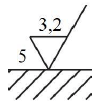
I. O símbolo indica que não é permitida a remoção de material da peça.
II. Deve-se deixar 5mm de sobremetal para usinagem.
III. O valor máximo de rugosidade admitida é de 3,2 μm.
Está(ão) CORRETA(S) a(s) afirmativa(s)
Provas
Questão presente nas seguintes provas
ScienceDaily (Dec. 19, 2008) — Wellcome Trust researchers have developed a new form of psychotherapy that has been shown to have the potential to treat more than eight out of ten cases of eating disorders in adults, a study out today reports.
This new "enhanced" form of cognitive behavioural therapy (CBT-E) builds on and improves the current leading treatment for bulimia nervosa as recommended by the National Institute of Health and Clinical Excellence (NICE). CBT-E is the first treatment to be shown to be suitable for the majority of cases of eating disorders.
According to NICE, eating disorders are a major cause of physical and psychosocial impairment in young women, affecting at least one in twenty women between the ages of 18 and 30. They also occur in young men but are less common. Three eating disorders are recognised: anorexia nervosa, which accounts for around one in ten cases in adults; bulimia nervosa, which accounts for a third of all cases; and the remainder are classed as "atypical eating disorders, which account for over half of all cases. In these atypical cases the features of anorexia nervosa and bulimia nervosa are combined in a different way.
The three eating disorders vary in their severity, but typically involve extreme and relentless dieting, self-induced vomiting or laxative misuse, binge eating, driven exercising and in some cases marked weight loss. Common associated features are depression, social withdrawal, perfectionism and low self-esteem. The disorders tend to run a chronic course and are notoriously difficult to treat. Relapse is common.
This new treatment derives from an earlier form of CBT that was designed exclusively for patients with bulimia nervosa. Both were developed by Professor Christopher Fairburn, a Wellcome Trust Principal Research Fellow at the University of Oxford. In 2004, the earlier treatment became the first psychotherapy to be recognised by NICE as the leading treatment for a clinical condition and its use was recommended across the NHS.
Now, in a study published today in the American Journal of Psychiatry, Professor Fairburn and colleagues have shown that the enhanced version of the treatment is not only more potent than the earlier NICE-recommended treatment, but it can also be used to treat both bulimia nervosa and the atypical eating disorders, making it suitable for over 80 percent of cases of eating disorders.
"Eating disorders are serious mental health problems and can be very distressing for both patients and their families," says Professor Fairburn. "Now for the first time, we have a single treatment which can be effective at treating the majority of cases without the need for patients to be admitted into hospital."
154 people were recruited for the study which was based in Oxfordshire and Leicestershire. Two versions of CBT-E were compared: a simple version that focused solely on the eating disorder and a second, more complex version that simultaneously addressed commonly associated problems such as low self-esteem and extreme perfectionism. Both treatments comprised twenty 50-minute outpatient appointments over twenty weeks.
The researchers found that the majority of patients responded well and rapidly to the two forms of CBT-E and that the changes were sustained over the following year, the time at which relapse is most likely to occur. Approximately two-thirds of those who completed treatment made a complete and lasting response with many of the remainder showing substantial improvement. Patients with bulimia nervosa or an atypical eating disorder responded equally well, though a planned sub-analysis showed that patients with particularly complex clinical features responded better to the more complex treatment and vice versa.
"This new psychotherapy is an effective and relatively straightforward intervention for treating most clinical disorders seen in adults," says Professor Fairburn. "It is increasingly being used across the NHS and has the potential to improve the lives of the hundreds of thousands of people living with eating disorders."
Professor Fairburn and colleagues are also nearing the completion of a largescale trial investigating the effectiveness of CBT-E as a treatment for anorexia nervosa, the interim result of which look very promising.
The findings have been welcomed by Susan Ringwood, Chief Executive Officer of Beat, the beating eating disorders campaign group: "This research shows that people can benefit from psychological therapy even at a very low weight. There has been so little research into eating disorders and anorexia in particular, and Professor Fairburn's work has really added to our knowledge in this challenging field."
The research is the culmination of a seven-year study funded by the Wellcome Trust, the UK's largest medical research charity.
Adapted from materials provided by Wellcome Trust.
Available at <http://www.sciencedaily.com/releases/2008/12/081215074404.htm> access on June 19, 2009.
Now, read the statements below, related to the text, in order to answer question 17.
I. At least 5% of women between 18 and 30 years old suffer from some type of eating disorder.
II. 10% of adults suffer from anorexia nervosa.
III. Bulimia nervosa comprises a little less than 35% of eating disorder cases.
IV. More than 50% of the eating disorders are classed as atypical.
According to the text,
Provas
Questão presente nas seguintes provas
A partir de meados do século XIX, a visão idealizada e sentimental dos românticos passou a ser rejeitada por uma nova tendência, que então surgia nas artes na Europa, notadamente na pintura, e que foi denominada
Provas
Questão presente nas seguintes provas
Uma viga maciça em aço comum, engastada, com seção transversal quadrada !$ a \times a !$ está sujeita a um carregamento conforme figura a seguir. Considere !$ 0ª < \alpha < 90º, |\vec{F}| > 0 !$, e que o comprimento L da viga é da ordem de 20 vezes maior do que a espessura da seção transversal. Nessas condições, assinale onde ocorre a maior solicitação na viga
Provas
Questão presente nas seguintes provas
Relacionado a crimes digitais, qual a alternativa INCORRETA?
Provas
Questão presente nas seguintes provas
Conflito é um desacordo entre pessoas sobre questões objetivas ou emocionais. O estilo interpessoal de gestão de conflitos que é moderadamente cooperativo e assertivo, barganhando soluções que sejam aceitáveis, nas quais cada parte ganhe um pouco e perca um pouco é a
Provas
Questão presente nas seguintes provas
Segundo Teixeira Coelho, em O que é indústria cultural, a relação entre cultura de massa e cultura popular deveria ser entendida em termos de
Provas
Questão presente nas seguintes provas
Numa empresa que é administrada na filosofia do Controle da Qualidade são conduzidos três tipos de ação gerencial:
I. Definir novos padrões para atingir metas de qualidade;
II. Cumprir os padrões, verificando os resultados e atuando no processo para corrigir os desvios;
III. Alterar os padrões estabelecidos no planejamento para atingir novas metas de qualidade.
Esta filosofia chamamos de
Provas
Questão presente nas seguintes provas
Cadernos
Caderno Container