Foram encontradas 492 questões.
Text 2
Book Review 2 –
The China-Pakistan Axis: Asia’s New Geopolitics
The China-Pakistan Axis: Asia’s New Geopolitics
by Andrew Small
The Beijing-Islamabad axis plays a central role in Asia’s geopolitics, from India’s rise to the prospects for a post-American Afghanistan, from the threat of nuclear terrorism to the continent’s new map of mines, ports and pipelines. China is Pakistan’s great economic hope and its most trusted military partner; Pakistan is the battleground for China’s encounters with Islamic militancy and the heart of its efforts to counter-balance the emerging US-India partnership. For decades, each country has been the other’s only ‘all-weather’ friend. Yet the relationship is still little understood. The wildest claims about it are widely believed, while many of its most dramatic developments are hidden from the public eye. This book sets out the recent history of Sino-Pakistani ties and their ramifications for the West, for India, for Afghanistan, and for Asia as a whole. It tells the stories behind some of its most sensitive aspects, including Beijing’s support for Pakistan’s nuclear program, China’s dealings with the Taliban, and the Chinese military’s planning for crises in Pakistan. It describes a relationship increasingly shaped by Pakistan’s internal strife, and the dilemmas China faces between the need for regional stability and the imperative for strategic competition with India and the USA.
Source: <www.amazon.com>. Retrieved on: March 2, 2014.
Based on Book Review 2, judge the item right (C) or wrong (E).
The book scrutinizes the relationship between China and Pakistan as well as some of their internal issues.
Provas
Questão presente nas seguintes provas

2482156
Ano: 2014
Disciplina: Espanhol (Língua Espanhola)
Banca: CESPE / CEBRASPE
Orgão: IRB
Disciplina: Espanhol (Língua Espanhola)
Banca: CESPE / CEBRASPE
Orgão: IRB
Provas:
Texto para la cuestione
Vine a Comala porque me dijeron que acá vivía mi padre, un tal Pedro Páramo. Mi madre me lo dijo. Y yo le prometí que vendría a verlo en cuanto ella muriera. Le apreté sus manos en señal de que lo haría, pues ella estaba por morirse y yo en un plan de prometerlo todo. “No dejes de ir a visitarlo—me recomendó—. Se llama de este modo y de este otro. Estoy segura de que le dará gusto conocerte.”Entonces no pude hacer otra cosa sino decirle que así lo haría, y de tanto decírselo se lo seguí diciendo aun después que a mis manos les costó trabajo zafarse de sus manos muertas.
Todavía antes me había dicho:—No vayas a pedirle nada. Exígele lo nuestro. Lo que estuvo obligado a darme y nunca me dio... El olvido en que nos tuvo, mi hijo, cóbraselo caro.
—Así lo haré, madre.
Pero no pensé cumplir mi promesa. Hasta que ahora pronto comencé a llenarme de sueños, a darle vuelo a las ilusiones. Y de este modo se me fue formando un mundo alrededor de la esperanza que era aquel señor llamado Pedro Páramo, el marido de mi madre. Por eso vine a Comala. Era ese tipo de canícula, cuando el aire de agosto sopla caliente, envenenado por el olor podrido, de las saponarias.
El camino subía y bajaba; “sube o baja según se va o se viene. Para el que va, sube; para el que viene, baja.”
—¿Cómo dice usted que se llama el pueblo que se ve allá abajo?
—Comala, señor.
—¿Está seguro de que ya es Comala?
—Seguro, señor.
—¿Y por qué se ve esto tan triste?
—Son los tiempos, señor.
—Comala, señor.
—¿Está seguro de que ya es Comala?
—Seguro, señor.
—¿Y por qué se ve esto tan triste?
—Son los tiempos, señor.
Yo imaginaba ver aquello a través de los recuerdos de mi madre; de su nostalgia entre retazos de suspiros. Siempre vivió ella suspirando por Comala, por el retorno; pero jamás volvió. Ahora yo vengo en su lugar. Traigo los ojos con que ella miró estas cosas, porque me dio sus ojos para ver:
“Hay allí, pasando el puerto de los Colimotes, la vista muy hermosa de una llanura verde, algo amarilla por el maíz maduro; desde ese lugar se ve Comala, blanqueando por la tierra, iluminándola durante la noche.” Y su voz era secreta, casi apagada, como si hablara consigo misma... Mi madre.
—¿Y a qué va usted a Comala, si se puede saber?—oí que me preguntaban.
—Voy a ver a mi padre—contesté.
—¡Ah!—dijo él.
Y volvimos al silencio.
—Voy a ver a mi padre—contesté.
—¡Ah!—dijo él.
Y volvimos al silencio.
Caminábamos cuesta abajo, oyendo el trote rebotado de los burros. Los ojos reventados por el sopor del sueño, en la canícula de agosto.
—Bonita fiesta le va a armar—volví a oír la voz del que iba allí a mi lado—. Se pondrá contento de ver a alguien después de tantos años que nadie viene por aquí.
Luego añadió:
—Sea usted quien sea, se alegrará de verlo.
En la reverberación del sol, la llanura parecía una laguna transparente, deshecha en vapores por donde se traslucía un horizonte gris. Y más allá, una línea de montañas. Y todavía más allá, la más remota lejanía.
—¿Y qué trazas tiene su padre, si se puede saber?
—No lo conozco—le dije—. Sólo sé que se llama
—No lo conozco—le dije—. Sólo sé que se llama
Pedro Páramo.
—¡Ah!, vaya.
—Sí, así me dijeron que se llamaba.
Oí otra vez el “¡ah!” del arriero.
—Sí, así me dijeron que se llamaba.
Oí otra vez el “¡ah!” del arriero.
Juan Rulfo. Pedro Páramo. Cátedra. Madrid, 2005 (con adaptaciones).
El vástago que buscaba a Pedro Páramo
acarició con ternura las muñecas de la madre.
Provas
Questão presente nas seguintes provas
2482125
Ano: 2014
Disciplina: Espanhol (Língua Espanhola)
Banca: CESPE / CEBRASPE
Orgão: IRB
Disciplina: Espanhol (Língua Espanhola)
Banca: CESPE / CEBRASPE
Orgão: IRB
Provas:
Historieta para la cuestione
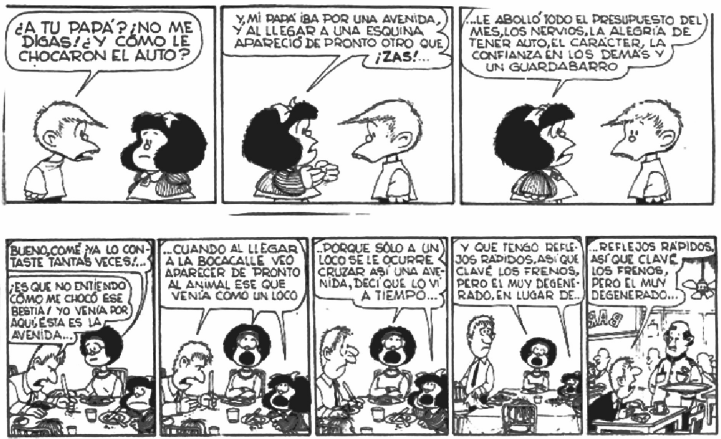
Quino. Todo Mafalda. Barcelona. Lumen, 1992 (con adaptaciones).
Lo acontecido en la viñeta le supuso al padre de Mafalda
pasar a tener una vida más sosegada.
Provas
Questão presente nas seguintes provas
Text 3 for question.
In addition to her impending, and no doubt ultimately successful, quest for Senate confirmation, Janet Yellen will have a lot on her plate in the coming months. Now that House Republicans and Senate Democrats have come to yet another temporary agreement on the budget and debt ceiling, there still exists another threat to the economy: The Federal Reserve’s temptation to pursue an overly ambitious monetary policy aimed at offsetting the damage to the economy arising from poorly conducted fiscal policy. Now that President Obama’s Fed Chairman nominee has been announced, the Fed needs to shift its focus from wondering who will lead it to what its realistic goals can be. Substantially different views are held by Fed hawks and doves.
The economy is still on uncertain footing, and public frustration with the Fed is increasing, especially since the May taper into September no-taper serious misstep. The Fed seems to be making up policy as it goes along. It has become distracted with trying to fix problems it is not well-equipped to handle, including sustained lower unemployment and a faster pace of growth than is obtainable during a period of fiscal consolidation and weak global growth.
The Fed’s post-financial crisis mission creep, since 2008, has fueled an unhealthy codependence between it and the market, akin to the infamous pre-crisis “Greenspan put,” whereby the Greenspan Fed was expected to — and did — step in to support financial markets whenever there arose a threat to rising asset markets. Markets assume the Fed can and will fix any problems, such as the latest episode of Washington’s fiscal policy bungling, that might harm the economy or depress stock prices. Once necessary, but now dangerous, improvisations of monetary policy — quantitative easing and forward guidance in particular — have become alternately ineffective and counter productive, as the recent tapering trauma has shown. Yellen, as the primary author of the Fed’s new communication strategy, needs to identify ways to improve the Fed’s communication with markets and the public.
The Fed has come a long way since its founding one hundred years ago. Its original role was to be the lender of last resort in a financial crisis. That role, as a temporary emergency supplier of liquidity in a panic, has continued and should continue going forward. But in the postfinancial crisis period, the Fed has been forced to accommodate the extra cash demands of households and firms confronting a world of elevated uncertainty about the direction and conduct of monetary and fiscal policy. That is because higher uncertainty has forced firms and wealthy households to self-insure against possible bad outcomes and to preserve optionality in the face of unforeseen shocks and opportunities.
Failure by the Fed to satisfy higher cash demands worsened the Great Depression in the United States and the deflationary lost decade in Japan. These elevated, postcrisis cash needs explain why the Fed’s rapid additions to the monetary base through quantitative easing have been followed by disinflation, not inflation, as many have predicted. Chairman Yellen will have to be vigilant to avoid tightening too soon, while uncertainty remains high.
Makin, John H. The challenge of a lifetime. In: The international economy.
Fall 2013, p. 10-11. Available at: <http: //www .internationaleconomy. com>. Adapted. Retrieved on: March 1, 2014.
Based on the article (text 3), decide if the item are right (C) or wrong (E).
Fed members differ as to what the goals for the Federal Reserve shall be from now on.
Provas
Questão presente nas seguintes provas
Text 3 for question.
In addition to her impending, and no doubt ultimately successful, quest for Senate confirmation, Janet Yellen will have a lot on her plate in the coming months. Now that House Republicans and Senate Democrats have come to yet another temporary agreement on the budget and debt ceiling, there still exists another threat to the economy: The Federal Reserve’s temptation to pursue an overly ambitious monetary policy aimed at offsetting the damage to the economy arising from poorly conducted fiscal policy. Now that President Obama’s Fed Chairman nominee has been announced, the Fed needs to shift its focus from wondering who will lead it to what its realistic goals can be. Substantially different views are held by Fed hawks and doves.
The economy is still on uncertain footing, and public frustration with the Fed is increasing, especially since the May taper into September no-taper serious misstep. The Fed seems to be making up policy as it goes along. It has become distracted with trying to fix problems it is not well-equipped to handle, including sustained lower unemployment and a faster pace of growth than is obtainable during a period of fiscal consolidation and weak global growth.
The Fed’s post-financial crisis mission creep, since 2008, has fueled an unhealthy codependence between it and the market, akin to the infamous pre-crisis “Greenspan put,” whereby the Greenspan Fed was expected to — and did — step in to support financial markets whenever there arose a threat to rising asset markets. Markets assume the Fed can and will fix any problems, such as the latest episode of Washington’s fiscal policy bungling, that might harm the economy or depress stock prices. Once necessary, but now dangerous, improvisations of monetary policy — quantitative easing and forward guidance in particular — have become alternately ineffective and counter productive, as the recent tapering trauma has shown. Yellen, as the primary author of the Fed’s new communication strategy, needs to identify ways to improve the Fed’s communication with markets and the public.
The Fed has come a long way since its founding one hundred years ago. Its original role was to be the lender of last resort in a financial crisis. That role, as a temporary emergency supplier of liquidity in a panic, has continued and should continue going forward. But in the postfinancial crisis period, the Fed has been forced to accommodate the extra cash demands of households and firms confronting a world of elevated uncertainty about the direction and conduct of monetary and fiscal policy. That is because higher uncertainty has forced firms and wealthy households to self-insure against possible bad outcomes and to preserve optionality in the face of unforeseen shocks and opportunities.
Failure by the Fed to satisfy higher cash demands worsened the Great Depression in the United States and the deflationary lost decade in Japan. These elevated, postcrisis cash needs explain why the Fed’s rapid additions to the monetary base through quantitative easing have been followed by disinflation, not inflation, as many have predicted. Chairman Yellen will have to be vigilant to avoid tightening too soon, while uncertainty remains high.
Makin, John H. The challenge of a lifetime. In: The international economy.
Fall 2013, p. 10-11. Available at: <http: //www .internationaleconomy. com>. Adapted. Retrieved on: March 1, 2014.
Based on the article (text 3), decide if the item are right (C) or wrong (E).
According to Makin, Americans are dissatisfied with the Federal Reserve because of its inability to cater for unemployment and slow economic growth.
Provas
Questão presente nas seguintes provas
Texte V — pour le question
Les Etats reviennent dans le monde. Les peuples les ont choisis pour être l’arme de la défense de leurs intérêts, ainsi que celle d’une rupture par rapport à la voie de la mondialisation. Cette dernière rencontre aujourd’hui une force nouvelle des Etats qui exprime un autre progrès des nations.
Dans le monde d’avant, les hommes avaient dénoncé leur responsabilité dans le déclenchement des guerres entre les peuples. Ils avaient critiqué le poids de leur réglementation qui avait pesé sur l’économie des nations. Comme leurs décisions aveugles avaient provoqué les guerres meurtrières, l’emprise bureaucratique des Etats avait limité la création de la richesse des nations. Leur légitimité était contestée. Les Etats étaient devenus la part maudite de l’organisation du monde.
A la faveur de la crise, leur utilité a été redécouverte. Ce sont bien les Etats qui ont sauvé du naufrage les grandes banques et les institutions financières, puis ont tenté de relancer les économies. La concurrence qui s’est dessinée entre les pays a suscité leur intervention bénéfique. Leur nécessité s’est imposée au monde. Les Etats sont redevenus l’instrument sur lequel les nations pouvaient à nouveau compter pour retrouver une autonomie de leur vie politique et le territoire de leur développement. […]
Michel Guénaire. Le retour des États. p.11-12.Ed. Grasset, 2013 (extrait).
Jugez si le item suivants sont vrais (C) ou faux (E) en vous référant au texte V.
Dans : « Les peuples les ont choisis », le « s » de choisis marque l’accord du participe passé avec le sujet : « les peuples ».
Provas
Questão presente nas seguintes provas
Considerando os princípios, direitos e garantias fundamentais previstos na CF e a responsabilidade civil do Estado, julgue (C ou E) o item subsequente.
A teoria da responsabilidade civil objetiva aplica-se às pessoas jurídicas de direito público, mas não às de direito privado, que, prestadoras, ou não, de serviços públicos, estão sujeitas à responsabilidade comum do direito civil.
Provas
Questão presente nas seguintes provas
2481926
Ano: 2014
Disciplina: Espanhol (Língua Espanhola)
Banca: CESPE / CEBRASPE
Orgão: IRB
Disciplina: Espanhol (Língua Espanhola)
Banca: CESPE / CEBRASPE
Orgão: IRB
Provas:
Texto para la cuestione
Deploro, señores, haber tenido que intercalar entre ustedes y mi persona este mecánico artefacto que es un micrófono, porque, sobre mecanizar crudamente la voz, es decir, una de las cosas en que más íntegramente se proyecta e imprime el hombre, en que más auténticamente una persona es—y esto lo saben muy bien las mujeres—, sobre eso tiene el inconveniente de que a veces no marcha bien. Pero era ineludible emplearlo y aun debemos estar agradecidos a sus servicios. Era ineludible, porque en la primera lección no conseguí ser oído en las profundidades de esta sala, pero, además, porque me obligaba a forzar la elocución, y en ello lo de menos es tener que esforzar la voz. Lo de más es que me compelía a vocalizar anormalmente, pronunciando por separado cada palabra, esto es, arrancándola de la frase, poniéndola en la honda de la voz y lanzándola al espacio como si fuese un proyectil, con lo cual resultaba que perdía yo el ritmo del decir y ni siquiera yo mismo reconocía los vocablos tan anómalamente pronunciados, hasta el punto de que alguna vez, cuando hablaba a ustedes de la nostalgia no estaba seguro de si había dicho más bien “hiperclorhidria”. Son esos secretos apuros del orador que no suelen ser flojos y que proporcionan a su faena un evidente dramatismo y un cierto peligro como tauromáquico.
(…) Si queremos conocer lo que es una hoja y nos ponemos a mirarla, pronto advertiremos que nuestra previa idea de hoja no coincide con la realidad hoja por la sencilla razón de que no podemos precisar dónde eso que llamábamos hoja termina y dónde empieza otra cosa. Descubrimos, en efecto, que la hoja no concluye en sí misma, sino que continúa; continúa en el pecíolo, a su vez, en la rama, y la rama en el tronco y el tronco en las raíces. La hoja, pues, no es una realidad por sí que pueda aislarse de lo demás. Es algo que tiene su realidad en cuanto parte de algo que es el árbol, el cual, en comparación con lo que llamábamos hoja, adquiere ahora el carácter de un todo. Sin ese todo no tiene comprensibilidad, no es inteligible para nosotros la hoja. Pero entonces, cuando hemos advertido y nos hemos hecho cargo de que la realidad de la hoja es el ser parte, el ser parte integrante del todo árbol y la hemos referido a él y la vemos en él nacer y averiguamos la función que en su conjunto sirve, por tanto, cuando nuestra mente, por decirlo así, sale de la hoja y va a algo más amplio—el todo que es el árbol—, entonces y sólo entonces podemos decir que conocemos lo que la hoja es. Hasta tal punto es esto así, de tal modo la hoja tiene condición de ser parte que cuando en vez de contemplarla en el árbol donde está siendo hoja la separamos de él decimos que la hemos cortado o arrancado—expresiones que declaran la violencia que hemos hecho sufrir a la hoja y al árbol. Más aún, al tenerla aislada entre nuestros dedos, cuando podría parecer un todo—dado, repito, que cupiera decidir dónde ella acaba y dónde empieza el pecíolo o la rama—, cuando aislada entre nuestros dedos podría dárselas de ser un todo, en ese momento empieza ya a no ser hoja sino un detritus vegetal que pronto acabará por desintegrarse. Esta relación de parte a todo es una de las categorías de la mente y de la realidad, sin la cual no es posible esta gran operación que es el conocimiento. Esto nos permite generalizar y decir: las cosas todas del mun(o real o son partes o son todos. Si una cosa es parte no resulta inteligible sino en cuanto la referimos al todo cuya es. Si una cosa es todo puede ser entendida por sí misma sin más que percibir las partes de que se compone. Esto vale para todos los órdenes de lo real. Por ejemplo, vale también para la realidad del lenguaje. Si yo pronuncio ahora la palabra “león”, sin más, resulta a ustedes ininteligible porque no pueden determinar si significa la ciudad de León, alguno de los Papas que llevaron este nombre, la ilustre fiera africana o uno de los leones que hay en la entrada del Congreso.
La palabra aislada no puede ser entendida porque es parte de un todo, como la hoja lo era del árbol, de un todo que es la frase, como la frase, a su vez, es parte de un todo, una conversación, o de otro todo, un libro. La palabra, como ustedes saben, es siempre equívoca y para precisar su sentido hace falta, aparte de la perspicacia que la vida nos enseña, toda una ciencia y de las más sugestivas e interesantes y de la que ha de ocuparse largamente el Instituto de Humanidades: la ciencia de la interpretación o hermenéutica. La labor principal de esta ciencia consiste en saber determinar a qué todo suficiente hay que referir una frase y una palabra para que su sentido pierda el equívoco. A ese todo en el cual la palabra se precisa llaman los hermeneutas y gramáticos el “contexto”. Pues bien, toda cosa real que es una parte reclama del todo, de su contexto, para que podamos entendernos. Una duda, sin embargo, se nos ofrece: tomado el árbol hasta su raíz, por tanto, siendo lo que es, nos parecía un todo—lo que la biología llama con ciertas inquietudes que ahora no interesan ”un individuo orgánico”—; pero es el caso que el árbol necesita para vivir de la tierra y de la atmósfera, y resulta, por tanto, ininteligible si no contamos con estas dos nuevas cosas. ¿Será entonces que el árbol entero, a su vez, forma parte de un nuevo y más auténtico todo, a saber: el que forman de consuno él y su medio? No vamos a dirimir la cuestión, que es más complicada de lo que parece, porque en lo que al presente nos afecta es cosa clara. En efecto, ese nuevo y más complejo todo que formarían el árbol y su medio no es tal, por la sencilla razón de que la tierra y la atmósfera no necesitan del árbol, aunque el árbol necesite de ellas. Arrancado el árbol, tierra y atmósfera subsisten—y no se traiga a comento que arrancado y desgajando los bosques todos de una región el clima se modifica y tierra y atmósfera varían, porque ahora estamos hablando simplemente de arrancar un árbol y esto es palmario que no modifica ni la tierra ni la atmósfera. No son estas, pues, partes integrantes de un nuevo todo, sino que son sólo contorno y medio externo de que el árbol va a vivir y solo en ese papel son biológicamente inteligibles, es decir estudiadas desde dentro del árbol, desde su interna constitución. Transportemos ahora todo esto al plano de la realidad histórica. (…)
José Ortega y Gasset. Una interpretación de la historia universal (En torno a Toynbee). Alianza Editorial. Madrid, 1984 (con adaptaciones).
Hablar ante un micrófono a un grupo de personas constituye una faena que produce en el ensayista
una sensación placentera.
Provas
Questão presente nas seguintes provas
No que concerne às relações entre a África e o Brasil, julgue (C ou E) o seguinte item.
Na esteira da criação do IBAS, o Brasil e a África do Sul sugeriram a criação da Cúpula América do Sul-África, ainda em 2003, em cujo marco os chefes de Estado e de governo dos países membros se reúnem anualmente para tratar do controle de fluxos migratórios internos, do combate conjunto à pirataria e do aperfeiçoamento da governança das instituições políticas e financeiras internacionais.
Provas
Questão presente nas seguintes provas
Text 1
Book Review 1 –
Karachi: Ordered Disorder and the Struggle for the City
by Laurent Gayer
With an official population approaching fifteen million, Karachi is one of the largest cities in the world. It is also the most violent. Since the mid-1980s, it has endured endemic political conflict and criminal violence, which revolve around control of the city and its resources (votes, land and bhatta — “protection” money). These struggles for the city have become ethnicized. Karachi, often referred to as a “Pakistan in miniature”, has become increasingly fragmented, socially as well as territorially.
Despite this chronic state of urban political warfare, Karachi is the cornerstone of the economy of Pakistan. Gayer’s book is an attempt to elucidate this conundrum. Against journalistic accounts describing Karachi as chaotic and ungovernable, he argues that there is indeed order of a kind in the city’s permanent civil war. Far from being entropic, Karachi’s polity is predicated upon organisational, interpretative and pragmatic routines that have made violence “manageable” for its populations. Whether such “ordered disorder” is viable in the long term remains to be seen, but for now Karachi works despite — and sometimes through — violence.
Source: <www.amazon.com>. Retrieved on: March 2, 2014.
Text 2
Book Review 2 –
The China-Pakistan Axis: Asia’s New Geopolitics
by Andrew Small
The Beijing-Islamabad axis plays a central role in Asia’s geopolitics, from India’s rise to the prospects for a post-American Afghanistan, from the threat of nuclear terrorism to the continent’s new map of mines, ports and pipelines. China is Pakistan’s great economic hope and its most trusted military partner; Pakistan is the battleground for China’s encounters with Islamic militancy and the heart of its efforts to counter-balance the emerging US-India partnership. For decades, each country has been the other’s only ‘all-weather’ friend. Yet the relationship is still little understood. The wildest claims about it are widely believed, while many of its most dramatic developments are hidden from the public eye. This book sets out the recent history of Sino-Pakistani ties and their ramifications for the West, for India, for Afghanistan, and for Asia as a whole. It tells the stories behind some of its most sensitive aspects, including Beijing’s support for Pakistan’s nuclear program, China’s dealings with the Taliban, and the Chinese military’s planning for crises in Pakistan. It describes a relationship increasingly shaped by Pakistan’s internal strife, and the dilemmas China faces between the need for regional stability and the imperative for strategic competition with India and the USA.
Source: <www.amazon.com>. Retrieved on: March 2, 2014.
Based on the information conveyed by the two book reviews, judge the item right (C) or wrong (E).
The books are connected inasmuch as the issues discussed in the first one influence Pakistan’s international relationships.
Provas
Questão presente nas seguintes provas
Cadernos
Caderno Container