Foram encontradas 50 questões.
Considere o jogo sequencial entre duas pessoas, A e B, representado pela árvore de decisão abaixo.
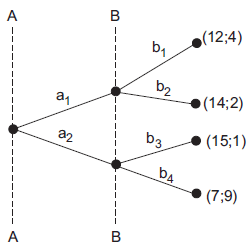
No primeiro nó à esquerda, A decide entre as estratégias a1 e a2 . Nos dois nós alcançáveis a seguir, B decide entre as estratégias b1 e b2 ou entre b3 e b4. Entre parênteses, ao final de cada combinação de estratégias, aparecem os retornos, em reais, que as pessoas obtiveram. Dentro dos parênteses, o retorno de A fica à esquerda e o de B à direita. Suponha que os jogadores tentem maximizar seus ganhos e conheçam todos os retornos, as estratégias e a estrutura do jogo. A solução do jogo será a combinação de estratégias
Provas

World Oil Reserves at 'Tipping Point'
ScienceDaily (Mar. 26, 2010) — The world's capacity to meet projected future oil demand is at a tipping point, according to research by the Smith School of Enterprise and the Environment at Oxford University. There is a need to accelerate the development of alternative energy fuel resources in order to ensure energy security and reduce emissions, says a paper just published in the journal Energy Policy.
The age of cheap oil has now ended as demand starts to outstrip supply as we head towards the middle of the decade, says the report. It goes on to suggest that the current oil reserve estimates should be downgraded from between 1150-1350 billion barrels to between 850-900 billion barrels, based on recent research. But how can potential oil shortages be mitigated?
Dr Oliver Inderwildi, Head of the Low Carbon Mobility centre at the Smith School, said: “The common belief that alternative fuels such as biofuels could mitigate oil supply shortages and eventually replace fossil fuels is pie in the sky. There is not sufficient land to cater for both food and fuel demand. Instead of relying on those silver bullet solutions, we have to make better use of the remaining resources by improving energy efficiency. Alternatives such as a hydrogen economy and electric transportation are not mature and will only play a major role in the medium to long term.
Nick Owen, from the Smith School of Enterprise and the Environment, added: 'Significant oil supply challenges will be compounded in the near future by rising demand and strengthening environmental policy. Mitigating the oil crunch without using lower grade resources such as tar sands is the key to maintaining energy stability and a low carbon future.”
The Smith School paper also highlights that in the past, political and financial objectives have led to misreporting of oil reserves, which has led to contradictory estimates of oil reserve data available in the public domain.
Sir David King, Director of the Smith School, commented: “We have to face up to a future of oil uncertainty much like the global economic uncertainty we have faced during the past two years. This challenge will have a longer term effect on our economies unless swift action is taken by governments and business. We all recognise that oil is a finite resource. We need to look at other low carbon alternatives and make the necessary funding available for research, development and deployment today if we are to mitigate the tipping point:
The report also raises the worrying issue that additional demand for oil could be met by nonconventional methods, such as the extraction of oil ffom Canada's tar sands. However, these methods have a far higher carbon output than conventional drilling, and have been described as having a double impact on emissions owing to the emissions produced during extraction as well as during usage.
Available in http://www .sciencedaily.com/releases/2010/03/ 100324225511.htm. Access on April 6, 2010
In “.. additional demand for oil could be met by nonconventional methods,” the verb form could expresses
Provas
World Oil Reserves at 'Tipping Point'
ScienceDaily (Mar. 26, 2010) — The world's capacity to meet projected future oil demand is at a tipping point, according to research by the Smith School of Enterprise and the Environment at Oxford University. There is a need to accelerate the development of alternative energy fuel resources in order to ensure energy security and reduce emissions, says a paper just published in the journal Energy Policy.
The age of cheap oil has now ended as demand starts to outstrip supply as we head towards the middle of the decade, says the report. It goes on to suggest that the current oil reserve estimates should be downgraded from between 1150-1350 billion barrels to between 850-900 billion barrels, based on recent research. But how can potential oil shortages be mitigated?
Dr Oliver Inderwildi, Head of the Low Carbon Mobility centre at the Smith School, said: “The common belief that alternative fuels such as biofuels could mitigate oil supply shortages and eventually replace fossil fuels is pie in the sky. There is not sufficient land to cater for both food and fuel demand. Instead of relying on those silver bullet solutions, we have to make better use of the remaining resources by improving energy efficiency. Alternatives such as a hydrogen economy and electric transportation are not mature and will only play a major role in the medium to long term.
Nick Owen, from the Smith School of Enterprise and the Environment, added: 'Significant oil supply challenges will be compounded in the near future by rising demand and strengthening environmental policy. Mitigating the oil crunch without using lower grade resources such as tar sands is the key to maintaining energy stability and a low carbon future.”
The Smith School paper also highlights that in the past, political and financial objectives have led to misreporting of oil reserves, which has led to contradictory estimates of oil reserve data available in the public domain.
Sir David King, Director of the Smith School, commented: “We have to face up to a future of oil uncertainty much like the global economic uncertainty we have faced during the past two years. This challenge will have a longer term effect on our economies unless swift action is taken by governments and business. We all recognise that oil is a finite resource. We need to look at other low carbon alternatives and make the necessary funding available for research, development and deployment today if we are to mitigate the tipping point:
The report also raises the worrying issue that additional demand for oil could be met by nonconventional methods, such as the extraction of oil ffom Canada's tar sands. However, these methods have a far higher carbon output than conventional drilling, and have been described as having a double impact on emissions owing to the emissions produced during extraction as well as during usage.
Available in http://www .sciencedaily.com/releases/2010/03/ 100324225511.htm. Access on April 6, 2010
“This challenge” in “This challenge will have a longer term effect on our economies...” refers to the
Provas
World Oil Reserves at 'Tipping Point'
ScienceDaily (Mar. 26, 2010) — The world's capacity to meet projected future oil demand is at a tipping point, according to research by the Smith School of Enterprise and the Environment at Oxford University. There is a need to accelerate the development of alternative energy fuel resources in order to ensure energy security and reduce emissions, says a paper just published in the journal Energy Policy.
The age of cheap oil has now ended as demand starts to outstrip supply as we head towards the middle of the decade, says the report. It goes on to suggest that the current oil reserve estimates should be downgraded from between 1150-1350 billion barrels to between 850-900 billion barrels, based on recent research. But how can potential oil shortages be mitigated?
Dr Oliver Inderwildi, Head of the Low Carbon Mobility centre at the Smith School, said: “The common belief that alternative fuels such as biofuels could mitigate oil supply shortages and eventually replace fossil fuels is pie in the sky. There is not sufficient land to cater for both food and fuel demand. Instead of relying on those silver bullet solutions, we have to make better use of the remaining resources by improving energy efficiency. Alternatives such as a hydrogen economy and electric transportation are not mature and will only play a major role in the medium to long term.
Nick Owen, from the Smith School of Enterprise and the Environment, added: 'Significant oil supply challenges will be compounded in the near future by rising demand and strengthening environmental policy. Mitigating the oil crunch without using lower grade resources such as tar sands is the key to maintaining energy stability and a low carbon future.”
The Smith School paper also highlights that in the past, political and financial objectives have led to misreporting of oil reserves, which has led to contradictory estimates of oil reserve data available in the public domain.
Sir David King, Director of the Smith School, commented: “We have to face up to a future of oil uncertainty much like the global economic uncertainty we have faced during the past two years. This challenge will have a longer term effect on our economies unless swift action is taken by governments and business. We all recognise that oil is a finite resource. We need to look at other low carbon alternatives and make the necessary funding available for research, development and deployment today if we are to mitigate the tipping point:
The report also raises the worrying issue that additional demand for oil could be met by nonconventional methods, such as the extraction of oil ffom Canada's tar sands. However, these methods have a far higher carbon output than conventional drilling, and have been described as having a double impact on emissions owing to the emissions produced during extraction as well as during usage.
Available in http://www .sciencedaily.com/releases/2010/03/ 100324225511.htm. Access on April 6, 2010
In Sir David King's main comment is that
Provas
World Oil Reserves at 'Tipping Point'
ScienceDaily (Mar. 26, 2010) — The world's capacity to meet projected future oil demand is at a tipping point, according to research by the Smith School of Enterprise and the Environment at Oxford University. There is a need to accelerate the development of alternative energy fuel resources in order to ensure energy security and reduce emissions, says a paper just published in the journal Energy Policy.
The age of cheap oil has now ended as demand starts to outstrip supply as we head towards the middle of the decade, says the report. It goes on to suggest that the current oil reserve estimates should be downgraded from between 1150-1350 billion barrels to between 850-900 billion barrels, based on recent research. But how can potential oil shortages be mitigated?
Dr Oliver Inderwildi, Head of the Low Carbon Mobility centre at the Smith School, said: “The common belief that alternative fuels such as biofuels could mitigate oil supply shortages and eventually replace fossil fuels is pie in the sky. There is not sufficient land to cater for both food and fuel demand. Instead of relying on those silver bullet solutions, we have to make better use of the remaining resources by improving energy efficiency. Alternatives such as a hydrogen economy and electric transportation are not mature and will only play a major role in the medium to long term.
Nick Owen, from the Smith School of Enterprise and the Environment, added: 'Significant oil supply challenges will be compounded in the near future by rising demand and strengthening environmental policy. Mitigating the oil crunch without using lower grade resources such as tar sands is the key to maintaining energy stability and a low carbon future.”
The Smith School paper also highlights that in the past, political and financial objectives have led to misreporting of oil reserves, which has led to contradictory estimates of oil reserve data available in the public domain.
Sir David King, Director of the Smith School, commented: “We have to face up to a future of oil uncertainty much like the global economic uncertainty we have faced during the past two years. This challenge will have a longer term effect on our economies unless swift action is taken by governments and business. We all recognise that oil is a finite resource. We need to look at other low carbon alternatives and make the necessary funding available for research, development and deployment today if we are to mitigate the tipping point:
The report also raises the worrying issue that additional demand for oil could be met by nonconventional methods, such as the extraction of oil ffom Canada's tar sands. However, these methods have a far higher carbon output than conventional drilling, and have been described as having a double impact on emissions owing to the emissions produced during extraction as well as during usage.
Available in http://www .sciencedaily.com/releases/2010/03/ 100324225511.htm. Access on April 6, 2010
In the text, 'contradictory estimates of oil reserve data available in the public domain. refers to the fact that
Provas
World Oil Reserves at 'Tipping Point'
ScienceDaily (Mar. 26, 2010) — The world's capacity to meet projected future oil demand is at a tipping point, according to research by the Smith School of Enterprise and the Environment at Oxford University. There is a need to accelerate the development of alternative energy fuel resources in order to ensurea energy security and reduce emissions, says a paper just published in the journal Energy Policy.
The age of cheap oil has now ended as demand starts to outstripb supply as we head towards the middle of the decade, says the report. It goes on to suggest that the current oil reserve estimates should be downgradedc from between 1150-1350 billion barrels to between 850-900 billion barrels, based on recent research. But how can potential oil shortages be mitigated?
Dr Oliver Inderwildi, Head of the Low Carbon Mobility centre at the Smith School, said: “The common belief that alternative fuels such as biofuels could mitigate oil supply shortages and eventually replace fossil fuels is pie in the sky. There is not sufficient land to cater for both food and fuel demand. Instead of relying on those silver bullet solutions, we have to make better use of the remaining resources by improving energy efficiency. Alternatives such as a hydrogen economy and electric transportation are not mature and will only play a major role in the medium to long term.
Nick Owen, from the Smith School of Enterprise and the Environment, added: 'Significant oil supply challenges will be compounded in the near future by rising demand and strengthening environmental policy. Mitigating the oil crunch without using lower grade resources such as tar sands is the key to maintaining energy stability and a low carbon future.”
The Smith School paper also highlightsd that in the past, political and financial objectives have led to misreporting of oil reserves, which has led to contradictory estimates of oil reserve data available in the public domain.
Sir David King, Director of the Smith School, commented: “We have to face up to a future of oil uncertainty much like the global economic uncertainty we have faced during the past two years. This challenge will have a longer term effect on our economies unless swift action is taken by governments and business. We all recognise that oil is a finite resource. We need to look at other low carbon alternatives and make the necessary funding available for research, development and deployment today if we are to mitigate the tipping point:
The report also raises the worrying issue that additional demand for oil could be met by nonconventional methods, such as the extraction of oil ffom Canada's tar sands. However, these methods have a far higher carbon output than conventional drilling, and have been described as having a double impact on emissions owing toe the emissions produced during extraction as well as during usage.
Available in http://www .sciencedaily.com/releases/2010/03/ 100324225511.htm. Access on April 6, 2010
Based on the meanings of the words in the text, it can be said that
Provas
World Oil Reserves at 'Tipping Point'
ScienceDaily (Mar. 26, 2010) — The world's capacity to meet projected future oil demand is at a tipping point, according to research by the Smith School of Enterprise and the Environment at Oxford University. There is a need to accelerate the development of alternative energy fuel resources in order to ensure energy security and reduce emissions, says a paper just published in the journal Energy Policy.
The age of cheap oil has now ended as demand starts to outstrip supply as we head towards the middle of the decade, says the report. It goes on to suggest that the current oil reserve estimates should be downgraded from between 1150-1350 billion barrels to between 850-900 billion barrels, based on recent research. But how can potential oil shortages be mitigated?
Dr Oliver Inderwildi, Head of the Low Carbon
Mobility centre at the Smith School, said: “The common belief that alternative fuels such as biofuels could mitigate oil supply shortages and eventually replace fossil fuels is pie in the sky. There is not sufficient land to cater for both food and fuel demand. Instead of relying on those silver bullet solutions, we have to make better use of the remaining resources by improving energy efficiency. Alternatives such as a hydrogen economy and electric transportation are not mature and will only play a major role in the medium to long term.
Nick Owen, from the Smith School of Enterprise and the Environment, added: 'Significant oil supply challenges will be compounded in the near future by rising demand and strengthening environmental policy. Mitigating the oil crunch without using lower grade resources such as tar sands is the key to maintaining energy stability and a low carbon future.”
The Smith School paper also highlights that in the past, political and financial objectives have led to misreporting of oil reserves, which has led to contradictory estimates of oil reserve data available in the public domain.
Sir David King, Director of the Smith School, commented: “We have to face up to a future of oil uncertainty much like the global economic uncertainty we have faced during the past two years. This challenge will have a longer term effect on our economies unless swift action is taken by governments and business. We all recognise that oil is a finite resource. We need to look at other low carbon alternatives and make the necessary funding available for research, development and deployment today if we are to mitigate the tipping point:
The report also raises the worrying issue that additional demand for oil could be met by nonconventional methods, such as the extraction of oil ffom Canada's tar sands. However, these methods have a far higher carbon output than conventional drilling, and have been described as having a double impact on emissions owing to the emissions produced during extraction as well as during usage.
Available in http://www .sciencedaily.com/releases/2010/03/ 100324225511.htm. Access on April 6, 2010
The author reports that world oil reserves are at a “tipping point” because oil
Provas
Será a felicidade necessária?
Felicidade é uma palavra pesada. Alegria é leve, mas felicidade é pesada. Diante da pergunta “Você é feliz?”, dois fardos são lançados às costas do inquirido. O primeiro é procurar uma definição para felicidade, o que equivale a rastrear uma escala que pode ir da simples satisfação de gozar de boa saúde até a conquista da bem-aventurança. O segundo é examinar-se, em busca de uma resposta. Nesse processo, depara-se com armadilhas. Caso se tenha ganhado um aumento no emprego no dia anterior, o mundo parecerá belo e justo; caso se esteja com dor de dente, parecerá feio e perverso. Mas a dor de dente vai passar, assim como a euforia pelo aumento de salário, e se há algo imprescindível, na difícil conceituação de felicidade, é o caráter de permanência. Uma resposta consequente exige colocar na balança a experiência passada, o estado presente e a expectativa futura. Dá trabalho, e a conclusão pode não ser clara.
Os pais de hoje costumam dizer que importante é que os filhos sejam felizes. É uma tendência que se impôs ao influxo das teses libertárias dos anos 1960.
É irrelevante que entrem na faculdade, que ganhem muito ou pouco dinheiro, que sejam bem-sucedidos na profissão. O que espero, eis a resposta correta, é que sejam felizes. Ora, felicidade é coisa grandiosa. É esperar, no mínimo, que o filho sinta prazer nas pequenas coisas da vida. Se não for suficiente, que consiga cumprir todos os desejos e ambições que venha a abrigar. Se ainda for pouco, que atinja o enlevo místico dos santos. Não dá para preencher caderno de encargos mais cruel para a pobre criança.
“É a felicidade necessária?” é a chamada de capa da última revista New Yorker (22 de março) para um artigo que, assinado por Elizabeth Kolbert, analisa livros recentes sobre o tema. No caso, a ênfase está nas pesquisas sobre felicidade (ou sobre “satisfação”, como mais modestamente às vezes são chamadas) e no impacto que exercem, ou deveriam exercer, nas políticas públicas. Um dos livros analisados, de autoria do ex-presidente de Harvard Derek Bok (...) constata que nos últimos 35 anos o PIB per capita dos americanos aumentou de 17.000 dólares para 27.000, o tamanho médio das casas cresceu 50% e as famílias que possuem computador saltaram de zero para 70% do total. No entanto, a porcentagem dos que se consideram felizes não se moveu. Conclusão do autor, de lógica irrefutável e alcance revolucionário: se o crescimento econômico não contribui para aumentar a felicidade, “por que trabalhar tanto, arriscando desastres ambientais, para continuar dobrando e redobrando o PIB”?
Outro livro, de autoria de Carol Graham, da Universidade de Maryland (...) informa que os nigerianos, com seus 1.400 dólares de PIB per capita, atribuem-se grau de felicidade equivalente ao dos japoneses, com PIB per capita 25 vezes maior, e que os habitantes de Bangladesh se consideram duas vezes mais felizes que os da Rússia, quatro vezes mais ricos. Surpresa das surpresas, os afegãos atribuem-se bom nível de felicidade, e a felicidade é maior nas áreas dominadas pelo Talibã. Os dois livros vão na mesma direção das conclusões de um relatório, também citado no artigo da New Yorker, preparado para o governo francês por dois detentores do Nobel de Economia. (...)
Embora embaladas com números e linguagem científica, tais conclusões apenas repisariam o pedestre conceito de que dinheiro não traz felicidade, não fosse que ambicionam influir na formulação das políticas públicas. O propósito é convidar os governantes a afinar seu foco, se têm em vista o bem-estar dos governados (e podem eles ter em vista algo mais relevante?). Derek Bok, o autor do primeiro dos livros, aconselha ao governo americano programas como estender o alcance do seguro-desemprego (as pesquisas apontam a perda de emprego como mais causadora de infelicidade do que o divórcio), facilitar o acesso a medicamentos contra a dor e a tratamentos da depressão e proporcionar atividades esportivas para as crianças. Bok desce ao mesmo nível terra a terra da mãe que trocasse o grandioso desejo de felicidade pelo de uma boa faculdade e um bom salário para o filho.
TOLEDO, Roberto Pompeu. In: Veja, 24 Mar. 2010.
Leia o seguinte trecho: “Embora embaladas com números e linguagem científica, tais conclusões apenas repisariam...". A sua reescritura mantém o sentido original e está de acordo com o registro formal culto da língua portuguesa em:
Provas
Será a felicidade necessária?
Felicidade é uma palavra pesada. Alegria é leve, mas felicidade é pesada. Diante da pergunta “Você é feliz?”, dois fardos são lançados às costas do inquirido. O primeiro é procurar uma definição para felicidade, o que equivale a rastrear uma escala que pode ir da simples satisfação de gozar de boa saúde até a conquista da bem-aventurança. O segundo é examinar-se, em busca de uma resposta. Nesse processo, depara-se com armadilhas. Caso se tenha ganhado um aumento no emprego no dia anterior, o mundo parecerá belo e justo; caso se esteja com dor de dente, parecerá feio e perverso. Mas a dor de dente vai passar, assim como a euforia pelo aumento de salário, e se há algo imprescindível, na difícil conceituação de felicidade, é o caráter de permanência. Uma resposta consequente exige colocar na balança a experiência passada, o estado presente e a expectativa futura. Dá trabalho, e a conclusão pode não ser clara.
Os pais de hoje costumam dizer que importante é que os filhos sejam felizes. É uma tendência que se impôs ao influxo das teses libertárias dos anos 1960.
É irrelevante que entrem na faculdade, que ganhem muito ou pouco dinheiro, que sejam bem-sucedidos na profissão. O que espero, eis a resposta correta, é que sejam felizes. Ora, felicidade é coisa grandiosa. É esperar, no mínimo, que o filho sinta prazer nas pequenas coisas da vida. Se não for suficiente, que consiga cumprir todos os desejos e ambições que venha a abrigar. Se ainda for pouco, que atinja o enlevo místico dos santos. Não dá para preencher caderno de encargos mais cruel para a pobre criança.
“É a felicidade necessária?” é a chamada de capa da última revista New Yorker (22 de março) para um artigo que, assinado por Elizabeth Kolbert, analisa livros recentes sobre o tema. No caso, a ênfase está nas pesquisas sobre felicidade (ou sobre “satisfação”, como mais modestamente às vezes são chamadas) e no impacto que exercem, ou deveriam exercer, nas políticas públicas. Um dos livros analisados, de autoria do ex-presidente de Harvard Derek Bok (...) constata que nos últimos 35 anos o PIB per capita dos americanos aumentou de 17.000 dólares para 27.000, o tamanho médio das casas cresceu 50% e as famílias que possuem computador saltaram de zero para 70% do total. No entanto, a porcentagem dos que se consideram felizes não se moveu. Conclusão do autor, de lógica irrefutável e alcance revolucionário: se o crescimento econômico não contribui para aumentar a felicidade, “por que trabalhar tanto, arriscando desastres ambientais, para continuar dobrando e redobrando o PIB”?
Outro livro, de autoria de Carol Graham, da Universidade de Maryland (...) informa que os nigerianos, com seus 1.400 dólares de PIB per capita, atribuem-se grau de felicidade equivalente ao dos japoneses, com PIB per capita 25 vezes maior, e que os habitantes de Bangladesh se consideram duas vezes mais felizes que os da Rússia, quatro vezes mais ricos. Surpresa das surpresas, os afegãos atribuem-se bom nível de felicidade, e a felicidade é maior nas áreas dominadas pelo Talibã. Os dois livros vão na mesma direção das conclusões de um relatório, também citado no artigo da New Yorker, preparado para o governo francês por dois detentores do Nobel de Economia. (...)
Embora embaladas com números e linguagem científica, tais conclusões apenas repisariam o pedestre conceito de que dinheiro não traz felicidade, não fosse que ambicionam influir na formulação das políticas públicas. O propósito é convidar os governantes a afinar seu foco, se têm em vista o bem-estar dos governados (e podem eles ter em vista algo mais relevante?). Derek Bok, o autor do primeiro dos livros, aconselha ao governo americano programas como estender o alcance do seguro-desemprego (as pesquisas apontam a perda de emprego como mais causadora de infelicidade do que o divórcio), facilitar o acesso a medicamentos contra a dor e a tratamentos da depressão e proporcionar atividades esportivas para as crianças. Bok desce ao mesmo nível terra a terra da mãe que trocasse o grandioso desejo de felicidade pelo de uma boa faculdade e um bom salário para o filho.
TOLEDO, Roberto Pompeu. In: Veja, 24 Mar. 2010.
A afirmativa *... se há algo imprescindível, na difícil conceituação de felicidade, é o caráter de permanência.” quer dizer que
Provas
Será a felicidade necessária?
Felicidade é uma palavra pesada. Alegria é leve, mas felicidade é pesada. Diante da pergunta “Você é feliz?”, dois fardos são lançados às costas do inquirido. O primeiro é procurar uma definição para felicidade, o que equivale a rastrear uma escala que pode ir da simples satisfação de gozar de boa saúde até a conquista da bem-aventurança. O segundo é examinar-se, em busca de uma resposta. Nesse processo, depara-se com armadilhas. Caso se tenha ganhado um aumento no emprego no dia anterior, o mundo parecerá belo e justoa; caso se esteja com dor de dente, parecerá feio e perverso. Mas a dor de dente vai passar, assim como a euforia pelo aumento de salário, e se há algo imprescindível, na difícil conceituação de felicidade, é o caráter de permanência. Uma resposta consequente exige colocar na balança a experiência passada, o estado presente e a expectativa futura. Dá trabalho, e a conclusão pode não ser clara.
Os pais de hoje costumam dizer que importante é que os filhos sejam felizes. É uma tendência que se impôs ao influxo das teses libertárias dos anos 1960.
É irrelevante que entrem na faculdade, que ganhem muito ou pouco dinheiro, que sejam bem-sucedidos na profissão. O que espero, eis a resposta correta, é que sejam felizes. Ora, felicidade é coisa grandiosab. É esperar, no mínimo, que o filho sinta prazer nas pequenas coisas da vida. Se não for suficiente, que consiga cumprir todos os desejos e ambições que venha a abrigar. Se ainda for pouco, que atinja o enlevo místico dos santos. Não dá para preencher caderno de encargos mais cruel para a pobre criança.
“É a felicidade necessária?c” é a chamada de capa da última revista New Yorker (22 de março) para um artigo que, assinado por Elizabeth Kolbert, analisa livros recentes sobre o tema. No caso, a ênfase está nas pesquisas sobre felicidade (ou sobre “satisfação”, como mais modestamente às vezes são chamadas) e no impacto que exercem, ou deveriam exercer, nas políticas públicas. Um dos livros analisados, de autoria do ex-presidente de Harvard Derek Bok (...) constata que nos últimos 35 anos o PIB per capita dos americanos aumentou de 17.000 dólares para 27.000, o tamanho médio das casas cresceu 50% e as famílias que possuem computador saltaram de zero para 70% do total. No entanto, a porcentagem dos que se consideram felizes não se moveu. Conclusão do autor, de lógica irrefutável e alcance revolucionário: se o crescimento econômico não contribui para aumentar a felicidade, “por que trabalhar tanto, arriscando desastres ambientais, para continuar dobrando e redobrando o PIB”?
Outro livro, de autoria de Carol Graham, da Universidade de Maryland (...) informa que os nigerianos, com seus 1.400 dólares de PIB per capita, atribuem-se grau de felicidade equivalente ao dos japoneses, com PIB per capita 25 vezes maior, e que os habitantes de Bangladesh se consideram duas vezes mais felizes que os da Rússia, quatro vezes mais ricos. Surpresa das surpresas, os afegãos atribuem-se bom nível de felicidade, e a felicidade é maior nas áreas dominadas pelo Talibã. Os dois livros vão na mesma direção das conclusões de um relatório, também citado no artigo da New Yorker, preparado para o governo francês por dois detentores do Nobel de Economia. (...)
Embora embaladas com números e linguagem científica, tais conclusões apenas repisariam o pedestred conceito de que dinheiro não traz felicidade, não fosse que ambicionam influir na formulação das políticas públicas. O propósito é convidar os governantes a afinar seu foco, se têm em vista o bem-estar dos governados (e podem eles ter em vista algo mais relevante?e). Derek Bok, o autor do primeiro dos livros, aconselha ao governo americano programas como estender o alcance do seguro-desemprego (as pesquisas apontam a perda de emprego como mais causadora de infelicidade do que o divórcio), facilitar o acesso a medicamentos contra a dor e a tratamentos da depressão e proporcionar atividades esportivas para as crianças. Bok desce ao mesmo nível terra a terra da mãe que trocasse o grandioso desejo de felicidade pelo de uma boa faculdade e um bom salário para o filho.
TOLEDO, Roberto Pompeu. In: Veja, 24 Mar. 2010.
Das palavras abaixo, conforme aparecem no texto, qual tem o mesmo sentido que a expressão “...terra a terra...” (. 82)?
Provas
Caderno Container