Foram encontradas 120 questões.
Disciplina: TI - Desenvolvimento de Sistemas
Banca: CESPE / CEBRASPE
Orgão: Petrobrás
Julgue o item subsequente, a respeito de padrões de projeto de software.
Design patterns é um conjunto de soluções generalistas para problemas recorrentes durante o desenvolvimento de um software; trata-se de um framework ou código pronto, e não de uma definição de alto nível de como um problema comum pode ser solucionado.
Provas

Disciplina: TI - Desenvolvimento de Sistemas
Banca: CESPE / CEBRASPE
Orgão: Petrobrás
Acerca dos conceitos referentes à arquitetura de aplicações, julgue o item a seguir.
Uma das vantagens do SOAP é a sua utilização correta dos métodos HTML (PUT, GET, POST, DELETE), enquanto o REST utiliza apenas o método POST para realizar as requisições através de um arquivo XML.
Provas
Disciplina: TI - Desenvolvimento de Sistemas
Banca: CESPE / CEBRASPE
Orgão: Petrobrás
Quanto a storytelling e análise de personas de usuários de software, julgue o item a seguir.
No contexto de storytelling, é fundamental mitigar as possibilidades de navegação por meio das interfaces e impor à experiência do usuário o sequenciamento estrito das atividades que constituem a sua história.
Provas
Disciplina: TI - Desenvolvimento de Sistemas
Banca: CESPE / CEBRASPE
Orgão: Petrobrás
Quanto a storytelling e análise de personas de usuários de software, julgue o item a seguir.
Entrevistas e questionários são técnicas comumente usadas para obter informações relacionadas às necessidades de grupos de usuários representados por personas, que exemplificam como um usuário típico interage com um produto.
Provas
Disciplina: TI - Gestão e Governança de TI
Banca: CESPE / CEBRASPE
Orgão: Petrobrás
- Gestão de ProjetosAnálise de Requisitos
- Gestão de ProcessosGestão de Requisitos
- Governança de TIPlanejamento EstratégicoAnálise de Negócios
A respeito de requisitos e experiência do usuário, julgue o item subsecutivo.
Os critérios de aceitação descrevem um conjunto mínimo de requisitos que precisam ser atendidos para que valha a pena implementar uma solução específica.
Provas
Disciplina: TI - Desenvolvimento de Sistemas
Banca: CESPE / CEBRASPE
Orgão: Petrobrás
A respeito de requisitos e experiência do usuário, julgue o item subsecutivo.
Ferramentas automatizadas para armazenamento de requisitos, gerenciamento de mudanças e gerenciamento de rastreabilidade são indicadas para apoio ao processo de gerenciamento de requisitos.
Provas
Disciplina: TI - Desenvolvimento de Sistemas
Banca: CESPE / CEBRASPE
Orgão: Petrobrás
Julgue o item subsecutivo, relativo a DevOps e notação BPMN.
No DevOps, a integração contínua possui como uma de suas atividades a realização de testes; a fim de se obter os benefícios esperados convém automatizar os testes para poder executá-los para cada alteração feita no repositório principal.
Provas
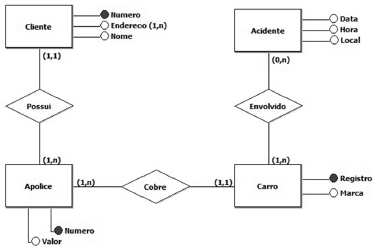
Considerando o diagrama entidade relacionamento precedente, julgue o item a seguir.
Uma Apolice pode estar associada a mais de uma instância de Carro, cujo atributo identificador é Registro.
Provas
In a world where many of us are glued to our smartphones, Dulcie Cowling is something of an anomaly — she has ditched hers. The 36-year-old decided at the end of last year that getting rid of her handset would improve her mental health. So, over Christmas she told her family and friends that she was switching to an old Nokia phone that could only make and receive calls and text messages.
She recalls that one of the pivotal moments that led to her decision was a day at the park with her two boys, aged six and three: “I was on my mobile at a playground with the kids and I looked up and every single parent — there was up to 20 — were looking at their phones, just scrolling away,” she says.
“I thought ‘when did this happen?’. Everyone is missing out on real life. I don’t think you get to your death bed and think you should have spent more time on Twitter, or reading articles online.”
Ms Cowling, who is a creative director at London-based advertising agency Hell Yeah!, adds that the idea to abandon her smartphone had built up during the covid-19 lockdowns.
“I thought about how much of my life is spent looking at the phone and what else could I do. Being constantly connected to lots of services creates a lot of distractions, and is a lot for the brain to process.”
She plans to use the time gained from quitting her smartphone to read and sleep more.
About nine out of 10 people in the UK now own a smartphone, a figure broadly replicated across the developed world. And we are glued to them — one recent study found that the average person spends 4.8 hours a day on their handset.
Yet for a small, but growing number of people, enough is enough.
Alex Dunedin binned his smartphone two years ago. “Culturally we have become addicted to these tools,” says the educational researcher and technology expert. “They are blunting cognition and impeding productivity.”
He has become happier and more productive since he stopped using a smartphone, he says.
Mr Dunedin doesn’t even have an old-fashioned mobile phone or even a landline anymore. He is instead only electronically contactable via emails to his home computer.
“It has improved my life,” he says. “My thoughts are freed up from constantly being cognitively connected to a machine that I need to feed with energy and money. I think that the danger of technologies is that they are emptying our lives.”
Yet, while some worry about how much time they spend on their handset, for millions of others they are a godsend.
“More than ever, access to healthcare, education, social services and often to our friends and family is digital, and the smartphone is an essential lifeline for people,” says a spokesperson for UK mobile network Vodafone.
“We also create resources to help people get the most from their tech, as well as to stay safe when they’re online — that’s hugely important.”
Suzanne Bearne.
The people deciding to ditch their smartphones. Internet: <www.bbc.com> (adapted).
Considering the previous text, judge the following item.
Although there is a movement of people ditching their smartphones in order to have what they think is a better life quality, millions believe digital technology is essential to everyone’s lives.
Provas
In a world where many of us are glued to our smartphones, Dulcie Cowling is something of an anomaly — she has ditched hers. The 36-year-old decided at the end of last year that getting rid of her handset would improve her mental health. So, over Christmas she told her family and friends that she was switching to an old Nokia phone that could only make and receive calls and text messages.
She recalls that one of the pivotal moments that led to her decision was a day at the park with her two boys, aged six and three: “I was on my mobile at a playground with the kids and I looked up and every single parent — there was up to 20 — were looking at their phones, just scrolling away,” she says.
“I thought ‘when did this happen?’. Everyone is missing out on real life. I don’t think you get to your death bed and think you should have spent more time on Twitter, or reading articles online.”
Ms Cowling, who is a creative director at London-based advertising agency Hell Yeah!, adds that the idea to abandon her smartphone had built up during the covid-19 lockdowns.
“I thought about how much of my life is spent looking at the phone and what else could I do. Being constantly connected to lots of services creates a lot of distractions, and is a lot for the brain to process.”
She plans to use the time gained from quitting her smartphone to read and sleep more.
About nine out of 10 people in the UK now own a smartphone, a figure broadly replicated across the developed world. And we are glued to them — one recent study found that the average person spends 4.8 hours a day on their handset.
Yet for a small, but growing number of people, enough is enough.
Alex Dunedin binned his smartphone two years ago. “Culturally we have become addicted to these tools,” says the educational researcher and technology expert. “They are blunting cognition and impeding productivity.”
He has become happier and more productive since he stopped using a smartphone, he says.
Mr Dunedin doesn’t even have an old-fashioned mobile phone or even a landline anymore. He is instead only electronically contactable via emails to his home computer.
“It has improved my life,” he says. “My thoughts are freed up from constantly being cognitively connected to a machine that I need to feed with energy and money. I think that the danger of technologies is that they are emptying our lives.”
Yet, while some worry about how much time they spend on their handset, for millions of others they are a godsend.
“More than ever, access to healthcare, education, social services and often to our friends and family is digital, and the smartphone is an essential lifeline for people,” says a spokesperson for UK mobile network Vodafone.
“We also create resources to help people get the most from their tech, as well as to stay safe when they’re online — that’s hugely important.”
Suzanne Bearne.
The people deciding to ditch their smartphones. Internet: <www.bbc.com> (adapted).
Considering the previous text, judge the following item.
In the sentence ‘They are blunting cognition and impeding productivity’ (ninth paragraph), the pronoun ‘They’ refers to the “nine out of 10 people in the UK who own a smartphone” (seventh paragraph).
Provas
Caderno Container