Foram encontradas 210 questões.
Leia os dois trechos dos poemas a seguir e assinale a alternativa sobre o que é correto afirmar sobre eles.
Trecho I
Peço licença para soletrar,
no alfabeto do sol pernambucano
a palavra ti-jo-Io, por exemplo,
e poder ver que dentro dela vivem
paredes, aconchegos e janelas,
e descobrir que todos os fonemas
no alfabeto do sol pernambucano
a palavra ti-jo-Io, por exemplo,
e poder ver que dentro dela vivem
paredes, aconchegos e janelas,
e descobrir que todos os fonemas
são mágicos sinais que vão se abrindo
constelação de girassóis girando
em círculos de amor que de repente
estalam como flor no chão da casa. (Thiago de Melo)
constelação de girassóis girando
em círculos de amor que de repente
estalam como flor no chão da casa. (Thiago de Melo)
Trecho lI
É uma receita de biscoito,
uma lista de compras, recados colados na geladeira,
um bilhete de amor,
telegramas de parabéns e cartas
de velhos amigos.
É viajar para países desconhecidos,
sem deixar sua cama,
é rir e chorar
com personagens, heróis e grandes amigos. (Kate M. Chong)
uma lista de compras, recados colados na geladeira,
um bilhete de amor,
telegramas de parabéns e cartas
de velhos amigos.
É viajar para países desconhecidos,
sem deixar sua cama,
é rir e chorar
com personagens, heróis e grandes amigos. (Kate M. Chong)
Provas
Questão presente nas seguintes provas

2238467
Ano: 2015
Disciplina: Direito Educacional e Tecnológico
Banca: CETAP
Orgão: Pref. Ananindeua-PA
Disciplina: Direito Educacional e Tecnológico
Banca: CETAP
Orgão: Pref. Ananindeua-PA
Provas:
Com base no Decreto n.o 5296/2004, desenho universal refere- se à concepção de espaços, artefatos e produtos que visam:
Provas
Questão presente nas seguintes provas
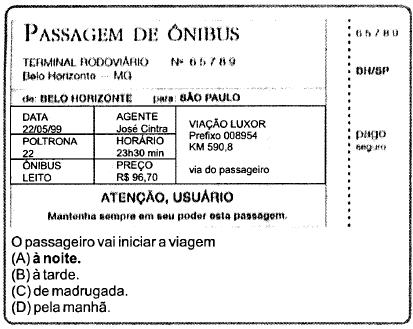
Analise a questão da Prova Brasil- Língua Portuguesa para o 50 ano do Ensino Fundamental (INEP, 2015) e assinale a alternativa com o descritor relativo à questão.
Provas
Questão presente nas seguintes provas
Sobre a Educação escolar dos alunos com surdez (ALVEZ, 2010,p. 7-9), analise as assertivas e assinale alternativa correta:
I- A proposta de educação bilíngue pauta a organização da prática pedagógica na Escola Especial e na Sala de Recurso Multifuncional.
II - É necessário reinventar as formas de conceber a escola e suas práticas pedagógicas, rompendo com os modos lineares do pensar e agir no que se refere à escolarização.
III - Historicamente as concepções desenvolvidas sobre a educação de pessoas com surdez se fundamentaram em três abordagens diferentes: a oralista, a comunicação total e a abordagem por meio do bilinguismo.
IV- As propostas educacionais, baseadas na comunicação total, não conseguiram atingir resultados satisfatórios, porque, normalizaram as diferenças, não aceitando a língua de sinais dessas pessoas.
Provas
Questão presente nas seguintes provas
2238464
Ano: 2015
Disciplina: Inglês (Língua Inglesa)
Banca: CETAP
Orgão: Pref. Ananindeua-PA
Disciplina: Inglês (Língua Inglesa)
Banca: CETAP
Orgão: Pref. Ananindeua-PA
Provas:
What Brazil's protests mean
(By Jeffrey Lesser CNN August 18, 2015)
What does it mean when hundreds of thousands of Brazilians take to the streets shouting "out with the President"? After countrywide protests this weekend, the answer is still not clear.
Sunday's protests in São Paulo were peaceful and mostly in the spirit of modern democracies. Many different groups helped organize the march, representing diverse political positions united by anti-President Oilma Rousseff, antiWorkers' Party rhetoric.
Numerous groups had rented their own loudspeakerequipped trucks and positioned them at different locations along the Avenida Paulista, where protests traditionally take place in São Paulo. The movements that represented fringe positions had few interested listeners. For example, only a couple of hundred people (in the midst of an estimated crowd of 135.000) were paying attention to an organization demanding a military coup and claiming that only the army could stop the "homosexualization" of Brazil.
Much larger crowds were massed in front of the trucks of the main organizers, Acorda Brasil (Wake Up Brazil) and Vem Pra Rua Brasil (Take to the Streets, Brazil). Their orators used music and anthems to rouse the crowd and, as is often the case in Brazil, soccer team chants were reworded with political slogans. The anti-Workers' Party movementAcorda Brasil changed the old leftist saying "Um povo unido, nunca será vencido" ("A people united will never be defeated") to "O povo anseia, Lula para a cadeia" ("The people demand (exPresident) Lula in prison"). Many marchers held signs proclaiming Sérgio Moro, the judge leading Brazil's corruption investigations, the hero ofthe day.
Yet Sunday's protests still drew smaller crowds than had been expected. True, the raw numbers cannot on their own be read as broad satisfaction with the ruling party. But the reality is that the chants of "out with Oilma" masked disagreement about what exactly the protesters wanted to see happen - most seemed to want Dilma to resign, many wanted her impeached, and others simply sought fresh elections.
Will the protesters get any ofthese wishes?
Oilma's resignation or impeachment are both unlikely scenarios, and the protests against the President and her party don't provide solutions to the current corruption crisis or to the continuing problems of social and economic inequality. What the protests do highlight, though, is the continued vibrancy of democracy in the country.
Like many Brazilian protests, the line between street fair and political action was quite fluid. On Sundays, Avenida Paulista is always filled with people eating, strolling and shopping. And while the march clearly drew more people than you would expect to find out on a typical Sunday, there were also more upscale food trucks, water and drink carts than usual mixed in with the anti-Oilma T-shirts styled to Brazil's national soccer jerseys.
But three moments stood out to me as fascinating examples ofthe particularly Brazilian way of doing politics.
The first was early in the day, when a few hundred of Brazil's Hells Angels were granted a police escort to roar down the Avenue in a way impossible on a regular Sunday (or any day). The second was the public hero-making of the military riot police who smilingly encouraged children to pet their horses (and thus encouraged their parents to forget continuing claims of police violence, especially in areas outside of the center of the city). Finally, there was the complexity of a group of eight smiling female military police officers in makeup, lined up together (presumably on command) and taking photographs with whistling mal e admirers.
Other issues were also apparent.
For a start, the numbers of college age protesters was modest -- the crowd appeared to be mainly families and those 50 and over. Meanwhile, the diversity ofthe crowd was equally modest - the protesters predominantly fell along the "white" end of the color spectrum (although in Brazil the terms for race vary widely, and rarely is the blacklwhite approach of the United States employed). Indeed, it was noticeable that the vendors, and the military police themselves, were of different colors -- and seemingly different classes - than many of the protesters.
Still, Sunday's protests are part of a continuum in modern Brazil that has been apparent since the 1960s. Two years ago, demonstrations started with young people opposing increases in public transportation fares. On Sunday, the street marches were led by different groups, ali protesting government corruption and united in opposition to Brazil's democratically elected president and the Workers' Party.
One of the many joys of being a historian is that I do not have to predict the future. But seeing the weekend's demonstrations close up, one thing was very clear - the use of the street as a location for making political points looks set to continue. And in doing so, it suggests a healthy democracy in Brazil - even during these times of political, economic, and social uncertainty.
Na oração: "Meanwhile, the diversity of the crowd was equally modest", a expressão "Meanwhile" significa:
Provas
Questão presente nas seguintes provas
Figura da questão 46:
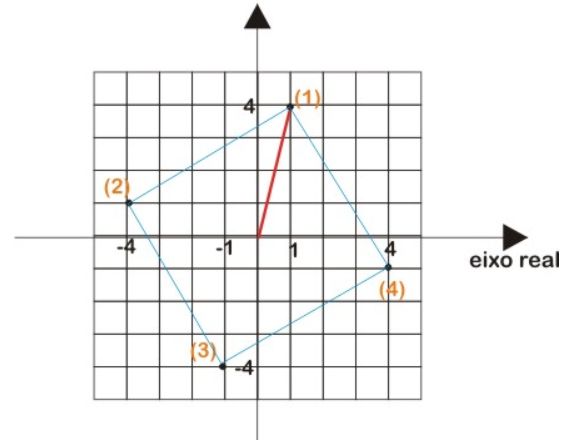
Qual a medida em metros quadrados da área do quadrado da questão número 46?
Provas
Questão presente nas seguintes provas
Leia as duas asserções sobre a expenencia de brincar da criança (BORBA, 2007) e observe a relação entre ambas.
A experiência do brincar cruza diferentes tempos e lugares, passados, presentes e futuros, sendo marcada ao mesmo tempo pela continuidade e pela mudança.
PORQUE
Essa experiência é simplesmente reproduzida a partir do que a criança percebe, ouve, vê e repete da cultura na qual se insere.
Sobre essas asserções, marque a alternativa CORRETA.
Provas
Questão presente nas seguintes provas
O poema "Toada de amor" é base à questão.
Toada de amor
E o amor sempre nessa toada
Briga perdoa perdoa briga.
Não se deve xingar a vida,
A gente vive, depois esquece.
Só o amor volta para brigar,
Para perdoar,
Amor cachorro bandido trem.
Mas, se não fosse ele, também
Que graça que a vida tinha?
Mariquinha, dá cá o pito,
No teu pito está o infinito.
(Carlos Orummond de Andrade)
A ausência de pontuação, no verso 2, serve estilisticamente:
Provas
Questão presente nas seguintes provas
Os conteúdos de ensino da Educação Física para os anos iniciais do Ensino Fundamental devem ser trabalhados nas dimensões conceituais, procedimentais e atitudinais que serão aprofundados e retomados nos ciclos posteriores de forma mais complexa, são exemplos desses conteúdos:
I- participação em diversos jogos e discussão de regras;
II - acompanhamento de uma dada estrutura rítmica com diferentes partes do corpo;
III - aquisição e desenvolvimento das capacidades físicas exigidas pelos esportes;
IV- aquisição e aperfeiçoamento das habilidades específicas relacionadas ao jogo;
Após a análise dos itens, marque a alternativa correta:
Provas
Questão presente nas seguintes provas
Segundo Carla Barbosa Alvez (201 O), o professor de Libras deve planejar o ensino dessa língua a partir dos diversos aspectos que envolvem sua aprendizagem, como, exceto:
Provas
Questão presente nas seguintes provas
Cadernos
Caderno Container