Foram encontradas 310 questões.
We have adopted the term ‘communicative competence’ to refer to the relationship and interaction between grammatical competence, or knowledge of language rules, and sociolinguistic competence, or knowledge of the rules of language use. Communicative competence is to be distinguished from communicative performance, which is the realization of these competencies and their interaction in the actual realization of utterances.
We think it is important to maintain these basic definitions for second language teaching and testing purposes. For example, if a communicative approach to language teaching is adopted, then principles of syllabus design must integrate aspects of both grammatical competence and socio-linguistic competence. Furthermore, teaching methodology and assessment instruments must be designed so as to address not only communicative competence but also communicative performance, i.e. the actual demonstration of this knowledge in a real second language situation and for an authentic communication purpose.
(CANALE, M. Theoretical bases of communicative approaches to second language teaching and testing. Applied Linguistics, 1/1, 1980.)
“Methodology”, “approach” and “syllabus” are terms frequently found in discussions about language teaching and learning, and yet very easily misunderstood. In the fragment from the second paragraph “principles of syllabus design must integrate aspects of both grammatical competence and socio-linguistic competence”, the term “syllabus” means the
Provas

Read the text.
Mr Wilson – Can I see Mr Wright, please?
Recepcionist – Mr Wright isn’t here, I’m afraid. He had left for a conference in Barcelona earlier today. I could put you through to someone else who has also worked on your project. I believe Mr Phillips must be able to help you.
Mr Wilson – Isn’t Mr Wright here??? I have talked to him on the phone just yesterday evening!
Recepcionist – I have to apologise for the inconvenience, Sir. I But problems has arisen in our office in Barcelona and Mr Wright could not postpone his trip.
Correct grammatical use of the present perfect tense is found in alternative:
Provas
Leia o texto para responder à questão.
For Campbell and Wales (1970), ‘by far the most important linguistic ability’ is that of being able to ‘produce or understand utterances which are not so much grammatical but, more important, appropriate to the context to which they are made’.
(CANALE, M. Theoretical bases of communicative approaches to second language teaching and testing. Applied Linguistics, 1/1, 1980)
Mark the alternative illustrating an utterance which is “appropriate to the context to which it is made”.
Provas
Leia o texto para responder à questão.
For Campbell and Wales (1970), ‘by far the most important linguistic ability’ is that of being able to ‘produce or understand utterances which are not so much grammatical but, more important, appropriate to the context to which they are made’.
(CANALE, M. Theoretical bases of communicative approaches to second language teaching and testing. Applied Linguistics, 1/1, 1980)
The concept of “language appropriacy” implies the
Provas
Combating teacher shortages in U.S.
In America, states have recently focused their efforts to reduce the nation’s teacher shortage by promoting strategies that “remove or relax barriers to entry” to quickly bring new people into the teaching profession. California allows teacher candidates to skip subject matter tests if they have taken approved college courses. New Mexico is replacing subject skills tests with a portfolio to demonstrate teaching competency. Missouri no longer looks at a prospective teacher’s overall grades – just the ones earned in select courses required to become a teacher. Arizona’s education requirements for teachers now allow people without a college degree to begin teaching – so long as they are currently enrolled in college.
But approaches to recruit new teachers do not address the actual causes of the comprehensive and nationwide teacher shortage. As revealed by research data recently published in the book “How Did We Get Here?: The Decay of the Teaching Profession,” college students who are interested in becoming teachers and current teachers agree: the root cause of the problem is a longstanding overall lack of respect for teachers and their craft, which is reflected by decades of low pay, hyperscrutiny and poor working conditions.
Even before covid-19 hit, teachers were leaving the profession at an increasing rate. And the stress of teaching through a pandemic has been speculated to drive away even more teachers. About 1 in 6 teachers expressed that they would likely leave their job pre-pandemic, but this increased to 1 in 4 by the 2020-21 school year. While teachers continue to leave classrooms, fewer people are signing up to replace them.
We believe efforts to loosen requirements for new teachers will bring more disrespect to the profession. Lowering the standards to allow more people to enter the teaching profession may, for a short period, boost the number of people available to stand in front of classrooms. Nevertheless, that approach does not make teaching an attractive profession to consider, nor worthwhile for someone to stay and thrive in. Solving the teacher shortage problem requires solutions that reduce the numbers of teachers leaving the field and specifically address the difficulties that they regularly endure.
(TRAN, H. & SMITH, D.A. www.theconversation.com, 08.08.2022. Adaptado)
Leia a charge.
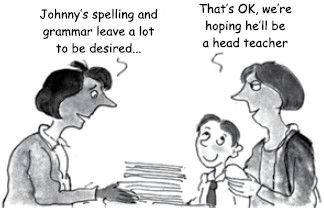
(facebook.com)
Relate the cartoon to the first sentence in the last paragraph of the text from theconversation.com – We believe efforts to loosen requirements for new teachers will bring more disrespect to the profession. Both mention the
Provas
Combating teacher shortages in U.S.
In America, states have recently focused their efforts to reduce the nation’s teacher shortage by promoting strategies that “remove or relax barriers to entry” to quickly bring new people into the teaching profession. California allows teacher candidates to skip subject matter tests if they have taken approved college courses. New Mexico is replacing subject skills tests with a portfolio to demonstrate teaching competency. Missouri no longer looks at a prospective teacher’s overall grades – just the ones earned in select courses required to become a teacher. Arizona’s education requirements for teachers now allow people without a college degree to begin teaching – so long as they are currently enrolled in college.
But approaches to recruit new teachers do not address the actual causes of the comprehensive and nationwide teacher shortage. As revealed by research data recently published in the book “How Did We Get Here?: The Decay of the Teaching Profession,” college students who are interested in becoming teachers and current teachers agree: the root cause of the problem is a longstanding overall lack of respect for teachers and their craft, which is reflected by decades of low pay, hyperscrutiny and poor working conditions.
Even before covid-19 hit, teachers were leaving the profession at an increasing rate. And the stress of teaching through a pandemic has been speculated to drive away even more teachers. About 1 in 6 teachers expressed that they would likely leave their job pre-pandemic, but this increased to 1 in 4 by the 2020-21 school year. While teachers continue to leave classrooms, fewer people are signing up to replace them.
We believe efforts to loosen requirements for new teachers will bring more disrespect to the profession. Lowering the standards to allow more people to enter the teaching profession may, for a short period, boost the number of people available to stand in front of classrooms. Nevertheless, that approach does not make teaching an attractive profession to consider, nor worthwhile for someone to stay and thrive in. Solving the teacher shortage problem requires solutions that reduce the numbers of teachers leaving the field and specifically address the difficulties that they regularly endure.
(TRAN, H. & SMITH, D.A. www.theconversation.com, 08.08.2022. Adaptado)
Leia o texto.
ABSTRACT. This article describes briefly the history of foreign language teaching (FLT) in Brazil, as seen from the perspective of different laws and the impact they cause on the curriculum. It is shown that the prestige of FLT has been constantly diminished over the years, reaching the lowest point in the law passed in 1971, when many students finished secondary school without ever getting in touch with a foreign language in the classroom. It is suggested that the new law published in 1996 remedies the situation to a certain point. The new parameters (Parâmetros Curriculares) and the prospects for the future are also discussed.
(LEFFA, V. J. O ensino de línguas estrangeiras no contexto nacional. Contexturas, APLIESP, n. 4, p. 13- 24, 1999.Adaptado.)
Both the article from theconversation.com and the abstract of Leffa’s academic text mention
Provas
Combating teacher shortages in U.S.
In America, states have recently focused their efforts to reduce the nation’s teacher shortage by promoting strategies that “remove or relax barriers to entry” to quickly bring new people into the teaching profession. California allows teacher candidates to skip subject matter tests if they have taken approved college courses. New Mexico is replacing subject skills tests with a portfolio to demonstrate teaching competency. Missouri no longer looks at a prospective teacher’s overall grades – just the ones earned in select courses required to become a teacher. Arizona’s education requirements for teachers now allow people without a college degree to begin teaching – so long as they are currently enrolled in college.
But approaches to recruit new teachers do not address the actual causes of the comprehensive and nationwide teacher shortage. As revealed by research data recently published in the book “How Did We Get Here?: The Decay of the Teaching Profession,” college students who are interested in becoming teachers and current teachers agree: the root cause of the problem is a longstanding overall lack of respect for teachers and their craft, which is reflected by decades of low pay, hyperscrutiny and poor working conditions.
Even before covid-19 hit, teachers were leaving the profession at an increasing rate. And the stress of teaching through a pandemic has been speculated to drive away even more teachers. About 1 in 6 teachers expressed that they would likely leave their job pre-pandemic, but this increased to 1 in 4 by the 2020-21 school year. While teachers continue to leave classrooms, fewer people are signing up to replace them.
We believe efforts to loosen requirements for new teachers will bring more disrespect to the profession. Lowering the standards to allow more people to enter the teaching profession may, for a short period, boost the number of people available to stand in front of classrooms. Nevertheless, that approach does not make teaching an attractive profession to consider, nor worthwhile for someone to stay and thrive in. Solving the teacher shortage problem requires solutions that reduce the numbers of teachers leaving the field and specifically address the difficulties that they regularly endure.
(TRAN, H. & SMITH, D.A. www.theconversation.com, 08.08.2022. Adaptado)
Leia o texto.
A referência ao ser crítico permite vários entendimentos. Um dos mais frequentes associa o desenvolvimento crítico com a escolaridade, tendo como premissa a ideia de que a crítica se situa em patamares altos da escala de estudos. O outro remete à capacidade de percepção crítica que cidadãos têm sobre a sociedade em que vivem, capacidade esta que não se atrela necessariamente aos altos níveis de escolarização.
(MONTE MÓR, W. M. Crítica e letramentos críticos: reflexões preliminares. In: MACIEL, R. F.; ROCHA, C. H. Língua estrangeira e formação cidadã: por entre discursos e práticas. Campinas: Pontes, p.3. 2013. Adaptado.)
You decide to use the article “Combating teacher shortages in U.S.” with an older, more advanced reading group. Having as point of reference the second of the two views on “ser crítico” mentioned in the excerpt, you would tell your students to
Provas
Combating teacher shortages in U.S.
In America, states have recently focused their efforts to reduce the nation’s teacher shortage by promoting strategies that “remove or relax barriers to entry” to quickly bring new people into the teaching profession. California allows teacher candidates to skip subject matter tests if they have taken approved college courses. New Mexico is replacing subject skills tests with a portfolio to demonstrate teaching competency. Missouri no longer looks at a prospective teacher’s overall grades – just the ones earned in select courses required to become a teacher. Arizona’s education requirements for teachers now allow people without a college degree to begin teaching – so long as they are currently enrolled in college.
But approaches to recruit new teachers do not address the actual causes of the comprehensive and nationwide teacher shortage. As revealed by research data recently published in the book “How Did We Get Here?: The Decay of the Teaching Profession,” college students who are interested in becoming teachers and current teachers agree: the root cause of the problem is a longstanding overall lack of respect for teachers and their craft, which is reflected by decades of low pay, hyperscrutiny and poor working conditions.
Even before covid-19 hit, teachers were leaving the profession at an increasing rate. And the stress of teaching through a pandemic has been speculated to drive away even more teachers. About 1 in 6 teachers expressed that they would likely leave their job pre-pandemic, but this increased to 1 in 4 by the 2020-21 school year. While teachers continue to leave classrooms, fewer people are signing up to replace them.
We believe efforts to loosen requirements for new teachers will bring more disrespect to the profession. Lowering the standards to allow more people to enter the teaching profession may, for a short period, boost the number of people available to stand in front of classrooms. Nevertheless, that approach does not make teaching an attractive profession to consider, nor worthwhile for someone to stay and thrive in. Solving the teacher shortage problem requires solutions that reduce the numbers of teachers leaving the field and specifically address the difficulties that they regularly endure.
(TRAN, H. & SMITH, D.A. www.theconversation.com, 08.08.2022. Adaptado)
Pronomes são um outro importante e frequente elemento de coesão em textos, e reconhecer a que/quem se referem contribui para a compreensão. No trecho do quarto parágrafo “Nevertheless, that approach does not make teaching an attractive profession to consider”, a expressão sublinhada faz referência, especificamente,
Provas
Combating teacher shortages in U.S.
In America, states have recently focused their efforts to reduce the nation’s teacher shortage by promoting strategies that “remove or relax barriers to entry” to quickly bring new people into the teaching profession. California allows teacher candidates to skip subject matter tests if they have taken approved college courses. New Mexico is replacing subject skills tests with a portfolio to demonstrate teaching competency. Missouri no longer looks at a prospective teacher’s overall grades – just the ones earned in select courses required to become a teacher. Arizona’s education requirements for teachers now allow people without a college degree to begin teaching – so long as they are currently enrolled in college.
But approaches to recruit new teachers do not address the actual causes of the comprehensive and nationwide teacher shortage. As revealed by research data recently published in the book “How Did We Get Here?: The Decay of the Teaching Profession,” college students who are interested in becoming teachers and current teachers agree: the root cause of the problem is a longstanding overall lack of respect for teachers and their craft, which is reflected by decades of low pay, hyperscrutiny and poor working conditions.
Even before covid-19 hit, teachers were leaving the profession at an increasing rate. And the stress of teaching through a pandemic has been speculated to drive away even more teachers. About 1 in 6 teachers expressed that they would likely leave their job pre-pandemic, but this increased to 1 in 4 by the 2020-21 school year. While teachers continue to leave classrooms, fewer people are signing up to replace them.
We believe efforts to loosen requirements for new teachers will bring more disrespect to the profession. Lowering the standards to allow more people to enter the teaching profession may, for a short period, boost the number of people available to stand in front of classrooms. Nevertheless, that approach does not make teaching an attractive profession to consider, nor worthwhile for someone to stay and thrive in. Solving the teacher shortage problem requires solutions that reduce the numbers of teachers leaving the field and specifically address the difficulties that they regularly endure.
(TRAN, H. & SMITH, D.A. www.theconversation.com, 08.08.2022. Adaptado)
Conjunctions and connectives are relevant elements of cohesion in texts. In the fragment from the fourth paragraph “Nevertheless, that approach does not make teaching an attractive profession to consider”, the underlined word indicates there is, in the context,
Provas
Combating teacher shortages in U.S.
In America, states have recently focused their efforts to reduce the nation’s teacher shortage by promoting strategies that “remove or relax barriers to entry” to quickly bring new people into the teaching profession. California allows teacher candidates to skip subject matter tests if they have taken approved college courses. New Mexico is replacing subject skills tests with a portfolio to demonstrate teaching competency. Missouri no longer looks at a prospective teacher’s overall grades – just the ones earned in select courses required to become a teacher. Arizona’s education requirements for teachers now allow people without a college degree to begin teaching – so long as they are currently enrolled in college.
But approaches to recruit new teachers do not address the actual causes of the comprehensive and nationwide teacher shortage. As revealed by research data recently published in the book “How Did We Get Here?: The Decay of the Teaching Profession,” college students who are interested in becoming teachers and current teachers agree: the root cause of the problem is a longstanding overall lack of respect for teachers and their craft, which is reflected by decades of low pay, hyperscrutiny and poor working conditions.
Even before covid-19 hit, teachers were leaving the profession at an increasing rate. And the stress of teaching through a pandemic has been speculated to drive away even more teachers. About 1 in 6 teachers expressed that they would likely leave their job pre-pandemic, but this increased to 1 in 4 by the 2020-21 school year. While teachers continue to leave classrooms, fewer people are signing up to replace them.
We believe efforts to loosen requirements for new teachers will bring more disrespect to the profession. Lowering the standards to allow more people to enter the teaching profession may, for a short period, boost the number of people available to stand in front of classrooms. Nevertheless, that approach does not make teaching an attractive profession to consider, nor worthwhile for someone to stay and thrive in. Solving the teacher shortage problem requires solutions that reduce the numbers of teachers leaving the field and specifically address the difficulties that they regularly endure.
(TRAN, H. & SMITH, D.A. www.theconversation.com, 08.08.2022. Adaptado)
A estratégia de leitura denominada “scanning” será utilizada pelo leitor deste texto se ele
Provas
Caderno Container