Foram encontradas 30 questões.
The following text is the phonetic transcription (in BrEng) of a part of a famous Pablo Neruda’s sonnet translated into English, the Sonnet XVII.
/ˈaɪ ˈduː ˈnɒt ˈl∧v ˈjuː ˈəz ˈɪf ˈjuː ˈwə ˈsɒltrəʊz | ˈɔː ˈtəʊpæz /
/ˈɔː ˈðɪ ˈærəʊ ˈəv kαːˈneɪʃᵊnz ðə ˈfaɪə ˈʃuːts ˈɒf /
/ˈaɪ ˈl∧v ˈjuː ˈəz ˈsɜːtᵊn ˈdαːk ˈθɪŋz ˈαː ˈtuː ˈbiː ˈl∧vd /
/ˈɪn ˈsiːkrət | bɪˈtwiːn ðə ˈʃædəʊ ˈənd ðə ˈsəʊl /
From the knowledge you must have concerning English Phonetics, which of the alternatives below brings the correct text for the abovementioned transcription?
Provas

Disciplina: Inglês (Língua Inglesa)
Banca: FUNCERN
Orgão: Pref. Bom Jesus-RN
Read the extract below.What do the words in bold have in common?
“Sir, please! I need some copies of that article I spent the whole night reading until I noticed I have entirely studied its pages. I believe my classmates we’ll love to have some notes of mine.”
Provas
Disciplina: Inglês (Língua Inglesa)
Banca: FUNCERN
Orgão: Pref. Bom Jesus-RN
The question is based on Text 03.
Text 03
In colloquial language, in expressions of everyday language, there are peculiar forms and sharp contrasts between the two languages – Portuguese and English. In both of these languages, the difficulty arises whenever we are faced with idiomatic expressions (idioms). These are forms that bear no resemblance to the forms used in the other language to express the same idea. There is correspondence in terms of idea, but not in terms of form.
(Adapted from: English Made in Brazil - https://www.sk.com.br/sk-idiom.html )
According to text 03, one of the alternatives below brings the correct correspondence between an idiom and its meaning.
Provas
Disciplina: Inglês (Língua Inglesa)
Banca: FUNCERN
Orgão: Pref. Bom Jesus-RN
The question is based on Text 03.
Text 03
In colloquial language, in expressions of everyday language, there are peculiar forms and sharp contrasts between the two languages – Portuguese and English. In both of these languages, the difficulty arises whenever we are faced with idiomatic expressions (idioms). These are forms that bear no resemblance to the forms used in the other language to express the same idea. There is correspondence in terms of idea, but not in terms of form.
(Adapted from: English Made in Brazil - https://www.sk.com.br/sk-idiom.html )
According to text 03, it is implicit that:
Provas
Disciplina: Inglês (Língua Inglesa)
Banca: FUNCERN
Orgão: Pref. Bom Jesus-RN
Which of the phrasal verbs below means “to go on vacation” / “to go somewhere different from where you live in order to have a rest or a holiday”?
Provas
Disciplina: Inglês (Língua Inglesa)
Banca: FUNCERN
Orgão: Pref. Bom Jesus-RN
The alternative that uses a question pronoun (an interrogative one) as a relative pronoun is.
Provas
Disciplina: Inglês (Língua Inglesa)
Banca: FUNCERN
Orgão: Pref. Bom Jesus-RN
The alternative that shows the CORRECT use of the indefinite article is (attention to the structures in bold):
Provas
Disciplina: Inglês (Língua Inglesa)
Banca: FUNCERN
Orgão: Pref. Bom Jesus-RN
The rules that explain why we use the indefinite article “A” instead of “AN” (and vice-versa) before some words are:
Provas
Disciplina: Inglês (Língua Inglesa)
Banca: FUNCERN
Orgão: Pref. Bom Jesus-RN
Only one of the alternatives below brings BOTH sentences in bold in the active voice. It is:
Provas
In the table below, we have the characteristics of two methods in Language Teaching. From what is informed in the chart, we can infer that the methods are, respectively (from the top to the bottom of the table, column 1):
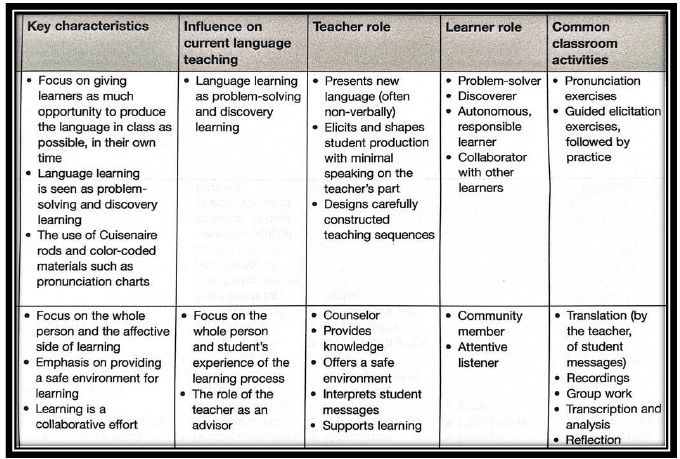
(Source: Richards and Rodgers. Approaches and Methods in Language Teaching. Appendix 1).
Provas
Caderno Container