Foram encontradas 579 questões.
3675894
Ano: 2025
Disciplina: Inglês (Língua Inglesa)
Banca: URCA
Orgão: Pref. Brejo Santo-CE
Disciplina: Inglês (Língua Inglesa)
Banca: URCA
Orgão: Pref. Brejo Santo-CE
Provas:
Text 1 – How children learn languages
Questions 31 to 39
How long does it take to learn a language?
Many different factors affect the time it takes. These include
your child’s age, first language, their reason for BLANK I English and their teachers. You can help your child learn quickly
by BLANK II them lots of opportunities to use English. It helps
to have real reasons for BLANK III a language, rather than just
BLANK IV grammar.
Is it true that boys and girls learn languages differently?
Yes. At early ages, girls tend to develop language more quickly. Remember that it’s OK for children to develop at different
speeds. It will be more similar by secondary school age. However, by this stage children might think that languages are ‘more
of a girl thing’. Attitudes to learning can have a big impact on
educational success so it’s important to find ways to encourage
your child and help them enjoy their learning.
Do primary and secondary children learn languages differently?
Yes, there are differences.
Primary school children are learning their first and second languages at the same time. It’s really important
to support both languages. Children with a strong foundation in their first language will find it easier to learn
a second language. Encourage your child to play, sing
and read in both their first and second languages. Remember to plan separate times to focus on each language.
If you say something in English and then in another language,
your child will automatically listen for their stronger language
and ‘tune out’ the other language.
Teenagers are interested in exploring their personalities and
identities. This creates lots of opportunities to use popular culture, films, TV, music and video games. Teenagers also enjoy
challenging authority, which provides opportunities for debates
and discussion.
Will learning another language affect how well my child
does at school?
Multilingual children learn at a young age that they can express their ideas in more than one way. This helps their
thought process and makes them better, more flexible, learners. Research has found that children who speak more than one
language do better in school, and have better memories and
problem-solving skills.
What kind of learner is my child?
Watch your child playing. What do they enjoy doing? Puzzles and problem-solving? Physical play and sports? Word games?
Writing stories? Creative play? Try doing these types of activities in English and make a note of what your child responds to
best. Alternatively, ask your child to create in English their own
one-week ‘dream timetable of activities’. Let them choose how
to present it. For example, they could act it out, prepare a written
fact file, make a video, draw pictures, go on a treasure hunt or
make a scrap book.
Source: https://www.cambridgeenglish.org/learning-english/parents-and-children/how-to-support-your-child/howchildren-learn-languages/. Accessed on 01/22/25
Provas
Questão presente nas seguintes provas

3675893
Ano: 2025
Disciplina: Inglês (Língua Inglesa)
Banca: URCA
Orgão: Pref. Brejo Santo-CE
Disciplina: Inglês (Língua Inglesa)
Banca: URCA
Orgão: Pref. Brejo Santo-CE
Provas:
Text 1 – How children learn languages
Questions 31 to 39
How long does it take to learn a language?
Many different factors affect the time it takes. These include
your child’s age, first language, their reason for BLANK I English and their teachers. You can help your child learn quickly
by BLANK II them lots of opportunities to use English. It helps
to have real reasons for BLANK III a language, rather than just
BLANK IV grammar.
Is it true that boys and girls learn languages differently?
Yes. At early ages, girls tend to develop language more quickly. Remember that it’s OK for children to develop at different
speeds. It will be more similar by secondary school age. However, by this stage children might think that languages are ‘more
of a girl thing’. Attitudes to learning can have a big impact on
educational success so it’s important to find ways to encourage
your child and help them enjoy their learning.
Do primary and secondary children learn languages differently?
Yes, there are differences.
Primary school children are learning their first and second languages at the same time. It’s really important
to support both languages. Children with a strong foundation in their first language will find it easier to learn
a second language. Encourage your child to play, sing
and read in both their first and second languages. Remember to plan separate times to focus on each language.
If you say something in English and then in another language,
your child will automatically listen for their stronger language
and ‘tune out’ the other language.
Teenagers are interested in exploring their personalities and
identities. This creates lots of opportunities to use popular culture, films, TV, music and video games. Teenagers also enjoy
challenging authority, which provides opportunities for debates
and discussion.
Will learning another language affect how well my child
does at school?
Multilingual children learn at a young age that they can express their ideas in more than one way. This helps their
thought process and makes them better, more flexible, learners. Research has found that children who speak more than one
language do better in school, and have better memories and
problem-solving skills.
What kind of learner is my child?
Watch your child playing. What do they enjoy doing? Puzzles and problem-solving? Physical play and sports? Word games?
Writing stories? Creative play? Try doing these types of activities in English and make a note of what your child responds to
best. Alternatively, ask your child to create in English their own
one-week ‘dream timetable of activities’. Let them choose how
to present it. For example, they could act it out, prepare a written
fact file, make a video, draw pictures, go on a treasure hunt or
make a scrap book.
Source: https://www.cambridgeenglish.org/learning-english/parents-and-children/how-to-support-your-child/howchildren-learn-languages/. Accessed on 01/22/25
Provas
Questão presente nas seguintes provas
3675892
Ano: 2025
Disciplina: Inglês (Língua Inglesa)
Banca: URCA
Orgão: Pref. Brejo Santo-CE
Disciplina: Inglês (Língua Inglesa)
Banca: URCA
Orgão: Pref. Brejo Santo-CE
Provas:
Text 1 – How children learn languages
Questions 31 to 39
How long does it take to learn a language?
Many different factors affect the time it takes. These include
your child’s age, first language, their reason for BLANK I English and their teachers. You can help your child learn quickly
by BLANK II them lots of opportunities to use English. It helps
to have real reasons for BLANK III a language, rather than just
BLANK IV grammar.
Is it true that boys and girls learn languages differently?
Yes. At early ages, girls tend to develop language more quickly. Remember that it’s OK for children to develop at different
speeds. It will be more similar by secondary school age. However, by this stage children might think that languages are ‘more
of a girl thing’. Attitudes to learning can have a big impact on
educational success so it’s important to find ways to encourage
your child and help them enjoy their learning.
Do primary and secondary children learn languages differently?
Yes, there are differences.
Primary school children are learning their first and second languages at the same time. It’s really important
to support both languages. Children with a strong foundation in their first language will find it easier to learn
a second language. Encourage your child to play, sing
and read in both their first and second languages. Remember to plan separate times to focus on each language.
If you say something in English and then in another language,
your child will automatically listen for their stronger language
and ‘tune out’ the other language.
Teenagers are interested in exploring their personalities and
identities. This creates lots of opportunities to use popular culture, films, TV, music and video games. Teenagers also enjoy
challenging authority, which provides opportunities for debates
and discussion.
Will learning another language affect how well my child
does at school?
Multilingual children learn at a young age that they can express their ideas in more than one way. This helps their
thought process and makes them better, more flexible, learners. Research has found that children who speak more than one
language do better in school, and have better memories and
problem-solving skills.
What kind of learner is my child?
Watch your child playing. What do they enjoy doing? Puzzles and problem-solving? Physical play and sports? Word games?
Writing stories? Creative play? Try doing these types of activities in English and make a note of what your child responds to
best. Alternatively, ask your child to create in English their own
one-week ‘dream timetable of activities’. Let them choose how
to present it. For example, they could act it out, prepare a written
fact file, make a video, draw pictures, go on a treasure hunt or
make a scrap book.
Source: https://www.cambridgeenglish.org/learning-english/parents-and-children/how-to-support-your-child/howchildren-learn-languages/. Accessed on 01/22/25
Provas
Questão presente nas seguintes provas
TEXTO VI
Provas
Questão presente nas seguintes provas
TEXTO VI
O primeiro trabalho com o texto, tanto o do aluno ao produzi-lo quanto o do professor ao dá-lo à leitura de seus possíveis e concretos leitores em sala de aula, é o de inseri-lo significativamente no diálogo em curso a respeito do assunto de que trata, tanto no diálogo em sala de aula quanto nos âmbitos mais amplos da sociedade e da história. Depois disso, vem o trabalho de inseri-lo no diálogo mais abstrato do gênero, da estrutura, da coerência, da coesão, da correção gramatical etc., questionando a conveniência de esse específico texto acomodar-se à tradição estabelecida, tensionar essa tradição ou mesmo romper com ela, orientando esse questionamento pelos efeitos pretendidos sobre os leitores a quem o texto pretende atingir.
(Jane Mary e Paulo Coimbra. Adaptado)
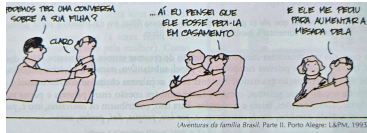
O gênero textual utilizado é:
Provas
Questão presente nas seguintes provas
TEXTO VI
Provas
Questão presente nas seguintes provas
TEXTO VI
Provas
Questão presente nas seguintes provas
TEXTO VI
I. Retrata situações distintas de comunicação em que há uma sequência lógica entre os quadros, constituída a partir de vários elementos.
II. Pode-se ler um quadrinho isoladamente sem modificar o sentido global do texto.
III. A palavra “aí”, no segundo quadrinho, serve de elemento conector de condição por representar o uso coloquial da comunicação.
IV. “E”, no terceiro quadrinho, liga a segunda cena à terceira, estabelecendo uma relação de adição.
V. O pronome “ele”, na segunda cena, retoma o termo “genro” e o assunto da conversa. Tal estratégia enunciativa, entre outras, é responsável pela textualidade.
Provas
Questão presente nas seguintes provas
TEXTO V – APANHO TODOS OS DIAS DA GRAMÁTICA.
ELA NÃO É TÃO IMPORTANTE ASSIM
Conceição Freitas, Metrópoles, 03/09/2019
Verissimo, filho do Érico, tem uma crônica saborosa sobre a língua portuguesa. Que as
feministas mais aguerridas não nos leiam, ele diz que a gramática precisa apanhar todos os
dias pra saber quem é que manda. Eu apanho dela todos os dias.
Nunca consegui decorar regras gramaticais. Tudo que é muito explicadinho me confunde.
Sorte minha é que a memória visual das boas leituras tem me ajudado desde sempre a não
tropeçar nos erros mais grotescos. Sei que "paralisação" é com S, que "cônjuge" se escreve
assim, que "cafta" é uma receita da culinária árabe e "Kafka" é o genial escritor austríaco.
O conhecimento da língua portuguesa não é um valor moral e nem mesmo distingue quem
é inteligente de quem não é. O rigor na obediência às regras gramaticais é um divisor de
classe – os cultos e os supostamente incultos; os inteligentes e os burros; os graduados e
os sem graduação.
O Verissimo escreveu o que quero dizer de um jeito delicioso:
“...a linguagem, qualquer linguagem, é um meio de comunicação e deve ser julgada exclusivamente como tal. Respeitadas algumas regras básicas da gramática, para evitar os
vexames mais gritantes, as outras são dispensáveis. A sintaxe é uma questão de uso de
princípios. Escrever bem é escrever claro, não necessariamente certo. Por exemplo: dizer
‘escrever claro’ não é certo, mas é claro, certo? O importante é comunicar (e quando
possível surpreender, iluminar, divertir, comover...). Mas aí entramos na área do talento, que
também não tem nada a ver com a gramática). A gramática é o esqueleto da língua. Só
predomina nas línguas mortas, e aí de interesse restrito de necrólogos e professores de
Latim, gente em geral pouco comunicativa. Aquela sombria gravidade que a gente nota nas
fotografias em grupo dos membros da Academia Brasileira de Letras é de reprovação pelo
português ainda estar vivo. Eles só estão esperando, fardados, que o português morra para
poderem carregar o caixão e escrever sua autópsia definitiva. É o esqueleto que nos traz de
pé, certo, mas ele não informa nada, como a gramática é a estrutura da língua, mas sozinha
não diz nada, não tem futuro. As múmias conversam entre si em gramática pura.”
Impura, sigo apanhando da gramática mesmo tendo de lidar com ela todos os dias, há tanto
tempo que nem é bom contar.
Não consigo decorar, por exemplo, quando devo usar “senão” ou “se não”. (“Senão”
significa “do contrário”. Como no exemplo: “Me escute, senão vou embora.” “Se não” quer
dizer “caso não”. Assim: “Se não vier logo, perderá a vez.” Mas como a língua portuguesa
não facilita pra ninguém, se for trocar o “se não” por “caso não”, muda a conjugação do
verbo: “Caso não venha logo, perderá a vez.”) Nem adianta escrever uma crônica sobre o
“senão”. Da próxima vez, terei de “googlar” de novo. Desconfio que há uma razão freudiana
nessa minha dificuldade com o “se” e o “não”. Talvez porque não me dê bem com
dubiedades.
Se for pra contar vantagem, posso dizer que tiro de letra o uso do “porque”, “por que”,
“porquê” e “por quê”. Também sei de cor, desde criancinha, todas as preposições simples:
“A, ante, após, até, com, contra, de, desde, em, entre, para, per, perante, por, sem, sobre,
sob, trás”. Talvez tenha sido a única lista que decorei no tempo da escola. Como ouvi há
muito tempo de um psicanalista: “Não existe memória, existe desejória.” Por isso, só guardo
o que é essencialmente importante.
Se não morri até agora, disso não morro mais. Será que acertei? (Se errei, senhor revisor,
me diga, que incluo suas considerações. Grata.) Senão, posso perder os leitores que
pacientemente venho tentando conquistar. (Acho que agora acertei!)
Provas
Questão presente nas seguintes provas
TEXTO V – APANHO TODOS OS DIAS DA GRAMÁTICA.
ELA NÃO É TÃO IMPORTANTE ASSIM
Conceição Freitas, Metrópoles, 03/09/2019
Verissimo, filho do Érico, tem uma crônica saborosa sobre a língua portuguesa. Que as
feministas mais aguerridas não nos leiam, ele diz que a gramática precisa apanhar todos os
dias pra saber quem é que manda. Eu apanho dela todos os dias.
Nunca consegui decorar regras gramaticais. Tudo que é muito explicadinho me confunde.
Sorte minha é que a memória visual das boas leituras tem me ajudado desde sempre a não
tropeçar nos erros mais grotescos. Sei que "paralisação" é com S, que "cônjuge" se escreve
assim, que "cafta" é uma receita da culinária árabe e "Kafka" é o genial escritor austríaco.
O conhecimento da língua portuguesa não é um valor moral e nem mesmo distingue quem
é inteligente de quem não é. O rigor na obediência às regras gramaticais é um divisor de
classe – os cultos e os supostamente incultos; os inteligentes e os burros; os graduados e
os sem graduação.
O Verissimo escreveu o que quero dizer de um jeito delicioso:
“...a linguagem, qualquer linguagem, é um meio de comunicação e deve ser julgada exclusivamente como tal. Respeitadas algumas regras básicas da gramática, para evitar os
vexames mais gritantes, as outras são dispensáveis. A sintaxe é uma questão de uso de
princípios. Escrever bem é escrever claro, não necessariamente certo. Por exemplo: dizer
‘escrever claro’ não é certo, mas é claro, certo? O importante é comunicar (e quando
possível surpreender, iluminar, divertir, comover...). Mas aí entramos na área do talento, que
também não tem nada a ver com a gramática). A gramática é o esqueleto da língua. Só
predomina nas línguas mortas, e aí de interesse restrito de necrólogos e professores de
Latim, gente em geral pouco comunicativa. Aquela sombria gravidade que a gente nota nas
fotografias em grupo dos membros da Academia Brasileira de Letras é de reprovação pelo
português ainda estar vivo. Eles só estão esperando, fardados, que o português morra para
poderem carregar o caixão e escrever sua autópsia definitiva. É o esqueleto que nos traz de
pé, certo, mas ele não informa nada, como a gramática é a estrutura da língua, mas sozinha
não diz nada, não tem futuro. As múmias conversam entre si em gramática pura.”
Impura, sigo apanhando da gramática mesmo tendo de lidar com ela todos os dias, há tanto
tempo que nem é bom contar.
Não consigo decorar, por exemplo, quando devo usar “senão” ou “se não”. (“Senão”
significa “do contrário”. Como no exemplo: “Me escute, senão vou embora.” “Se não” quer
dizer “caso não”. Assim: “Se não vier logo, perderá a vez.” Mas como a língua portuguesa
não facilita pra ninguém, se for trocar o “se não” por “caso não”, muda a conjugação do
verbo: “Caso não venha logo, perderá a vez.”) Nem adianta escrever uma crônica sobre o
“senão”. Da próxima vez, terei de “googlar” de novo. Desconfio que há uma razão freudiana
nessa minha dificuldade com o “se” e o “não”. Talvez porque não me dê bem com
dubiedades.
Se for pra contar vantagem, posso dizer que tiro de letra o uso do “porque”, “por que”,
“porquê” e “por quê”. Também sei de cor, desde criancinha, todas as preposições simples:
“A, ante, após, até, com, contra, de, desde, em, entre, para, per, perante, por, sem, sobre,
sob, trás”. Talvez tenha sido a única lista que decorei no tempo da escola. Como ouvi há
muito tempo de um psicanalista: “Não existe memória, existe desejória.” Por isso, só guardo
o que é essencialmente importante.
Se não morri até agora, disso não morro mais. Será que acertei? (Se errei, senhor revisor,
me diga, que incluo suas considerações. Grata.) Senão, posso perder os leitores que
pacientemente venho tentando conquistar. (Acho que agora acertei!)
Provas
Questão presente nas seguintes provas
Cadernos
Caderno Container