Foram encontradas 2.369 questões.
Disciplina: Inglês (Língua Inglesa)
Banca: FGV
Orgão: Pref. Caraguatatuba-SP
Text
Digital Inclusion for All
Shaping our Digital Future
Digital technologies – the internet, mobile phones, and all the other tools to collect, store, analyze, and share information digitally – have spread rapidly in much of the world. Many of us depend on them to work, to educate the young, and reach out to our friends and family. These technologies have enabled digital public services, digital payments, online learning, telehealth, online shopping and more. However, about half the world's people access and use the Internet, the other half do not. Millions of people cannot work or go to school remotely or access technology and its benefits. Many of the unconnected live in least developed countries, landlocked developing countries and small island developing states, and within countries in rural and remote areas or urban impoverished areas.
Digital divide still persists between more and less connected countries, communities, and people. Enabling all the world's people to access and use digital technologies (the Internet including mobile technologies) – and closing digital divides – remains a challenge that needs to be addressed if the world community is to achieve the United Nations Sustainable Development Goals (SDGs) by 2030.
Adapted from: https://www.un.org/development/desa/dspd/wp-content/uploads/sites/22/2021/02/Draft-DigitalInclusion4All-OnlineGlobalForum2021-12Feb.pdf
The opposite of “least” in “least developed countries” (1st paragraph) is:
Provas

Disciplina: Inglês (Língua Inglesa)
Banca: FGV
Orgão: Pref. Caraguatatuba-SP
Text
Digital Inclusion for All
Shaping our Digital Future
Digital technologies – the internet, mobile phones, and all the other tools to collect, store, analyze, and share information digitally – have spread rapidly in much of the world. Many of us depend on them to work, to educate the young, and reach out to our friends and family. These technologies have enabled digital public services, digital payments, online learning, telehealth, online shopping and more. However, about half the world's people access and use the Internet, the other half do not. Millions of people cannot work or go to school remotely or access technology and its benefits. Many of the unconnected live in least developed countries, landlocked developing countries and small island developing states, and within countries in rural and remote areas or urban impoverished areas.
Digital divide still persists between more and less connected countries, communities, and people. Enabling all the world's people to access and use digital technologies (the Internet including mobile technologies) – and closing digital divides – remains a challenge that needs to be addressed if the world community is to achieve the United Nations Sustainable Development Goals (SDGs) by 2030.
Adapted from: https://www.un.org/development/desa/dspd/wp-content/uploads/sites/22/2021/02/Draft-DigitalInclusion4All-OnlineGlobalForum2021-12Feb.pdf
The word “challenge” in “remains a challenge” (2nd paragraph) means something:
Provas
Disciplina: Inglês (Língua Inglesa)
Banca: FGV
Orgão: Pref. Caraguatatuba-SP
Text
Digital Inclusion for All
Shaping our Digital Future
Digital technologies – the internet, mobile phones, and all the other tools to collect, store, analyze, and share information digitally – have spread rapidly in much of the world. Many of us depend on them to work, to educate the young, and reach out to our friends and family. These technologies have enabled digital public services, digital payments, online learning, telehealth, online shopping and more. However, about half the world's people access and use the Internet, the other half do not. Millions of people cannot work or go to school remotely or access technology and its benefits. Many of the unconnected live in least developed countries, landlocked developing countries and small island developing states, and within countries in rural and remote areas or urban impoverished areas.
Digital divide still persists between more and less connected countries, communities, and people. Enabling all the world's people to access and use digital technologies (the Internet including mobile technologies) – and closing digital divides – remains a challenge that needs to be addressed if the world community is to achieve the United Nations Sustainable Development Goals (SDGs) by 2030.
Adapted from: https://www.un.org/development/desa/dspd/wp-content/uploads/sites/22/2021/02/Draft-DigitalInclusion4All-OnlineGlobalForum2021-12Feb.pdf
The text concludes that to reach the United Nations Sustainable Development Goals (SDGs) by 2030 the world community should:
Provas
Disciplina: Inglês (Língua Inglesa)
Banca: FGV
Orgão: Pref. Caraguatatuba-SP
Text
Digital Inclusion for All
Shaping our Digital Future
Digital technologies – the internet, mobile phones, and all the other tools to collect, store, analyze, and share information digitally – have spread rapidly in much of the world. Many of us depend on them to work, to educate the young, and reach out to our friends and family. These technologies have enabled digital public services, digital payments, online learning, telehealth, online shopping and more. However, about half the world's people access and use the Internet, the other half do not. Millions of people cannot work or go to school remotely or access technology and its benefits. Many of the unconnected live in least developed countries, landlocked developing countries and small island developing states, and within countries in rural and remote areas or urban impoverished areas.
Digital divide still persists between more and less connected countries, communities, and people. Enabling all the world's people to access and use digital technologies (the Internet including mobile technologies) – and closing digital divides – remains a challenge that needs to be addressed if the world community is to achieve the United Nations Sustainable Development Goals (SDGs) by 2030.
Adapted from: https://www.un.org/development/desa/dspd/wp-content/uploads/sites/22/2021/02/Draft-DigitalInclusion4All-OnlineGlobalForum2021-12Feb.pdf
Based on the text, mark the statements below as TRUE (T) or FALSE (F).
( ) Digital technologies have undergone fast proliferation.
( ) Every place in the world has access to the internet.
( ) Digital exclusion needs to come to an end.
The statements are, respectively,
Provas
Disciplina: Inglês (Língua Inglesa)
Banca: FGV
Orgão: Pref. Caraguatatuba-SP
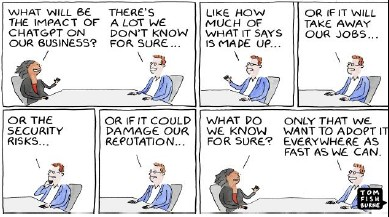
From: https://marketoonist.com/2023/06/impact-of-chatgpt.html
“For sure” in the last panel is similar in meaning to:
Provas
Disciplina: Inglês (Língua Inglesa)
Banca: FGV
Orgão: Pref. Caraguatatuba-SP
From: https://marketoonist.com/2023/06/impact-of-chatgpt.html
Regarding the fast adoption of CHATGPT, this cartoon aims at:
Provas
A elipse descrita no plano cartesiano por
\( x^2 + 2y^2 + 2x - y - 3 = 0 \)
intersecta os eixos coordenados \( \vec{0x} \) e \( \vec{0y} \) em pontos que formam um quadrilátero convexo de área igual a
Provas
A média aritmética de 5 números é 6,8 e o desvio padrão dessa população é 1,47. Se todos os 5 números forem acrescidos de duas unidades,
Provas
Um produto custa, à vista, R$ 820,00, mas pode ser adquirido a prazo mediante o pagamento de duas prestações mensais, iguais e consecutivas, sendo a primeira delas paga um mês após a compra.
Se compras a prazo sofrem incidência de juros mensais de 5%, o valor das parcelas a serem pagas nessa modalidade é
Provas
Considere uma circunferência de centro na origem do plano de Argand-Gauss. Um ponto A, no primeiro quadrante, pertencente à circunferência, representa um número complexo \( z \) que, ao ser elevado à quinta potência, dá como resultado −32.
O argumento do número complexo \( i\bar{z} \) é
Provas
Caderno Container