Foram encontradas 40 questões.
A teoria de aprendizagem desta abordagem consiste no tipo de hábito de aprendizagem. Para tanto, utiliza-se de frases previamente prontas, que são apresentadas aos alunos e relacionadas a diferentes situações ou contextos para que esses as memorizem e repitam. Desse modo, frases já prontas são apresentadas aos alunos, sendo relacionadas a diferentes situações ou contextos para que os alunos as memorizem e repitam. Esses exercícios de repetição são referidos como ‘drills’.
O texto acima se refere a qual das abordagens e métodos de ensino de língua inglesa?
Provas

Observe as afirmativas a seguir:
I - A competência gramatical diz respeito ao domínio da língua, entendida como um sistema, englobando os conhecimentos fonológicos, morfológicos, sintáticos e semânticos, além de pronúncia e ortografia.
II - A competência sociolinguística compreende os fatores de uso da língua em diferentes contextos, depende de fatores contextuais como o status dos participantes, o propósito da interação, além das normas e convenções dos grupos sociais e do repertório do indivíduo.
III - A competência interpessoal diz respeito a capacidade de viver em sociedade, à interação dos seres falantes da língua e como eles usam a língua para se comunicarem entre si formando, assim, ciclos sociais.
Sobre as competências da abordagem comunicativa, assinale a alternativa correta:
Provas
Provas
A prática citada no trecho acontece quando enviamos um e-mail:
Provas
Provas
Provas
Provas
Provas
Disciplina: Inglês (Língua Inglesa)
Banca: Avança SP
Orgão: Pref. Louveira-SP
- Gramática - Língua InglesaPronomes | PronounsPronome possessivo adjetivo | Possessive adjective
- Gramática - Língua InglesaPronomes | PronounsPronome possessivo substantivo | Possessive pronoun
Observe a tabela a seguir:
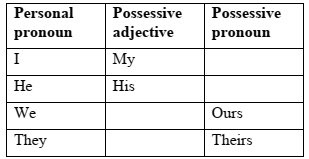
Assinale a alternativa que preenche corretamente os espaços em branco na tabela acima:
Provas
Disciplina: Inglês (Língua Inglesa)
Banca: Avança SP
Orgão: Pref. Louveira-SP
Leia o texto a seguir e responda a questão.
“He remembered the time he had hooked one of a pair of marlin. The male fish always let the female fish feed first and the hooked fish, the female, made a wild, panic-stricken, despairing fight that soon exhausted her, and all the time the male had stayed with her, crossing the line and circling with her on the surface.
He had stayed so close that the old man was afraid he would cut the line with his tail which was sharp as a scythe and almost of that size and shape. When the old man had gaffed her and clubbed her, holding the rapier bill with its sandpaper edge and clubbing her across the top of her head until her colour turned to a colour almost like the backing of mirrors, and then, with the boy’s aid, hoisted her aboard, the male fish had stayed by the side of the boat.
Then, while the old man was clearing the lines and preparing the harpoon, the male fish jumped high into the air beside the boat to see where the female was and then went down deep, his lavender wings, that were his pectoral fins, spread wide and all his wide lavender stripes showing. He was beautiful, the old man remembered, and he had stayed.”
HEMINGWAY, Ernest. The Old Man and the Sea.
Eua: Hueber Verlag, 1952. 108 p.
Provas
Caderno Container