Magna Concursos

Foram encontradas 999 questões.

1497270 Ano: 2018
Disciplina: Inglês (Língua Inglesa)
Banca: UFF
Orgão: Pref. Maricá-RJ
Provas:

Still in practical terms, focusing on lexical terms may be a challenge for the teacher and the student. Penny Ur (2012, p. 69) alerts teachers to the importance of revising vocabulary instead of testing students on it so as to “consolidate and deepen students’ basic knowledge”. It’s important to focus the revision on single-items as well as items in context, using a wide range of exercises, which means, for example:

I conducting dictations.

II having students brainstorm in groups.

III doing a quick bingo.

IV composing stories together.

V finding collocations on websites or dictionaries.

The alternative that best matches the exercises suggested above with their target language is:


Provas

Questão presente nas seguintes provas
1497269 Ano: 2018
Disciplina: Inglês (Língua Inglesa)
Banca: UFF
Orgão: Pref. Maricá-RJ
Provas:
In practical terms, focusing on a grammar topic may be a challenge for the teacher and the student. Using the Passive Voice as mere example, Larsen-Freeman (2003, p. 47) states that “the ultimate challenge of the passive voice is not form” because “although it is a grammatical form, it is not the form that presents the learning challenge”. In her example, focusing on form, teachers may mistakenly choose to introduce the passive as a transformed version of the active, implying they are interchangeable or that all passive sentences include the agent, which is definitely not the case. A good alternative to teaching through form could be to:
 

Provas

Questão presente nas seguintes provas
1497268 Ano: 2018
Disciplina: Inglês (Língua Inglesa)
Banca: UFF
Orgão: Pref. Maricá-RJ
Provas:

According to Larsen-Freeman (2003), it’s possible to assert that focusing on the dynamics of language (grammaring) is very important and it helps improve teaching/ learning abilities because:

I it allows teachers/ learners to understand language as having an organic dynamism that renders it simultaneously flexible (real-time) and stable (over-time).

II teachers/ learners tend to perceive language as an idealized, objectified, atemporal “thing” that can be easily understood by the examination of its parts, which is very limited.

Looking at I and II, the most appropriate conclusion is that:


Provas

Questão presente nas seguintes provas
1497267 Ano: 2018
Disciplina: Inglês (Língua Inglesa)
Banca: UFF
Orgão: Pref. Maricá-RJ
Provas:
Larsen-Freeman (2003, p. 34) asserts that “there is much more of concern in the teaching and learning of grammar than whether or not students produce grammatical forms accurately” and she goes on to say that “the complexity is partly captured by the fact that form is only one of three dimensions, all of which play a part in grammaring”. The other two dimensions she refers to are:
 

Provas

Questão presente nas seguintes provas
1497266 Ano: 2018
Disciplina: Inglês (Língua Inglesa)
Banca: UFF
Orgão: Pref. Maricá-RJ
Provas:
enunciado 1497266-1
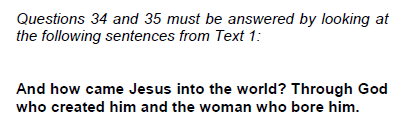
It’s correct to say that “And” and “Through” in the sentences above are used, respectively:
 

Provas

Questão presente nas seguintes provas
1497265 Ano: 2018
Disciplina: Inglês (Língua Inglesa)
Banca: UFF
Orgão: Pref. Maricá-RJ
Provas:
enunciado 1497265-1
Looking at verb “come into” above, it’s correct to say that:
 

Provas

Questão presente nas seguintes provas
1497264 Ano: 2018
Disciplina: Inglês (Língua Inglesa)
Banca: UFF
Orgão: Pref. Maricá-RJ
Provas:
enunciado 1497264-1
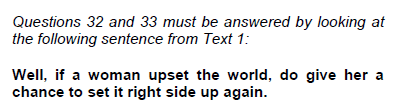
The use of “do” in the sentence is:
 

Provas

Questão presente nas seguintes provas
1497263 Ano: 2018
Disciplina: Inglês (Língua Inglesa)
Banca: UFF
Orgão: Pref. Maricá-RJ
Provas:
enunciado 1497263-1

The use of “well” in the beginning of the sentence is a very common feature of cohesion in spoken discourse and is usually used for:

I softening and correcting.

II gaining time.

III referring to your own expectations.

IV indicating you don’t need any help.

The only correct ways to finish the assertion are:


Provas
Questão presente nas seguintes provas
1497262 Ano: 2018
Disciplina: Inglês (Língua Inglesa)
Banca: UFF
Orgão: Pref. Maricá-RJ
Provas:
enunciado 1497262-1
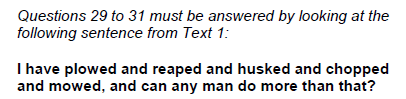
When Sojourner chooses to use “can” in “and can any man do more than that?”, she does it because:
 

Provas

Questão presente nas seguintes provas
1497261 Ano: 2018
Disciplina: Inglês (Língua Inglesa)
Banca: UFF
Orgão: Pref. Maricá-RJ
Provas:
enunciado 1497261-1

About the use of -ed made by Sojourner, identify the correct and incorrect items:

( ) she uses –ed arbitrarily.

( ) she uses –ed to indicate the completeness of the actions.

( ) these words finish in –ed because they mark the perfective aspect of the verbs.

( ) these words finish in –ed because they’re adjectives.

The alternative that best represents the appropriate sequence, top-down, is:


Provas

Questão presente nas seguintes provas