Foram encontradas 122 questões.
Disciplina: Inglês (Língua Inglesa)
Banca: OBJETIVA
Orgão: Pref. Nonoai-RS
Here's why Friday the 13th scares us
Jane Risen, a behavioral scientist at the University of Chicago Booth School of Business, has found that superstitions can influence even nonbelievers. In one 2016 study, Risen found that people who identify as superstitious and non-superstitious both believe a bad outcome is more likely when they've been jinxed. For example, they worry that stating they definitely won't get into a car accident will make it more likely to happen.
“Generally speaking, I find that this occurs because the bad outcome springs to mind and is imagined more clearly following the jinx,” she explains. “People use the ease of imagining something as a cue to its likelihood.”
Fortunately, Risen's research also suggests that performing rituals that ward off bad luck can have surprising results. In a 2014 study, she found that some people use them even when they don't actively believe, and when tested, both types of people reported benefits from such acts.
It's difficult to pin down the origins and evolution of a superstition. But Stuart Vyse, an author and former professor of psychology at Connecticut College in New London, told National Geographic in 2014 that our fear of Friday the 13th may be rooted in religious beliefs surrounding the 13th guest at the Last Supper—Judas, the apostle said to have betrayed Jesus—and the crucifixion of Jesus on a Friday, which was known as hangman's day. The combination of those factors produced a "sort of double whammy of 13 falling on an already nervous day," Vyse explained.
(Fonte: National Geographic - adaptado.)
Concerning the parts of speech, the underlined word in “The combination of those factors…” is classified as:
Provas

Disciplina: Inglês (Língua Inglesa)
Banca: OBJETIVA
Orgão: Pref. Nonoai-RS
Here's why Friday the 13th scares us
Jane Risen, a behavioral scientist at the University of Chicago Booth School of Business, has found that superstitions can influence even nonbelievers. In one 2016 study, Risen found that people who identify as superstitious and non-superstitious both believe a bad outcome is more likely when they've been jinxed. For example, they worry that stating they definitely won't get into a car accident will make it more likely to happen.
“Generally speaking, I find that this occurs because the bad outcome springs to mind and is imagined more clearly following the jinx,” she explains. “People use the ease of imagining something as a cue to its likelihood.”
Fortunately, Risen's research also suggests that performing rituals that ward off bad luck can have surprising results. In a 2014 study, she found that some people use them even when they don't actively believe, and when tested, both types of people reported benefits from such acts.
It's difficult to pin down the origins and evolution of a superstition. But Stuart Vyse, an author and former professor of psychology at Connecticut College in New London, told National Geographic in 2014 that our fear of Friday the 13th may be rooted in religious beliefs surrounding the 13th guest at the Last Supper—Judas, the apostle said to have betrayed Jesus—and the crucifixion of Jesus on a Friday, which was known as hangman's day. The combination of those factors produced a "sort of double whammy of 13 falling on an already nervous day," Vyse explained.
(Fonte: National Geographic - adaptado.)
According to the text, mark the CORRECT alternative:
Provas
Disciplina: Inglês (Língua Inglesa)
Banca: OBJETIVA
Orgão: Pref. Nonoai-RS
Here's why Friday the 13th scares us
Jane Risen, a behavioral scientist at the University of Chicago Booth School of Business, has found that superstitions can influence even nonbelievers. In one 2016 study, Risen found that people who identify as superstitious and non-superstitious both believe a bad outcome is more likely when they've been jinxed. For example, they worry that stating they definitely won't get into a car accident will make it more likely to happen.
“Generally speaking, I find that this occurs because the bad outcome springs to mind and is imagined more clearly following the jinx,” she explains. “People use the ease of imagining something as a cue to its likelihood.”
, Risen's research also suggests that performing rituals that ward off bad luck can have surprising results. In a 2014 study, she found that some people use them even when they don't actively believe, and when tested, both types of people reported benefits from such acts.
It's difficult to pin down the origins and evolution of a superstition. But Stuart Vyse, an author and former of psychology at Connecticut College in New London, told National Geographic in 2014 that our fear of Friday the 13th may be rooted in religious beliefs surrounding the 13th guest at the Last Supper—Judas, the apostle said to have betrayed Jesus—and the of Jesus on a Friday, which was known as hangman's day. The combination of those factors produced a "sort of double whammy of 13 falling on an already nervous day," Vyse explained.
(Fonte: National Geographic - adaptado.)
Check the alternative that CORRECTLY fills the gaps in the text:
Provas
Disciplina: Inglês (Língua Inglesa)
Banca: OBJETIVA
Orgão: Pref. Nonoai-RS
Here's why Friday the 13th scares us
Jane Risen, a behavioral scientist at the University of Chicago Booth School of Business, has found that superstitions can influence even nonbelievers. In one 2016 study, Risen found that people who identify as superstitious and non-superstitious both believe a bad outcome is more likely when they've been jinxed. For example, they worry that stating they definitely won't get into a car accident will make it more likely to happen.
“Generally speaking, I find that this occurs because the bad outcome springs to mind and is imagined more clearly following the jinx,” she explains. “People use the ease of imagining something as a cue to its likelihood.”
Fortunately, Risen's research also suggests that performing rituals that ward off bad luck can have surprising results. In a 2014 study, she found that some people use them even when they don't actively believe, and when tested, both types of people reported benefits from such acts.
It's difficult to pin down the origins and evolution of a superstition. But Stuart Vyse, an author and former professor of psychology at Connecticut College in New London, told National Geographic in 2014 that our fear of Friday the 13th may be rooted in religious beliefs surrounding the 13th guest at the Last Supper—Judas, the apostle said to have betrayed Jesus—and the crucifixion of Jesus on a Friday, which was known as hangman's day. The combination of those factors produced a "sort of double whammy of 13 falling on an already nervous day," Vyse explained.
(Fonte: National Geographic - adaptado.)
In “They worry that stating they definitely won't get into a car accident will make it more likely to happen”, the underlined word can be substituted without loss of meaning by:
Provas
Disciplina: Inglês (Língua Inglesa)
Banca: OBJETIVA
Orgão: Pref. Nonoai-RS
A Base Nacional Comum Curricular estabelece eixos organizadores que estão intrinsecamente ligados nas práticas sociais de usos da língua inglesa. A respeito dos eixos organizadores propostos para o ensino da Língua Inglesa, analisar os itens abaixo:
I. O eixo dimensão intercultural envolve a reflexão sobre aspectos relativos à interação entre culturas (dos alunos e aquelas relacionadas a demais falantes de língua inglesa), de modo a favorecer o convívio, o respeito, a superação de conflitos e a valorização da diversidade entre os povos.
II. O eixo oralidade envolve as práticas de compreensão e produção oral de língua inglesa, em diferentes contextos discursivos presenciais ou simulados, com repertório de falas diversas, incluída a fala do professor.
III. O eixo conhecimentos linguísticos envolve práticas de produção de textos em língua inglesa relacionados ao cotidiano dos alunos, em diferentes suportes e esferas de circulação. Tais práticas envolvem a escrita mediada pelo professor ou colegas e articulada com os conhecimentos prévios dos alunos em língua materna e/ou outras línguas.
Estão CORRETOS:
Provas
Certa pirâmide com base quadrada possui altura igual 12 cm. Sabendo-se que o volume dessa pirâmide é igual a 16 cm³, qual a medida do lado do quadrado que é base dessa pirâmide?
Provas
Assinalar a alternativa que apresenta a quantidade total de anagramas da palavra ABACAXI que começam com a letra X:
Provas
Considerando-se a função !$ f(x) = \begin{cases} x, x < 1 \\ 2^{x-1}, 1 \le x \le 4 \\ x^2 - 2x +1, x > 4 \end{cases} !$, analisar os itens abaixo:
I. A função !$ f(x) !$ é contínua em todo o seu domínio.
II.!$ ^{\large{\text{lim}}}_{x \rightarrow 4^+} f(x) = 9 !$
III.!$ ^{\large{\text{lim}}}_{x \rightarrow 1^-} f(x) = \ ^{\large{\text{lim}}}_{x \rightarrow 1^+} f(x) !$
Estão CORRETOS:
Provas
Sejam a, b, c números naturais diferentes de zero tais que a + b + c = 52, MMC (a, b, c) = 48 e MDC (a, b, c) = 4 Nessas condições, assinalar a alternativa CORRETA:
Provas
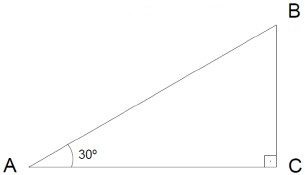
Três cidades diferentes, A, B e C são interligadas por estradas conforme a figura abaixo. Sabendo-se que a distância entre as cidades AC é de 30km, que o ângulo entre AB e AC é de 30º e que o triângulo ABC é retângulo em C, assinalar a alternativa que corresponde ao tamanho da estrada entre B e C. (Dado: tg 30º = 0,58)
Provas
Caderno Container