Foram encontradas 1.331 questões.
2565802
Ano: 2019
Disciplina: Inglês (Língua Inglesa)
Banca: FUNDEP
Orgão: Pref. Uberlândia-MG
Disciplina: Inglês (Língua Inglesa)
Banca: FUNDEP
Orgão: Pref. Uberlândia-MG
Provas:
TEXT I
Using authentic reading materials in FLT
Let us discuss what reading in a foreign language is, how it differs from reading in one’s mother-tongue. If the foreign language learners are poor readers in their mother-tongue, we can’t expect them to read efficiently in the foreign language. But if they are good readers in their mother-tongue, we expect them to transfer their reading strategies to the foreign language automatically. Unfortunately, this doesn’t always happen. Automatic transfer of reading strategies from L1 to L2 is difficult or never occurs. Good readers use top-down and bottom-up strategies to make predictions about the meaning of the text and check them. They vary their reading speed and strategies according to the purpose for their reading and the type of the text. When the same students read a text in the foreign language, they tend to use bottom-up strategies, i.e. their linguistic knowledge, but they rarely dare to use top-down strategies, i.e. their knowledge about the world. Appropriate reading strategies are rarely used and even some faulty reading habits, e.g. subvocalizing, regressive eye movements, etc., can be observed. So, foreign language students usually need more reading practice in order to become efficient readers in the foreign language. The use of authentic materials is an important principle of Communicative Language Teaching. In real life we read because we are interested in the communicative purpose of the text, in the ideas that the writer has expressed or the effect that the text is supposed to produce on the reader. The language in an authentic text is varied, whereas in a non-authentic one there is often one single structure that is repeated. The use of truly authentic texts is an important means of teaching students to communicate effectively.
Unfortunately, most textbooks make use of non-authentic texts. They are supposed to be easier than authentic ones and to be better suited to the students’ language proficiency level. However, this is not true because:
• non-authentic texts are usually over-explicit: they say too much because they lack the natural redundancy of authentic ones, they abound with details, so, the students are not given the chance to make any inferences;
• textbook reading materials usually deal with over-familiar topics. This can hardly be avoided at beginner level but at the higher levels the reading texts can be more informative, enjoyable and interesting;
• there is often a noticeable emphasis on the product of the activity, i.e. on the answers to the comprehension questions, over the process, i.e. the appropriate use of reading skills and strategies in order to understand the text.
We can overcome these shortcomings quite successfully if we provide supplementary authentic texts. Thus the language learners will become better readers, confident in their ability to cope with reading in real life situations.
So, why do we read? In our daily lives we read for two basic reasons: for pleasure and for information (Grellet, 1981:4). We read for information because we want to find out something, to learn something from the text, or for instruction, in order to do something with the information we get, to find out how to act. These reasons for reading are authentic. […]
Having mentioned the major drawbacks of textbook reading materials, let’s now consider the guidelines for selecting a text to supplement them or even replace them. These are the readability, the suitability of content and the exploitability of the authentic text (Nuttal, 1982:25).
• Readability means that the text should be at the right level. When we try to find a readable text, we have to assess the level of its structural and lexical difficulty. Still, we should not forget that the students can deal with more difficult texts, provided the task is not too difficult.
• Suitability of content means that the text should be interesting and informative. The students’ preferences should not be neglected and a survey of their tastes might help the teacher quite a lot.
• Exploitability means that the text should facilitate the development of reading skills in order to help the students become competent and independent readers.
However, we shouldn’t forget the fact that language classes are not entirely homogeneous: the level of the students is not the same, their tastes may vary and it is virtually impossible to create an ideal reader who could tackle all existing texts successfully. So, our goals and criteria should be realistic.
[…]
What should be pointed out in conclusion is the vital importance of using authentic texts as supplements to textbook reading materials in order to prepare students for real life reading. Authentic texts foster the development of their reading skills thus helping them gain confidence in their reading ability in the foreign language. They become autonomous readers, who can take responsibility for their own reading.
Available at: <https://www.beta-iatefl.org/1106/blogpublications>.
Accessed on: July 9th, 2019. (Adapted).
According to the text, the strategies used by readers vary
Provas
Questão presente nas seguintes provas

2565801
Ano: 2019
Disciplina: Inglês (Língua Inglesa)
Banca: FUNDEP
Orgão: Pref. Uberlândia-MG
Disciplina: Inglês (Língua Inglesa)
Banca: FUNDEP
Orgão: Pref. Uberlândia-MG
Provas:
TEXT I
Using authentic reading materials in FLT
Let us discuss what reading in a foreign language is, how it differs from reading in one’s mother-tongue. If the foreign language learners are poor readers in their mother-tongue, we can’t expect them to read efficiently in the foreign language. But if they are good readers in their mother-tongue, we expect them to transfer their reading strategies to the foreign language automatically. Unfortunately, this doesn’t always happen. Automatic transfer of reading strategies from L1 to L2 is difficult or never occurs. Good readers use top-down and bottom-up strategies to make predictions about the meaning of the text and check them. They vary their reading speed and strategies according to the purpose for their reading and the type of the text. When the same students read a text in the foreign language, they tend to use bottom-up strategies, i.e. their linguistic knowledge, but they rarely dare to use top-down strategies, i.e. their knowledge about the world. Appropriate reading strategies are rarely used and even some faulty reading habits, e.g. subvocalizing, regressive eye movements, etc., can be observed. So, foreign language students usually need more reading practice in order to become efficient readers in the foreign language. The use of authentic materials is an important principle of Communicative Language Teaching. In real life we read because we are interested in the communicative purpose of the text, in the ideas that the writer has expressed or the effect that the text is supposed to produce on the reader. The language in an authentic text is varied, whereas in a non-authentic one there is often one single structure that is repeated. The use of truly authentic texts is an important means of teaching students to communicate effectively.
Unfortunately, most textbooks make use of non-authentic texts. They are supposed to be easier than authentic ones and to be better suited to the students’ language proficiency level. However, this is not true because:
• non-authentic texts are usually over-explicit: they say too much because they lack the natural redundancy of authentic ones, they abound with details, so, the students are not given the chance to make any inferences;
• textbook reading materials usually deal with over-familiar topics. This can hardly be avoided at beginner level but at the higher levels the reading texts can be more informative, enjoyable and interesting;
• there is often a noticeable emphasis on the product of the activity, i.e. on the answers to the comprehension questions, over the process, i.e. the appropriate use of reading skills and strategies in order to understand the text.
We can overcome these shortcomings quite successfully if we provide supplementary authentic texts. Thus the language learners will become better readers, confident in their ability to cope with reading in real life situations.
So, why do we read? In our daily lives we read for two basic reasons: for pleasure and for information (Grellet, 1981:4). We read for information because we want to find out something, to learn something from the text, or for instruction, in order to do something with the information we get, to find out how to act. These reasons for reading are authentic. […]
Having mentioned the major drawbacks of textbook reading materials, let’s now consider the guidelines for selecting a text to supplement them or even replace them. These are the readability, the suitability of content and the exploitability of the authentic text (Nuttal, 1982:25).
• Readability means that the text should be at the right level. When we try to find a readable text, we have to assess the level of its structural and lexical difficulty. Still, we should not forget that the students can deal with more difficult texts, provided the task is not too difficult.
• Suitability of content means that the text should be interesting and informative. The students’ preferences should not be neglected and a survey of their tastes might help the teacher quite a lot.
• Exploitability means that the text should facilitate the development of reading skills in order to help the students become competent and independent readers.
However, we shouldn’t forget the fact that language classes are not entirely homogeneous: the level of the students is not the same, their tastes may vary and it is virtually impossible to create an ideal reader who could tackle all existing texts successfully. So, our goals and criteria should be realistic.
[…]
What should be pointed out in conclusion is the vital importance of using authentic texts as supplements to textbook reading materials in order to prepare students for real life reading. Authentic texts foster the development of their reading skills thus helping them gain confidence in their reading ability in the foreign language. They become autonomous readers, who can take responsibility for their own reading.
Available at: <https://www.beta-iatefl.org/1106/blogpublications>.
Accessed on: July 9th, 2019. (Adapted).
According to the text, a good reader in the mother tongue usually
Provas
Questão presente nas seguintes provas
Analise a tabela a seguir, que apresenta dados da estrutura etária da população de Uberlândia / MG nos anos de 1991, 2000 e 2010.
| Estrutura Etária | População (1991) | % do Total (1991) | População (2000) | % do Total (2000) | População (2010) | % do Total (2010) |
| Menos de 15 anos | 114.336 | 31,15 | 130.935 | 26,12 | 125.589 | 20,79 |
| 15 a 64 anos | 238.355 | 64,94 | 345.611 | 68,95 | 437.111 | 72,37 |
| População de 65 anos ou mais | 14.370 | 3,91 | 24.668 | 4,92 | 41.313 | 6,84 |
Disponível em: <http://www.atlasbrasil.org.br/2013/pt/perfil_m/uberlandia_mg>. Acesso em: 09 jul. 2019.
Com base nessas informações, assinale a alternativa incorreta.
Provas
Questão presente nas seguintes provas
No ano de 2002, a Libras foi reconhecida como língua no Brasil.
São contribuições desse reconhecimento legal, exceto:
Provas
Questão presente nas seguintes provas
De acordo com a história da Educação Especial e Inclusiva, assinale a alternativa correta.
Provas
Questão presente nas seguintes provas
Assinale a alternativa correta acerca da deficiência intelectual.
Provas
Questão presente nas seguintes provas
As imagens a seguir são exemplos de recursos de tecnologia assistiva aplicada na educação em uma perspectiva inclusiva.
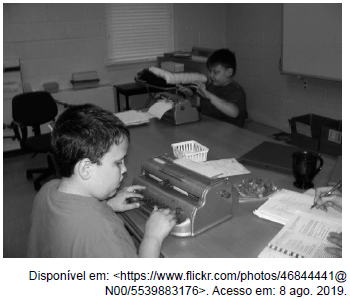
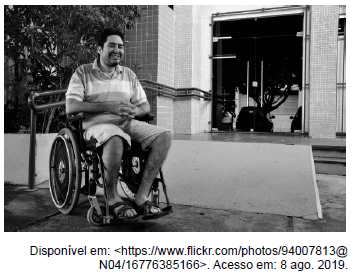
São modalidades de tecnologia assistiva que podem ser identificadas nessas imagens, exceto:
Provas
Questão presente nas seguintes provas
No que se refere à organização e à oferta do atendimento educacional especializado, relacione a COLUNA II com a COLUNA I, associando as atribuições do professor de Atendimento Educacional Especializado a suas respectivas funções.
COLUNA I
1. Estudo de caso
2. Plano de atendimento educacional especializado
3. Organização de recursos e serviços
4. Avaliação das ações e reestruturação do plano
COLUNA II
( ) Definir objetivos, o tipo de atendimento, os materiais que deverão ser produzidos e a frequência do aluno ao atendimento na SRM.
( ) Conhecer o aluno, com sua história de vida, sua individualidade, seus desejos e diferenças.
( ) Buscar parceria com a família dos alunos, com parceiros intersetoriais e com a comunidade na qual a escola está inserida(o) a fim de avaliar as ações empreendidas no AEE e de propor parcerias no âmbito escolar e social.
( ) Adequar materiais pedagógicos e de tecnologia assistiva de acordo com as necessidades educacionais especiais do aluno.
Assinale a sequência correta.
Provas
Questão presente nas seguintes provas
O atendimento educacional especializado deve ser uma ação dos sistemas de ensino para acolher a diversidade ao longo do processo educativo. É realizado mediante a atuação de professores com conhecimentos específicos para atender às necessidades educacionais especiais.
São alguns desses conhecimentos específicos, exceto:
Provas
Questão presente nas seguintes provas
Acerca da deficiência física, assinale a alternativa incorreta.
Provas
Questão presente nas seguintes provas
Cadernos
Caderno Container