Foram encontradas 50 questões.
TEXT 1
REFERS TO QUESTION FROM
Lessons for Americans, From a Chines Classroom
Observing how Chinese 2- and 3-year-olds navigated a second language, I wondered whether I could have done this for my children.
SHANGHAI — We sat in toddler-size wooden chairs around an orderly circle of Chinese 2-year-olds, busy with circle time. As a parent of three children who collectively spent 15 years in American day care, I am very familiar with circle time.
But I was in this Shanghai classroom as a professor, with college students from many different countries in a class I’m teaching here on children and childhood.
We were observing in a private kindergarten, designed to provide young children — starting at age 2 — with a carefully structured, fully bilingual curriculum, especially important because English language skills are vital for educational success in China.
Visits to Chinese educational institutions allow the college students in my course to get a look at real children and the ways that they learn, while also thinking about Chinese society today. They get windows onto certain slices of this complex country: a high-end private bilingual program that starts with toddlers; a city high school for academically gifted students; a middle school created for the children of the rural migrants who have come by the millions from China’s poorer provinces to work in Shanghai, but whose rights to social benefits are severely limited in the city.
These visits offer the college students insights into many of the social issues facing China, and we spend time in class discussing questions like the huge role that the annual gaokao college entrance exam plays in determining a child’s educational destiny (English is one of the required subjects), the pressures on families that create a culture of cram schools, and the controversies over reserving spots in colleges for kids from rural areas.
But all of those questions have powerful resonances when you think about the issues of childhood education and child development, which have to be addressed in every country. As my college students discuss the different facets of childhood around the world, visiting the Chinese schools also helps them in remembering and thinking about what children look like at different ages, and how they play and interact and learn.
Available in : https://www.nytimes.com/2020/01/20/, accessed on February 26th, 2020. Adapted
Which option has a tag question that completes the following sentence correctly?
“I am very familiar with circle time, ”
Provas

TEXT 1
REFERS TO QUESTION FROM
Lessons for Americans, From a Chines Classroom
Observing how Chinese 2- and 3-year-olds navigated a second language, I wondered whether I could have done this for my children.
SHANGHAI — We sat in toddler-size wooden chairs around an orderly circle of Chinese 2-year-olds, busy with circle time. As a parent of three children who collectively spent 15 years in American day care, I am very familiar with circle time.
But I was in this Shanghai classroom as a professor, with college students from many different countries in a class I’m teaching here on children and childhood.
We were observing in a private kindergarten, designed to provide young children — starting at age 2 — with a carefully structured, fully bilingual curriculum, especially important because English language skills are vital for educational success in China.
Visits to Chinese educational institutions allow the college students in my course to get a look at real children and the ways that they learn, while also thinking about Chinese society today. They get windows onto certain slices of this complex country: a high-end private bilingual program that starts with toddlers; a city high school for academically gifted students; a middle school created for the children of the rural migrants who have come by the millions from China’s poorer provinces to work in Shanghai, but whose rights to social benefits are severely limited in the city.
These visits offer the college students insights into many of the social issues facing China, and we spend time in class discussing questions like the huge role that the annual gaokao college entrance exam plays in determining a child’s educational destiny (English is one of the required subjects), the pressures on families that create a culture of cram schools, and the controversies over reserving spots in colleges for kids from rural areas.
But all of those questions have powerful resonances when you think about the issues of childhood education and child development, which have to be addressed in every country. As my college students discuss the different facets of childhood around the world, visiting the Chinese schools also helps them in remembering and thinking about what children look like at different ages, and how they play and interact and learn.
Available in : https://www.nytimes.com/2020/01/20/, accessed on February 26th, 2020. Adapted
The expression LOOK LIKE in “thinking about what children look like at different ages” could be replaced in this context, without change of meaning, by:
Provas
TEXT 1
REFERS TO QUESTION FROM
Lessons for Americans, From a Chines Classroom
Observing how Chinese 2- and 3-year-olds navigated a second language, I wondered whether I could have done this for my children.
SHANGHAI — We sat in toddler-size wooden chairse around an orderly circle of Chinese 2-year-olds, busy with circle time. As a parent of three children who collectively spent 15 years in American day care, I am very familiar with circle time.
But I was in this Shanghai classroom as a professor, with college students from many different countriesb in a class I’m teaching here on children and childhood.
We were observing in a private kindergarten, designed to provide young children — starting at age 2 — with a carefully structured, fully bilingual curriculum, especially important because English language skills are vital for educational success in China.
Visits to Chinese educational institutions allow the college students in my course to get a look at real children and the ways that they learn, while also thinking about Chinese society today. They get windows onto certain slices of this complex country: a high-end private bilingual program that starts with toddlers; a city high school for academically gifted students; a middle school created for the children of the rural migrants who have come by the millions from China’s poorer provinces to work in Shanghai, but whose rights to social benefits are severely limited in the city.
These visits offer the college students insightsc into many of the social issues facing China, and we spend time in class discussing questions like the huge role that the annual gaokao college entrance exam plays in determining a child’s educational destiny (English is one of the required subjects), the pressures on families that create a culture of cram schools, and the controversies over reserving spotsd in colleges for kids from rural areas.
But all of those questions have powerful resonancesa when you think about the issues of childhood education and child development, which have to be addressed in every country. As my college students discuss the different facets of childhood around the world, visiting the Chinese schools also helps them in remembering and thinking about what children look like at different ages, and how they play and interact and learn.
Available in : https://www.nytimes.com/2020/01/20/, accessed on February 26th, 2020. Adapted
Read the sentences below and choose one which has a verb in the Simple Past.
Provas
TEXT 1
REFERS TO QUESTION FROM
Lessons for Americans, From a Chines Classroom
Observing how Chinese 2- and 3-year-olds navigated a second language, I wondered whether I could have done this for my children.
SHANGHAI — We sat in toddler-size wooden chairs around an orderly circle of Chinese 2-year-olds, busy with circle time. As a parent of three children who collectively spent 15 years in American day care, I am very familiar with circle time.
But I was in this Shanghai classroom as a professor, with college students from many different countries in a class I’m teaching here on children and childhood.
We were observing in a private kindergarten, designed to provide young children — starting at age 2 — with a carefully structured, fully bilingual curriculum, especially important because English language skills are vital for educational success in China.
Visits to Chinese educational institutions allow the college students in my course to get a look at real children and the ways that they learn, while also thinking about Chinese society today. They get windows onto certain slices of this complex country: a high-end private bilingual program that starts with toddlers; a city high school for academically gifted students; a middle school created for the children of the rural migrants who have come by the millions from China’s poorer provinces to work in Shanghai, but whose rights to social benefits are severely limited in the city.
These visits offer the college students insights into many of the social issues facing China, and we spend time in class discussing questions like the huge role that the annual gaokao college entrance exam plays in determining a child’s educational destiny (English is one of the required subjects), the pressures on families that create a culture of cram schools, and the controversies over reserving spots in colleges for kids from rural areas.
But all of those questions have powerful resonances when you think about the issues of childhood education and child development, which have to be addressed in every country. As my college students discuss the different facets of childhood around the world, visiting the Chinese schools also helps them in remembering and thinking about what children look like at different ages, and how they play and interact and learn.
Available in : https://www.nytimes.com/2020/01/20/, accessed on February 26th, 2020. Adapted
The word WHO is:
Provas
REFERS TO QUESTION FROM

Available in: https://www.gocomics.com, accessed on February 18th, 2020. Garfield by Jim Davis
Choose correct meaning for MISSUS as in: “So what did you get the missus this year?”
Provas
REFERS TO QUESTION FROM
Available in: https://www.gocomics.com, accessed on February 18th, 2020. Garfield by Jim Davis
Read the sentences below and choose the one that has a verb which could replace ALLOW and keep the same meaning as in “Visits to Chinese educational institutions allow the college students in my course to get a look at real children”.
Provas
Texto 2
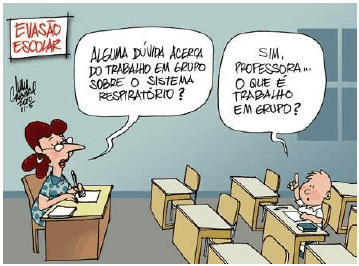
Na fala da professora “Alguma dúvida acerca do trabalho em grupo sobre o sistema respiratório?”, o emprego de ‘acerca de’ está correto. Assinale a alternativa com devido uso também.
Provas
Texto 1 - Evasão escolar
Uma pesquisa recente do Banco Mundial revelou que 52% dos jovens brasileiros entre 19 a 25 anos largaram os estudos, não se dedicam minimamente à escola ou estão com a formação atrasada. O dado é alarmante.
A mesma pesquisa ainda nos revela outras informações, como o fato de que, atualmente, 43% da população no Brasil acima dos 25 anos não completaram o Ensino Médio.
Contrariando o senso comum de que a maior causa da evasão escolar é os jovens deixarem as salas de aula para trabalharem, o abandono da escola começa com faltas esporádicas, devido à falta de interesse do aluno.
Mesmo entre a juventude que continua nas salas de aula – contando adolescentes e jovens acima dos 18 anos -, constata-se que 62% não estudam no ano adequado a sua idade.
A partir dos dados acima, é necessário fazer um levantamento das principais causas da evasão escolar a fim de entender a raiz desse problema, portanto destacam-se:
Distância - principalmente entre os alunos da educação infantil e do começo do ensino fundamental, a distância entre a residência e a escola pode ser um fator determinante para a ausência do aluno das salas de aula. A oferta de transporte escolar por parte de órgãos públicos poderia ser uma solução viável para esse problema.
• Desinteresse - mais presente entre alunos do final do ensino fundamental ou do ensino médio, o desinteresse é a principal causa da evasão escolar. Criticado por educadores, o atual sistema de ensino é considerado ultrapassado. Profissionais do ramo acreditam que o tradicional “aluno em carteiras enfileiradas e um professor na frente da sala” não funciona mais como outrora, sendo cada vez mais necessária uma mudança.
• Situação econômica desfavorável - relacionada às duas causas citadas, faz-se necessário mais um contribuinte para pagar as contas de casa – acarretando, então, no abandono da escola pelo jovem e a consequente inserção precoce no mercado de trabalho.
Essa causa é uma das mais comuns para a evasão escolar. Não conseguindo conciliar os estudos com as atividades laborais, o jovem prefere trabalhar com o que der desde cedo para conseguir sua autonomia financeira – mesmo que com um baixo salário.
A não conclusão dos estudos, no entanto, faz com que esse jovem seja classificado com uma baixa qualificação perante outros concorrentes formados.
(Fonte: texto adaptado de https://escolaweb.com.br/artigos/conheca-as-principais-causas-da-evasao-escolar/, acesso em fevereiro de 2020.)
Em “43% da população no Brasil não completaram o Ensino Médio.”, a concordância do verbo destacado encontra-se:
Provas
Texto 1 - Evasão escolar
Uma pesquisa recente do Banco Mundial revelou que 52% dos jovens brasileiros entre 19 a 25 anos largaram os estudos, não se dedicam minimamente à escola ou estão com a formação atrasada. O dado é alarmante.
A mesma pesquisa ainda nos revela outras informações, como o fato de que, atualmente, 43% da população no Brasil acima dos 25 anos não completaram o Ensino Médio.
Contrariando o senso comum de que a maior causa da evasão escolar é os jovens deixarem as salas de aula para trabalharem, o abandono da escola começa com faltas esporádicas, devido à falta de interesse do aluno.
Mesmo entre a juventude que continua nas salas de aula – contando adolescentes e jovens acima dos 18 anos -, constata-se que 62% não estudam no ano adequado a sua idade.
A partir dos dados acima, é necessário fazer um levantamento das principais causas da evasão escolar a fim de entender a raiz desse problema, portanto destacam-se:
Distância - principalmente entre os alunos da educação infantil e do começo do ensino fundamental, a distância entre a residência e a escola pode ser um fator determinante para a ausência do aluno das salas de aula. A oferta de transporte escolar por parte de órgãos públicos poderia ser uma solução viável para esse problema.
• Desinteresse - mais presente entre alunos do final do ensino fundamental ou do ensino médio, o desinteresse é a principal causa da evasão escolar. Criticado por educadores, o atual sistema de ensino é considerado ultrapassado. Profissionais do ramo acreditam que o tradicional “aluno em carteiras enfileiradas e um professor na frente da sala” não funciona mais como outrora, sendo cada vez mais necessária uma mudança.
• Situação econômica desfavorável - relacionada às duas causas citadas, faz-se necessário mais um contribuinte para pagar as contas de casa – acarretando, então, no abandono da escola pelo jovem e a consequente inserção precoce no mercado de trabalho.
Essa causa é uma das mais comuns para a evasão escolar. Não conseguindo conciliar os estudos com as atividades laborais, o jovem prefere trabalhar com o que der desde cedo para conseguir sua autonomia financeira – mesmo que com um baixo salário.
A não conclusão dos estudos, no entanto, faz com que esse jovem seja classificado com uma baixa qualificação perante outros concorrentes formados.
(Fonte: texto adaptado de https://escolaweb.com.br/artigos/conheca-as-principais-causas-da-evasao-escolar/, acesso em fevereiro de 2020.)
Em “Profissionais do ramo acreditam que o tradicional ‘aluno em carteiras enfileiradas e um professor na frente da sala’ não funciona mais como outrora,...”, o vocábulo destacado poderia ser substituído sem prejuízo significativo por:
Provas
Texto 1 - Evasão escolar
Uma pesquisa recente do Banco Mundial revelou que 52% dos jovens brasileiros entre 19 a 25 anos largaram os estudos, não se dedicam minimamente à escola ou estão com a formação atrasada. O dado é alarmante.
A mesma pesquisa ainda nos revela outras informações, como o fato de que, atualmente, 43% da população no Brasil acima dos 25 anos não completaram o Ensino Médio.
Contrariando o senso comum de que a maior causa da evasão escolar é os jovens deixarem as salas de aula para trabalharem, o abandono da escola começa com faltas esporádicas, devido à falta de interesse do aluno.
Mesmo entre a juventude que continua nas salas de aula – contando adolescentes e jovens acima dos 18 anos -, constata-se que 62% não estudam no ano adequado a sua idade.
A partir dos dados acima, é necessário fazer um levantamento das principais causas da evasão escolar a fim de entender a raiz desse problema, portanto destacam-se:
Distância - principalmente entre os alunos da educação infantil e do começo do ensino fundamental, a distância entre a residência e a escola pode ser um fator determinante para a ausência do aluno das salas de aula. A oferta de transporte escolar por parte de órgãos públicos poderia ser uma solução viável para esse problema.
• Desinteresse - mais presente entre alunos do final do ensino fundamental ou do ensino médio, o desinteresse é a principal causa da evasão escolar. Criticado por educadores, o atual sistema de ensino é considerado ultrapassado. Profissionais do ramo acreditam que o tradicional “aluno em carteiras enfileiradas e um professor na frente da sala” não funciona mais como outrora, sendo cada vez mais necessária uma mudança.
• Situação econômica desfavorável - relacionada às duas causas citadas, faz-se necessário mais um contribuinte para pagar as contas de casa – acarretando, então, no abandono da escola pelo jovem e a consequente inserção precoce no mercado de trabalho.
Essa causa é uma das mais comuns para a evasão escolar. Não conseguindo conciliar os estudos com as atividades laborais, o jovem prefere trabalhar com o que der desde cedo para conseguir sua autonomia financeira – mesmo que com um baixo salário.
A não conclusão dos estudos, no entanto, faz com que esse jovem seja classificado com uma baixa qualificação perante outros concorrentes formados.
(Fonte: texto adaptado de https://escolaweb.com.br/artigos/conheca-as-principais-causas-da-evasao-escolar/, acesso em fevereiro de 2020.)
Marque a alternativa com característica que se destaca após a leitura e compreensão do texto:
Provas
Caderno Container