Foram encontradas 819 questões.
1247970
Ano: 2013
Disciplina: Direito Cultural, Desportivo e da Comunicação
Banca: UFSC
Orgão: UFSC
Disciplina: Direito Cultural, Desportivo e da Comunicação
Banca: UFSC
Orgão: UFSC
Provas:
Em uma saída de sinal, a 100% Dry de um Processador de multi-efeitos corresponde a:
Provas
Questão presente nas seguintes provas

O LibreOffice é uma suíte de escritório livre e aberta, compatível com as principais suítes de escritório do mercado e disponível para Windows, Linux e MACOS-X. Assinale a alternativa correspondente aos programas que compõem a suíte LibreOffice.
Provas
Questão presente nas seguintes provas
A cota em que deve ser deixado o topo de uma estaca ou tubulão, demolido ou cortado o excesso, de forma que a estaca penetre no bloco de coroamento, considerando um comprimento que satisfaça a transferência de esforços do bloco à(s) estaca(s) ou tubulão(ões), denomina-se:
Provas
Questão presente nas seguintes provas
Read the description below:
“Interpreters/translators shall not counsel, refer, give advice, or express personal opinions to individuals for whom they are interpreting/translating, or engage in any other activities that may be construed to constitute a service other than interpreting/translating.”
(Source: http://www.dshs.wa.gov/ltc/ethics.shtml)
Bearing in mind the Translator's Code of Ethics, it refers to:
Provas
Questão presente nas seguintes provas
A densidade, em g !$ L^{–1} !$, do gás hélio a 27 ºC e 0,82 atm, considerando os dados a seguir, é:
Dados: T(K) = T(ºC) + 273; PV = nRT; R = 0,082 atm L mol!$ ^{–1} !$ K!$ ^{–1} !$, Massa molar do He = 4 g mol!$ ^{–1} !$
Provas
Questão presente nas seguintes provas
A partir do fragmento de planilha de Excel mostrado na figura a seguir, analise os itens I a III.
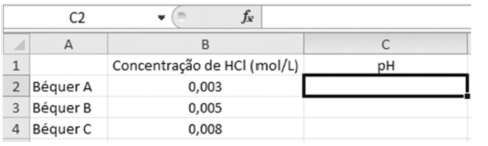
I) O pH da solução contida no béquer A pode ser calculado na célula C2 digitando = –log(B2)
II) A média dos pH das soluções contidas nos béqueres A, B e C pode ser obtida digitando-se em outra célula =MEDIA(C2:C4).
III) Pode-se transformar a coluna B em uma linha utilizando a opção Transpor.
Está(ão) CORRETO(s):
Provas
Questão presente nas seguintes provas
Um aquecedor elétrico possui três resistências elétricas, cada uma com 6 Ω, que podem ser ligadas de forma independente por meio de três chaves diferentes. Se o usuário inicialmente liga apenas uma das resistências, meia hora depois, liga a segunda e, posteriormente, acaba ligando a terceira resistência e, se o aquecedor está ligado a uma fonte de tensão de 120V, os três valores de potência elétrica são, respectivamente:
Provas
Questão presente nas seguintes provas
Introduction
The Census Bureau’s Methodology and Standards Council sets statistical standards for the Census Bureau’s surveys and censuses. This responsibility encompasses providing guidelines for the translation of Census Bureau data collection instruments and related materials. This guideline provides direction to program managers to help them and their teams ensure that Census Bureau data collection instruments and related materials that are translated from a source language into a target language are of the highest quality possible, given available resources.
Translation Guideline
The Census Bureau developed guidelines for the translation of data collection instruments and supporting materials in order to ensure that such documents translated from a source language into a target language are reliable, complete, accurate, and culturally appropriate. When the translated text conveys the intended meaning of the original text, the translation is deemed reliable. Translations that do not add any new information to the translated document and do not omit information provided in the source document are said to be complete. An accurate translation is one that is free of spelling and grammatical errors. Cultural appropriateness is achieved when the message conveyed in the translated text is appropriate for the target population. In addition to meeting the aforementioned criteria, translated Census Bureau data collection instruments and related materials should also have semantic, conceptual, and normative equivalence.
The matter of equivalence and the extent to which there is equivalence (to the source language) in the translated text is central to the quality and appropriateness of a translation. If the translation lacks equivalence, then the intended meaning of the information in the source language text is not appropriately conveyed in the translation. The literature points to several types of equivalence. Semantic equivalence refers to the extent to which the terms and sentence structures that give meaning to the information presented in the source language is maintained in the translated text. Conceptual equivalence concerns the degree to which a given concept is present in both the source and target cultures, regardless of the words used to express the concept. The third main type of equivalence discussed in the research literature is normative equivalence. This form of equivalence refers to the extent to which the translated text successfully addresses the difficulties created by differences in societal rules between the source and target cultures.
Census Bureau research conducted for the development of the translation guideline showed that there is considerable evidence in the field of survey methodology and crosscultural research that translated questionnaires which lack the features noted above are not of the highest possible quality and that data obtained from such instruments may not necessarily be comparable to data collected using the source language instrument.
Adapted from <http://www.census.gov/srd/papers/pdf/rsm2005-06.pdf> Acesso em 20 nov. 2013)
The best translation to the phrase “given available resources” in the Introduction is:
Provas
Questão presente nas seguintes provas
Which kind of interpretation is described below?
“The interpreter listens to a unit of the source language, often making notes, then delivers a translation of the content after the original speaker. This type is often used for meetings, seminars, speeches, presentations, and so on where the listeners all understand one of two languages. It does not require any special equipment. Often the interpreter will have a microphone and interpret the source language from off-stage; at other times the interpreter will be alongside the speaker.” (http://www.lan-bridge.co.uk/types-of-interpretation/)
Provas
Questão presente nas seguintes provas
A imagem a seguir é referente ao diagrama de fases sólido-líquido das espécies E1 e E2. Com base nos sistemas simbolizados pelas letras a, b, c, d, analise os itens a seguir:
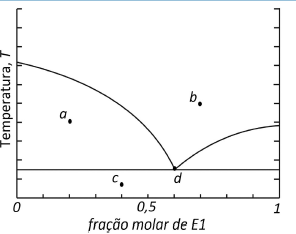
I) O sistema “a” possui duas fases, uma sólida contendo E1 puro e outra fase líquida de composição em fração molar de 0,2 de E1 e 0,8 de E2.
II) O sistema “b” é homogêneo de composição 70% de E1 e 30% de E2 em mol.
III) O sistema “c” é uma mistura líquida heterogênea com 60% de E2.
IV) A isopleta que passa por “d” corresponde à composição do eutético.
Estão CORRETOS apenas:
Provas
Questão presente nas seguintes provas
Cadernos
Caderno Container