Foram encontradas 352 questões.
Disciplina: Espanhol (Língua Espanhola)
Banca: CESPE / CEBRASPE
Orgão: UnB
Pedalear por La Noche Estrellada de van Gogh
Pasear en bicicleta por La Noche Estrellada de van Gogh ya es posible. Fue inaugurado el primer carril fluorescente para bici del mundo. La ruta del homenaje marca el inicio de van Gogh 2015, un año cargado de eventos culturales en Holanda, Bélgica y Francia para conmemorar el 125 aniversario del fallecimiento del pintor. Esta vía está inspirada en el cuadro de van Gogh, combinando innovación y diseño con la herencia cultural. El camino es resultado de la colaboración entre la constructora Heijmans y el diseñador Daan Roosegaarde, y forma parte de la ruta ciclista de la provincia de Brabante, Holanda, donde el pintor vivió entre 1883 y 1885.
Con la oscuridad de la noche, los visitantes pueden disfrutar de un diseño inspirado en La Noche Estrellada, una de las obras más famosas del pintor posimpresionista. Los inventores del homenaje han desarrollado una tecnología que permite iluminar el carril con miles de piedras resplandecientes. Para lograr ese centelleo, los creadores han combinado un material que brilla en la oscuridad con luces LED (diodo emisor de luz) que funcionan por energía solar, de forma que el camino se carga de día y se ilumina de noche. Así se crea una interacción entre luz y poesía, un ejemplo auténtico de tecnopoesía. “Quería crear un lugar donde las personas experimentaran de una forma especial, combinando la técnica con la experiencia, eso es lo que significa la tecnopoesía para mí”, afirma Roosegaarde en el comunicado de prensa.
Internet: <www.elmundo.es> (con adaptaciones).
Juzgue el siguiente ítem de acuerdo con el texto anterior.
Los vocablos “pintor” y “diseñador” hacen alusión a la misma persona en el texto.
Provas

Artist uses DNA to recreate live replica of van Gogh’s ear
Many know Vincent van Gogh as a brilliant impressionist painter, whose many works are displayed in museums across the world. Van Gogh has also come to embody the quintessential tortured creative genius — notorious for cutting off his left ear in a fit of madness in 1888.
A different museum exhibition showcases the anguished creativity of van Gogh in a far more unusual way: currently a recreation of van Gogh’s left ear is on display at The Center for Art and Media in Karlsruhe, Germany.
Artist Diemut Strebe used cells from the great-great grandson of van Gogh’s brother, Theo, and other DNA to construct a living replica of the ear. The ear was created using a 3D-printer and was grown in Boston’s Brigham and Women’s Hospital, she explains. It is currently being kept alive inside a case full of nourishing fluids, according to the Associated Press, and could “theoretically last for years.”
Vincent van Gogh’s descendant, Lieuwe van Gogh, was readily interested in the project. Also an artist, he was intrigued by the project, and willingly donated a tissue sample (cartilage) taken from behind his ear. “He liked the idea right away, so it wasn’t hard to convince him,” said Strebe. Lieuwe shares a sixteenth of Vincent’s DNA, including the Y chromosome passed down through the male line.
The project, which is a combination of science and art, is part of the work “Sugababe,” and was first presented on May 30. As part of the exhibit, viewers can speak to the ear through a microphone. Once the sound moves through the solution of nutrients and hits the ear’s artificial nerves, the words change and the sound — as the ear hears it — is then produced in an audio installation.
Internet: <www.salon.com> (adapted).
Based on the text above, judge the following item.
Theo van Gogh’s son was Lieuwe’s great-grandfather.
Provas
L’oreille coupée de van Gogh exposée en Allemagne
L’artiste néerlandaise Diemut Strebe a recréé l’appendice que le célèbre peintre Vincent van Gogh s’était tranché dans un accès de folie. L’oeuvre est actuellement exposée au musée de Karlsruhe en Allemagne. Vincent van Gogh avait enregistré pour toujours cet acte radical dans une peinture connue sous le titre « autoportrait à l’oreille bandée », de 1889. Diemut Strebe, qui travaille à partir de matières biologiques et vivantes, a régénéré avec la collaboration de scientifiques l’oreille du peintre néerlandais en utilisant l’ADN d’un de ses descendants et une imprimante 3D. « L’oreille a été fabriquée avec des tissus de cartilage et elle a la même forme que celle de van Gogh », a expliqué Dominika Szope, la porte-parole du Centre pour l’Art et les médias ZKM de Karlsruhe.
L’équipe a utilisé des cellules du cartilage de Lieuwe van Gogh, l’arrière-arrière petit-fils du frère de van Gogh, Théo. Les visiteurs de l’exposition peuvent ainsi murmurer à l’oreille de van Gogh avec un microphone et le son, une fois passé dans le liquide où elle baigne, est enregistré dans l’installation. L’oeuvre a été exposée à Karlsruhe jusqu’au 6 juillet 2014, et partira pour New York en 2015.
Olivier Delacroix. Internet: <www.lefigaro.fr> (texte adapté).
Sur la base du texte ci-dessus, jugez l’élément suivant.
L’adverbe « ainsi » peut être remplacé par de cette façon sans changement de sens ou de forme grammaticale.
Provas
Disciplina: Espanhol (Língua Espanhola)
Banca: CESPE / CEBRASPE
Orgão: UnB
Pedalear por La Noche Estrellada de van Gogh
Pasear en bicicleta por La Noche Estrellada de van Gogh ya es posible. Fue inaugurado el primer carril fluorescente para bici del mundo. La ruta del homenaje marca el inicio de van Gogh 2015, un año cargado de eventos culturales en Holanda, Bélgica y Francia para conmemorar el 125 aniversario del fallecimiento del pintor. Esta vía está inspirada en el cuadro de van Gogh, combinando innovación y diseño con la herencia cultural. El camino es resultado de la colaboración entre la constructora Heijmans y el diseñador Daan Roosegaarde, y forma parte de la ruta ciclista de la provincia de Brabante, Holanda, donde el pintor vivió entre 1883 y 1885.
Con la oscuridad de la noche, los visitantes pueden disfrutar de un diseño inspirado en La Noche Estrellada, una de las obras más famosas del pintor posimpresionista. Los inventores del homenaje han desarrollado una tecnología que permite iluminar el carril con miles de piedras resplandecientes. Para lograr ese centelleo, los creadores han combinado un material que brilla en la oscuridad con luces LED (diodo emisor de luz) que funcionan por energía solar, de forma que el camino se carga de día y se ilumina de noche. Así se crea una interacción entre luz y poesía, un ejemplo auténtico de tecnopoesía. “Quería crear un lugar donde las personas experimentaran de una forma especial, combinando la técnica con la experiencia, eso es lo que significa la tecnopoesía para mí”, afirma Roosegaarde en el comunicado de prensa.
Internet: <www.elmundo.es> (con adaptaciones).
Juzgue el siguiente ítem de acuerdo con el texto anterior.
El adjetivo “resplandecientes” puede ser substituido por relucientes, sin que se produzcan alteraciones en el sentido del texto.
Provas
L’oreille coupée de van Gogh exposée en Allemagne
L’artiste néerlandaise Diemut Strebe a recréé l’appendice que le célèbre peintre Vincent van Gogh s’était tranché dans un accès de folie. L’oeuvre est actuellement exposée au musée de Karlsruhe en Allemagne. Vincent van Gogh avait enregistré pour toujours cet acte radical dans une peinture connue sous le titre « autoportrait à l’oreille bandée », de 1889. Diemut Strebe, qui travaille à partir de matières biologiques et vivantes, a régénéré avec la collaboration de scientifiques l’oreille du peintre néerlandais en utilisant l’ADN d’un de ses descendants et une imprimante 3D. « L’oreille a été fabriquée avec des tissus de cartilage et elle a la même forme que celle de van Gogh », a expliqué Dominika Szope, la porte-parole du Centre pour l’Art et les médias ZKM de Karlsruhe.
L’équipe a utilisé des cellules du cartilage de Lieuwe van Gogh, l’arrière-arrière petit-fils du frère de van Gogh, Théo. Les visiteurs de l’exposition peuvent ainsi murmurer à l’oreille de van Gogh avec un microphone et le son, une fois passé dans le liquide où elle baigne, est enregistré dans l’installation. L’oeuvre a été exposée à Karlsruhe jusqu’au 6 juillet 2014, et partira pour New York en 2015.
Olivier Delacroix. Internet: <www.lefigaro.fr> (texte adapté).
Sur la base du texte ci-dessus, jugez l’élément suivant.
Les formes participiales « recréé » et « régénéré » sont synonymes de « enregistré ».
Provas
Artist uses DNA to recreate live replica of van Gogh’s ear
Many know Vincent van Gogh as a brilliant impressionist painter, whose many works are displayed in museums across the world. Van Gogh has also come to embody the quintessential tortured creative genius — notorious for cutting off his left ear in a fit of madness in 1888.
A different museum exhibition showcases the anguished creativity of van Gogh in a far more unusual way: currently a recreation of van Gogh’s left ear is on display at The Center for Art and Media in Karlsruhe, Germany.
Artist Diemut Strebe used cells from the great-great grandson of van Gogh’s brother, Theo, and other DNA to construct a living replica of the ear. The ear was created using a 3D-printer and was grown in Boston’s Brigham and Women’s Hospital, she explains. It is currently being kept alive inside a case full of nourishing fluids, according to the Associated Press, and could “theoretically last for years.”
Vincent van Gogh’s descendant, Lieuwe van Gogh, was readily interested in the project. Also an artist, he was intrigued by the project, and willingly donated a tissue sample (cartilage) taken from behind his ear. “He liked the idea right away, so it wasn’t hard to convince him,” said Strebe. Lieuwe shares a sixteenth of Vincent’s DNA, including the Y chromosome passed down through the male line.
The project, which is a combination of science and art, is part of the work “Sugababe,” and was first presented on May 30. As part of the exhibit, viewers can speak to the ear through a microphone. Once the sound moves through the solution of nutrients and hits the ear’s artificial nerves, the words change and the sound — as the ear hears it — is then produced in an audio installation.
Internet: <www.salon.com> (adapted).
Based on the text above, judge the following item.
Lieuwe van Gogh shares 1/60 of Vincent’s DNA.
Provas
Disciplina: Espanhol (Língua Espanhola)
Banca: CESPE / CEBRASPE
Orgão: UnB
Pedalear por La Noche Estrellada de van Gogh
Pasear en bicicleta por La Noche Estrellada de van Gogh ya es posible. Fue inaugurado el primer carril fluorescente para bici del mundo. La ruta del homenaje marca el inicio de van Gogh 2015, un año cargado de eventos culturales en Holanda, Bélgica y Francia para conmemorar el 125 aniversario del fallecimiento del pintor. Esta vía está inspirada en el cuadro de van Gogh, combinando innovación y diseño con la herencia cultural. El camino es resultado de la colaboración entre la constructora Heijmans y el diseñador Daan Roosegaarde, y forma parte de la ruta ciclista de la provincia de Brabante, Holanda, donde el pintor vivió entre 1883 y 1885.
Con la oscuridad de la noche, los visitantes pueden disfrutar de un diseño inspirado en La Noche Estrellada, una de las obras más famosas del pintor posimpresionista. Los inventores del homenaje han desarrollado una tecnología que permite iluminar el carril con miles de piedras resplandecientes. Para lograr ese centelleo, los creadores han combinado un material que brilla en la oscuridad con luces LED (diodo emisor de luz) que funcionan por energía solar, de forma que el camino se carga de día y se ilumina de noche. Así se crea una interacción entre luz y poesía, un ejemplo auténtico de tecnopoesía. “Quería crear un lugar donde las personas experimentaran de una forma especial, combinando la técnica con la experiencia, eso es lo que significa la tecnopoesía para mí”, afirma Roosegaarde en el comunicado de prensa.
Internet: <www.elmundo.es> (con adaptaciones).
Juzgue el siguiente ítem de acuerdo con el texto anterior.
La conjunción “Así” indica una continuación del discurso y puede ser sustituida por aunque, sin que haya alteraciones gramaticales o semánticas en el texto.
Provas
Artist uses DNA to recreate live replica of van Gogh’s ear
Many know Vincent van Gogh as a brilliant impressionist painter, whose many works are displayed in museums across the world. Van Gogh has also come to embody the quintessential tortured creative genius — notorious for cutting off his left ear in a fit of madness in 1888.
A different museum exhibition showcases the anguished creativity of van Gogh in a far more unusual way: currently a recreation of van Gogh’s left ear is on display at The Center for Art and Media in Karlsruhe, Germany.
Artist Diemut Strebe used cells from the great-great grandson of van Gogh’s brother, Theo, and other DNA to construct a living replica of the ear. The ear was created using a 3D-printer and was grown in Boston’s Brigham and Women’s Hospital, she explains. It is currently being kept alive inside a case full of nourishing fluids, according to the Associated Press, and could “theoretically last for years.”
Vincent van Gogh’s descendant, Lieuwe van Gogh, was readily interested in the project. Also an artist, he was intrigued by the project, and willingly donated a tissue sample (cartilage) taken from behind his ear. “He liked the idea right away, so it wasn’t hard to convince him,” said Strebe. Lieuwe shares a sixteenth of Vincent’s DNA, including the Y chromosome passed down through the male line.
The project, which is a combination of science and art, is part of the work “Sugababe,” and was first presented on May 30. As part of the exhibit, viewers can speak to the ear through a microphone. Once the sound moves through the solution of nutrients and hits the ear’s artificial nerves, the words change and the sound — as the ear hears it — is then produced in an audio installation.
Internet: <www.salon.com> (adapted).
Based on the text above, judge the following item.
Convincing van Gogh’s descendant to donate material for the project was easy.
Provas
L’oreille coupée de van Gogh exposée en Allemagne
L’artiste néerlandaise Diemut Strebe a recréé l’appendice que le célèbre peintre Vincent van Gogh s’était tranché dans un accès de folie. L’oeuvre est actuellement exposée au musée de Karlsruhe en Allemagne. Vincent van Gogh avait enregistré pour toujours cet acte radical dans une peinture connue sous le titre « autoportrait à l’oreille bandée », de 1889. Diemut Strebe, qui travaille à partir de matières biologiques et vivantes, a régénéré avec la collaboration de scientifiques l’oreille du peintre néerlandais en utilisant l’ADN d’un de ses descendants et une imprimante 3D. « L’oreille a été fabriquée avec des tissus de cartilage et elle a la même forme que celle de van Gogh », a expliqué Dominika Szope, la porte-parole du Centre pour l’Art et les médias ZKM de Karlsruhe.
L’équipe a utilisé des cellules du cartilage de Lieuwe van Gogh, l’arrière-arrière petit-fils du frère de van Gogh, Théo. Les visiteurs de l’exposition peuvent ainsi murmurer à l’oreille de van Gogh avec un microphone et le son, une fois passé dans le liquide où elle baigne, est enregistré dans l’installation. L’oeuvre a été exposée à Karlsruhe jusqu’au 6 juillet 2014, et partira pour New York en 2015.
Olivier Delacroix. Internet: <www.lefigaro.fr> (texte adapté).
Sur la base du texte ci-dessus, jugez l’élément suivant.
Le nom masculin « appendice » est dans le texte un synonyme de « oreille » .
Provas
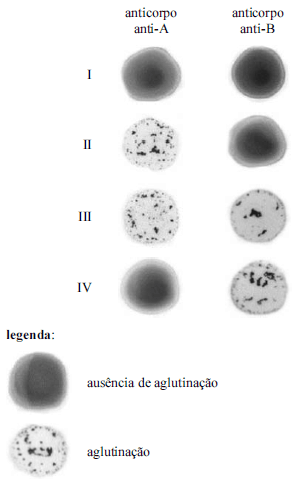
Internet: <cienciasomostodos.wordpress.com> (com adaptações).
A figura acima ilustra os resultados de testes de aglutinação realizados com o sangue dos indivíduos I, II, III e IV, para a determinação do grupo sanguíneo do sistema ABO a que cada um desses indivíduos pertence. A partir desses resultados, julgue o item a seguir.
O indivíduo I é doador universal, do grupo O, uma vez que ele não é capaz de produzir anticorpos contra antígenos ABO no receptor da transfusão sanguínea.
Provas
Caderno Container