Foram encontradas 80 questões.
Mental health determinants
Adolescence (10-19 years) is a unique and formative time. It is a crucial period for developing and maintaining social and emotional habits important for mental well-being. These include adopting healthy sleep patterns; taking regular exercise; developing coping, problem-solving, and interpersonal skills; and learning to manage emotions. Supportive environments in the family, at school and in the wider community are also important. An estimated 10-20% of adolescents globally experience mental health conditions, yet these remain underdiagnosed and undertreated.
Multiple factors determine mental health outcomes. The more risk factors adolescents are exposed to, the greater the potential impact on their mental health. Factors that can contribute to stress during adolescence include a desire for greater autonomy, pressure to conform with peers, exploration of sexual identity, and increased access to and use of technology. Media influence and gender norms can exacerbate the disparity between an adolescent’s lived reality and their perceptions or aspirations for the future. Other important determinants include the quality of their home life and relationships with peers. Violence (including harsh parenting and bullying) and socioeconomic problems are recognized risks to mental health. Children and adolescents are especially vulnerable to sexual violence, which has a clear association with detrimental mental health.
Some adolescents are at greater risk of mental health conditions due to their living conditions, stigma, discrimination or exclusion, or lack of access to quality support and services.
Emotional disorders commonly emerge during adolescence. In addition to depression or anxiety, adolescents with emotional disorders can also experience excessive irritability, frustration or anger. Symptoms can overlap across more than one emotional disorder with rapid and unexpected changes in mood and emotional outbursts. Younger adolescents may additionally develop emotionrelated physical symptoms such as stomachache, headache or nausea.
Globally, depression is the fourth leading cause of illness and disability among adolescents aged 15-19 years and fifteenth for those aged 10-14 years. Anxiety is the ninth leading cause for adolescents aged 15-19 years and sixth for those aged 10-14 years. Emotional disorders can profoundly affect areas like schoolwork and school attendance. Social withdrawal can exacerbate isolation and loneliness.
Promoting psychological well-being and protecting adolescents from adverse experiences and risk factors that may impact their potential to thrive are critical for their well-being during adolescence and for their physical and mental health in adulthood.
(Adapted from https://www.who.int)
Conforme o texto,
Provas

Mental health determinants
Adolescence (10-19 years) is a unique and formative time. It is a crucial period for developing and maintaining social and emotional habits important for mental well-being. These include adopting healthy sleep patterns; taking regular exercise; developing coping, problem-solving, and interpersonal skills; and learning to manage emotions. Supportive environments in the family, at school and in the wider community are also important. An estimated 10-20% of adolescents globally experience mental health conditions, yet these remain underdiagnosed and undertreated.
Multiple factors determine mental health outcomes. The more risk factors adolescents are exposed to, ....II.... the potential impact on their mental health. Factors that can contribute to stress during adolescence include a desire for greater autonomy, pressure to conform with peers, exploration of sexual identity, and increased access to and use of technology. Media influence and gender norms can exacerbate the disparity between an adolescent’s lived reality and their perceptions or aspirations for the future. Other important determinants include the quality of their home life and relationships with peers. Violence (including harsh parenting and bullying) and socioeconomic problems are recognized risks to mental health. Children and adolescents are especially vulnerable to sexual violence, which has a clear association with detrimental mental health.
Some adolescents are at greater risk of mental health conditions due to their living conditions, stigma, discrimination or exclusion, or lack of access to quality support and services.
Emotional disorders commonly emerge during adolescence. In addition to depression or anxiety, adolescents with emotional disorders can also experience excessive irritability, frustration or anger. Symptoms can overlap across more than one emotional disorder with rapid and unexpected changes in mood and emotional outbursts. Younger adolescents may additionally develop emotionrelated physical symptoms such as stomachache, headache or nausea.
Globally, depression is the fourth leading cause of illness and disability among adolescents aged 15-19 years and fifteenth for those aged 10-14 years. Anxiety is the ninth leading cause for adolescents aged 15-19 years and sixth for those aged 10-14 years. Emotional disorders can profoundly affect areas like schoolwork and school attendance. Social withdrawal can exacerbate isolation and loneliness.
Promoting psychological well-being and protecting adolescents from adverse experiences and risk factors that may impact their potential to thrive are critical for their well-being during adolescence and for their physical and mental health in adulthood.
(Adapted from https://www.who.int)
A alternativa que preenche corretamente a lacuna II é
Provas
Mental health determinants
Adolescence (10-19 years) is a unique and formative time. It is a crucial period for developing and maintaining social and emotional habits important for mental well-being. These include adopting healthy sleep patterns; taking regular exercise; developing coping, problem-solving, and interpersonal skills; and learning to manage emotions. Supportive environments in the family, at school and in the wider community are also important. An estimated 10-20% of adolescents globally experience mental health conditions, ....I.... these remain underdiagnosed and undertreated.
Multiple factors determine mental health outcomes. The more risk factors adolescents are exposed to, since the potential impact on their mental health. Factors that can contribute to stress during adolescence include a desire for greater autonomy, pressure to conform with peers, exploration of sexual identity, and increased access to and use of technology. Media influence and gender norms can exacerbate the disparity between an adolescent’s lived reality and their perceptions or aspirations for the future. Other important determinants include the quality of their home life and relationships with peers. Violence (including harsh parenting and bullying) and socioeconomic problems are recognized risks to mental health. Children and adolescents are especially vulnerable to sexual violence, which has a clear association with detrimental mental health.
Some adolescents are at greater risk of mental health conditions due to their living conditions, stigma, discrimination or exclusion, or lack of access to quality support and services.
Emotional disorders commonly emerge during adolescence. In addition to depression or anxiety, adolescents with emotional disorders can also experience excessive irritability, frustration or anger. Symptoms can overlap across more than one emotional disorder with rapid and unexpected changes in mood and emotional outbursts. Younger adolescents may additionally develop emotionrelated physical symptoms such as stomachache, headache or nausea.
Globally, depression is the fourth leading cause of illness and disability among adolescents aged 15-19 years and fifteenth for those aged 10-14 years. Anxiety is the ninth leading cause for adolescents aged 15-19 years and sixth for those aged 10-14 years. Emotional disorders can profoundly affect areas like schoolwork and school attendance. Social withdrawal can exacerbate isolation and loneliness.
Promoting psychological well-being and protecting adolescents from adverse experiences and risk factors that may impact their potential to thrive are critical for their well-being during adolescence and for their physical and mental health in adulthood.
(Adapted from https://www.who.int)
A palavra que preenche corretamente a lacuna I é
Provas
O polinômio !$ P(x)=x^2+ax+b !$ quando dividido por !$ x-3 !$ fornece resto 0, mas quando dividido por !$ x-5 !$ fornece resto 2. O resto da divisão de !$ P(x) !$ por !$ x-4 !$ é:
Provas
No plano cartesiano, os pontos (1,0) e (3,2) são vértices de um quadrado e estão em uma mesma diagonal. A circunferência inscrita nesse quadrado tem equação dada por:
Provas
- Estatística DescritivaMedidas de Tendência CentralMédiasMédia AritméticaMédia Simples (Não Agrupados)
Em uma empresa a média salarial das mulheres é R$ 1.100,00 e a dos homens R$ 1.500,00. A média de todos os salários é R$ 1.200,00. A proporção de mulheres nessa empresa é:
Provas
A figura mostra, no plano cartesiano, um círculo de raio r, centrado na origem do sistema de coordenadas, e um retângulo de lados paralelos aos eixos coordenados inscrito no círculo.
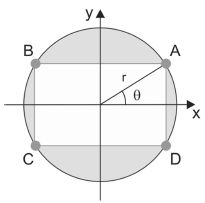
Sabendo que o ângulo entre o eixo x e a reta que passa pela origem e por um dos vértices do retângulo mede !$ θ !$, a área externa ao retângulo e interna ao círculo vale
Provas
Considere a sequência numérica !$ S_n=3+{\large{(-1)^{n+1} \over n}} !$, !$ n > 0 !$. O número de inteiros ímpares n tais que !$ {\large{124 \over 41}} \le S_n \le {\large{100 \over 33}} !$ é:
Provas
Maria tem duas moedas, uma delas com duas faces iguais, a cara, e outra com uma face cara e uma face coroa. Maria escolhe uma moeda ao acaso − isto é, as moedas têm a mesma chance de serem escolhidas − e a lança duas vezes. A probabilidade de sair duas caras é:
Provas
A coleção de 400 selos de José foi dividida entre seus netos Ana, Bruno, Carla e Davi. Ana ficou com mais selos do que cada um dos outros netos. Bruno e Carla ficaram, juntos, com 261 selos. O número máximo de selos com que Davi pode ter ficado é:
Provas
Caderno Container