Foram encontradas 810 questões.
A soma de todas as soluções reais da equação
\(1 + \dfrac{1}{x} = x\)
é igual a:
Note e adote: Considere x ≠ 0.
Provas

Ao analisar a Nota Fiscal de uma compra realizada em um supermercado, um consumidor notou a seguinte informação:
Valor Aproximado de Tributos Federais: R$ 24,00
Valor Aproximado de Tributos Estaduais: R$ 30,00
Se o valor total pago pela compra foi de R$ 180,00, é correto afirmar que as respectivas taxas de Tributos Federais e de Tributos Estaduais aplicadas na compra do consumidor foram, aproximadamente, de
Provas
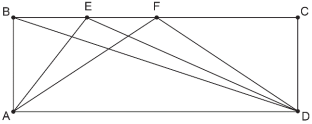
Na figura, ABCD é um retângulo, e E e F são pontos no segmento BC. Se indicarmos por A1 a área do triângulo ABD, por A2 a área do triângulo AED e por A3 a área do triângulo AFD, é correto afirmar:
Provas
Provas
Provas
Provas
The word "synesthesia" has Greek roots. It translates to “perceive together.” Synesthesia isn’t a disease or disorder. It won’t harm your health, and it doesn’t mean you’re mentally ill. Some studies suggest people who have it may do better on memory and intelligence tests than those who don’t.
One of the most common responses is to see letters, numbers, or sounds as colors. You might also see or hear a word and taste food; hear sounds and see shapes or patterns; feel a touch when seeing someone else being touched. (This is called mirror touch.)
It can be an annoyance. But most synesthetes see their condition as a sixth sense, not a drawback.
You can’t control it. The response happens right away. For example, if you hear a new piece of music, you may see a color or taste a flavor without any effort. It just happens.
It’s internal, mostly. The colors are just in your mind.
It stays the same over time. If you see the letter "A" in green today, you’ll see it in green 10 years from now.
It often starts in childhood. Studies of kids with synesthesia found that it develops over time.
webmd.com. December 17, 2024. Adaptado.
De acordo com o texto apresentado, a sinestesia pode ser descrita como
Provas
- Interpretação de texto | Reading comprehension
- Gramática - Língua InglesaPalavras conectivas | Connective words
Scientists have found that generally the world feels brighter when you wake up.
People start the day in the best frame of mind in the morning, but end in the worst, at about midnight, the findings suggest, with the day of the week and the season also playing a part.
Mental health also tends to be more varied at weekends but steadier during the week, according to the study led by University College London.
“Generally, things do seem better in the morning,” the researchers concluded.
Mental health and wellbeing are dynamic in nature, and subject to change over short and long periods. However, few studies have looked at how they might change over the course of the day.
Scientists wanted to explore whether time of day was associated with variations in mental health, happiness, life satisfaction, sense of life being worthwhile and loneliness.
People in the study answered questionnaires, with questions such as: “In the past week, how happy did you feel?”, “How satisfied have you been with your life?”, and “To what extent have you felt the things you are doing in your life are worthwhile?”
Factors such as age, health conditions and whether people worked were taken into account.
The results showed that happiness, life satisfaction, and worthwhile ratings were all higher on Mondays and Fridays than on Sundays, while happiness was also higher on Tuesdays. There was no evidence that loneliness differed across days of the week.
There was clear evidence of a seasonal influence on mood. Compared with winter, people tended to have lower levels of depressive and anxiety symptoms and loneliness, and higher levels of happiness, and feeling that life was worthwhile in the three other seasons.
Mental health was best in the summer across all outcomes. But the season didn’t affect the associations observed across the day, however.
This was an observational study, so it cannot establish cause.
The Guardian.com. February 5, 2025. Adaptado.
Provas
Scientists have found that generally the world feels brighter when you wake up.
People start the day in the best frame of mind in the morning, but end in the worst, at about midnight, the findings suggest, with the day of the week and the season also playing a part.
Mental health also tends to be more varied at weekends but steadier during the week, according to the study led by University College London.
“Generally, things do seem better in the morning,” the researchers concluded.
Mental health and wellbeing are dynamic in nature, and subject to change over short and long periods. However, few studies have looked at how they might change over the course of the day.
Scientists wanted to explore whether time of day was associated with variations in mental health, happiness, life satisfaction, sense of life being worthwhile and loneliness.
People in the study answered questionnaires, with questions such as: “In the past week, how happy did you feel?”, “How satisfied have you been with your life?”, and “To what extent have you felt the things you are doing in your life are worthwhile?”
Factors such as age, health conditions and whether people worked were taken into account.
The results showed that happiness, life satisfaction, and worthwhile ratings were all higher on Mondays and Fridays than on Sundays, while happiness was also higher on Tuesdays. There was no evidence that loneliness differed across days of the week.
There was clear evidence of a seasonal influence on mood. Compared with winter, people tended to have lower levels of depressive and anxiety symptoms and loneliness, and higher levels of happiness, and feeling that life was worthwhile in the three other seasons.
Mental health was best in the summer across all outcomes. But the season didn’t affect the associations observed across the day, however.
This was an observational study, so it cannot establish cause.
The Guardian.com. February 5, 2025. Adaptado.
Provas
Provas
Caderno Container