Foram encontradas 45.274 questões.
3986729
Ano: 2025
Disciplina: Inglês (Língua Inglesa)
Banca: AMEOSC
Orgão: Pref. Itapiranga-SC
Disciplina: Inglês (Língua Inglesa)
Banca: AMEOSC
Orgão: Pref. Itapiranga-SC
Provas:
Communicative Language Teaching (CLT) and active
methodologies share pedagogical principles that place
the student at the center of the learning process. Mark T
for true statements and F for false ones:
(__)Both value the student as a protagonist and active agent in their learning, rather than as a passive receiver of information.
(__)Activities such as information gap and role play, common in CLT, are examples of active methodologies, as they require interaction and problem-solving.
(__)Active methodologies, such as Problem-Based Learning (PBL), require students to use the target language (English) authentically to collaborate and find solutions.
(__)The only goal of active methodologies and CLT is fun, with no concern for the development of linguistic or cognitive competencies.
Select the alternative that shows the correct sequence, from top to bottom:
(__)Both value the student as a protagonist and active agent in their learning, rather than as a passive receiver of information.
(__)Activities such as information gap and role play, common in CLT, are examples of active methodologies, as they require interaction and problem-solving.
(__)Active methodologies, such as Problem-Based Learning (PBL), require students to use the target language (English) authentically to collaborate and find solutions.
(__)The only goal of active methodologies and CLT is fun, with no concern for the development of linguistic or cognitive competencies.
Select the alternative that shows the correct sequence, from top to bottom:
Provas
Questão presente nas seguintes provas

3986727
Ano: 2025
Disciplina: Inglês (Língua Inglesa)
Banca: AMEOSC
Orgão: Pref. Itapiranga-SC
Disciplina: Inglês (Língua Inglesa)
Banca: AMEOSC
Orgão: Pref. Itapiranga-SC
Provas:
The teaching of grammar and vocabulary in the
Communicative Language Teaching (CLT) approach
differs from traditional methods. Mark T for true
statements and F for false ones:
(__)Vocabulary should be presented and practiced in meaningful contexts, preferably through lexical fields (e.g., "food," "travel"), rather than as isolated word lists.
(__)Grammar should be taught in context, showing how structures are used to perform communicative functions (e.g., asking for permission, giving advice).
(__)The goal of grammar teaching in CLT is exclusively the explicit knowledge of rules (metalinguistic knowledge), even if the student cannot use them in communication.
(__)Grammatical or vocabulary errors should always be corrected, interrupting the learner's fluency, even during free communication activities.
Select the alternative that shows the correct sequence, from top to bottom:
(__)Vocabulary should be presented and practiced in meaningful contexts, preferably through lexical fields (e.g., "food," "travel"), rather than as isolated word lists.
(__)Grammar should be taught in context, showing how structures are used to perform communicative functions (e.g., asking for permission, giving advice).
(__)The goal of grammar teaching in CLT is exclusively the explicit knowledge of rules (metalinguistic knowledge), even if the student cannot use them in communication.
(__)Grammatical or vocabulary errors should always be corrected, interrupting the learner's fluency, even during free communication activities.
Select the alternative that shows the correct sequence, from top to bottom:
Provas
Questão presente nas seguintes provas
3986725
Ano: 2025
Disciplina: Inglês (Língua Inglesa)
Banca: AMEOSC
Orgão: Pref. Itapiranga-SC
Disciplina: Inglês (Língua Inglesa)
Banca: AMEOSC
Orgão: Pref. Itapiranga-SC
Provas:
In teaching culture in English classes, it is essential to
avoid stereotypes and promote a broad, critical
perspective. Analyze the following statements:
I.The intercultural approach to teaching culture focuses on comparing the learner's own culture with the cultures of English-speaking countries (the "big C," such as literature and history, and the "small c," such as customs and daily life), encouraging reflection.
II.The teaching of culture should be limited to presenting isolated facts and celebrating holidays (such as Halloween), without connection to language use or students' realities.
III.The concept of "English-speaking countries" should be limited to the United States and the United Kingdom, disregarding the diversity of English as an official or lingua franca language in countries such as India, South Africa, Nigeria, or Singapore.
The correct statement(s) is(are):
I.The intercultural approach to teaching culture focuses on comparing the learner's own culture with the cultures of English-speaking countries (the "big C," such as literature and history, and the "small c," such as customs and daily life), encouraging reflection.
II.The teaching of culture should be limited to presenting isolated facts and celebrating holidays (such as Halloween), without connection to language use or students' realities.
III.The concept of "English-speaking countries" should be limited to the United States and the United Kingdom, disregarding the diversity of English as an official or lingua franca language in countries such as India, South Africa, Nigeria, or Singapore.
The correct statement(s) is(are):
Provas
Questão presente nas seguintes provas
3986719
Ano: 2025
Disciplina: Inglês (Língua Inglesa)
Banca: AMEOSC
Orgão: Pref. Itapiranga-SC
Disciplina: Inglês (Língua Inglesa)
Banca: AMEOSC
Orgão: Pref. Itapiranga-SC
Provas:
In the teaching of pronunciation in English as a Lingua
Franca (ELF), the pedagogical focus shifts in relation to
the native-speaker model. Analyze the following
statements:
I.The main goal of pronunciation teaching from an ELF perspective is intelligibility, that is, the speaker's ability to be understood by other speakers (native or non-native).
II.The ELF approach values the diversity of accents, as long as communication is not hindered, and does not aim at imitating a specific accent (e.g., British or American) as a target.
III.Pronunciation teaching in ELF should focus on both segmental (sounds) and suprasegmental (rhythm, intonation, stress) features that are crucial for mutual understanding.
The correct statements are:
I.The main goal of pronunciation teaching from an ELF perspective is intelligibility, that is, the speaker's ability to be understood by other speakers (native or non-native).
II.The ELF approach values the diversity of accents, as long as communication is not hindered, and does not aim at imitating a specific accent (e.g., British or American) as a target.
III.Pronunciation teaching in ELF should focus on both segmental (sounds) and suprasegmental (rhythm, intonation, stress) features that are crucial for mutual understanding.
The correct statements are:
Provas
Questão presente nas seguintes provas
3986718
Ano: 2025
Disciplina: Inglês (Língua Inglesa)
Banca: AMEOSC
Orgão: Pref. Itapiranga-SC
Disciplina: Inglês (Língua Inglesa)
Banca: AMEOSC
Orgão: Pref. Itapiranga-SC
Provas:
In English teaching, the development of the four skills
(listening, speaking, reading, writing) should be worked
on in an integrated way, reflecting real language use.
Which activity best exemplifies this integration?
Provas
Questão presente nas seguintes provas
3986716
Ano: 2025
Disciplina: Inglês (Língua Inglesa)
Banca: AMEOSC
Orgão: Pref. Itapiranga-SC
Disciplina: Inglês (Língua Inglesa)
Banca: AMEOSC
Orgão: Pref. Itapiranga-SC
Provas:
Reading strategies are cognitive tools that help the
reader construct the meaning of a text. Which alternative
correctly describes the skimming strategy?
Provas
Questão presente nas seguintes provas
3985120
Ano: 2025
Disciplina: Inglês (Língua Inglesa)
Banca: FUNDATEC
Orgão: Pref. Cordilheira Alta-SC
Disciplina: Inglês (Língua Inglesa)
Banca: FUNDATEC
Orgão: Pref. Cordilheira Alta-SC
Provas:
The secret history of Stonehenge
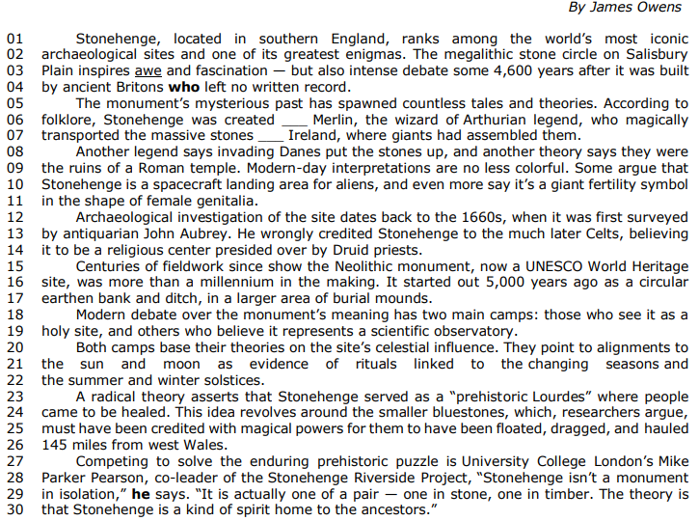
(Available at: https://www.nationalgeographic.com/history/article/stonehenge-1 – text specially adapted for
this test).
Provas
Questão presente nas seguintes provas
3985119
Ano: 2025
Disciplina: Inglês (Língua Inglesa)
Banca: FUNDATEC
Orgão: Pref. Cordilheira Alta-SC
Disciplina: Inglês (Língua Inglesa)
Banca: FUNDATEC
Orgão: Pref. Cordilheira Alta-SC
Provas:
The secret history of Stonehenge
(Available at: https://www.nationalgeographic.com/history/article/stonehenge-1 – text specially adapted for
this test).
I. The article “the” is correct because it specifies a particular noun.
II. It would be grammatically correct to use “an” as a non-specific article because of the pronunciation rule.
III. It would be grammatically correct to use “a” as a non-specific article because of the pronunciation rule.
Which ones are correct?
Provas
Questão presente nas seguintes provas
3985118
Ano: 2025
Disciplina: Inglês (Língua Inglesa)
Banca: FUNDATEC
Orgão: Pref. Cordilheira Alta-SC
Disciplina: Inglês (Língua Inglesa)
Banca: FUNDATEC
Orgão: Pref. Cordilheira Alta-SC
Provas:
The secret history of Stonehenge
(Available at: https://www.nationalgeographic.com/history/article/stonehenge-1 – text specially adapted for
this test).
Provas
Questão presente nas seguintes provas
3985117
Ano: 2025
Disciplina: Inglês (Língua Inglesa)
Banca: FUNDATEC
Orgão: Pref. Cordilheira Alta-SC
Disciplina: Inglês (Língua Inglesa)
Banca: FUNDATEC
Orgão: Pref. Cordilheira Alta-SC
Provas:
The secret history of Stonehenge
(Available at: https://www.nationalgeographic.com/history/article/stonehenge-1 – text specially adapted for
this test).
Provas
Questão presente nas seguintes provas
Cadernos
Caderno Container