Foram encontradas 45.388 questões.
The speech “Don’t try to sneak a water bottle past security this time” implies that the character in the cartoon
Provas

Text II
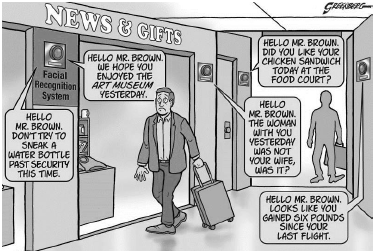
From: https://www.cartoonmovement.com/cartoon/facial-recognition-0
The cartoon criticizes the fact that face recognition can be
Provas
Text I
Understanding bias in facial recognition technologies
Over the past couple of years, the growing debate around automated facial recognition has reached a boiling point. As developers have continued to swiftly expand the scope of these kinds of technologies into an almost unbounded range of applications, an increasingly strident chorus of critical voices has sounded concerns about the injurious effects of the proliferation of such systems on impacted individuals and communities. Critics argue that the irresponsible design and use of facial detection and recognition technologies (FDRTs) threaten to violate civil liberties, infringe on basic human rights and further entrench structural racism and systemic marginalisation. In addition, they argue that the gradual creep of face surveillance infrastructures into every domain of lived experience may eventually eradicate the modern democratic forms of life that have long provided cherished means to individual flourishing, social solidarity and human self-creation.
Defenders, by contrast, emphasise the gains in public safety, security and efficiency that digitally streamlined capacities for facial identification, identity verification and trait characterisation may bring. These proponents point to potential real-world benefits like the added security of facial recognition enhanced border control, the increased efficacy of missing children or criminal suspect searches that are driven by the application of brute force facial analysis to largescale databases and the many added conveniences of facial verification in the business of everyday life.
Whatever side of the debate on which one lands, it would appear that FDRTs are here to stay.
Adapted from: understanding_bias_in_facial_recognition_technology.pdf
The word “like” in “like the added security of facial recognition” (2nd paragraph, in green) introduces a(n)
Provas
Text I
Understanding bias in facial recognition technologies
Over the past couple of years, the growing debate around automated facial recognition has reached a boiling point. As developers have continued to swiftly expand the scope of these kinds of technologies into an almost unbounded range of applications, an increasingly strident chorus of critical voices has sounded concerns about the injurious effects of the proliferation of such systems on impacted individuals and communities. Critics argue that the irresponsible design and use of facial detection and recognition technologies (FDRTs) threaten to violate civil liberties, infringe on basic human rights and further entrench structural racism and systemic marginalisation. In addition, they argue that the gradual creep of face surveillance infrastructures into every domain of lived experience may eventually eradicate the modern democratic forms of life that have long provided cherished means to individual flourishing, social solidarity and human self-creation.
Defenders, by contrast, emphasise the gains in public safety, security and efficiency that digitally streamlined capacities for facial identification, identity verification and trait characterisation may bring. These proponents point to potential real-world benefits like the added security of facial recognition enhanced border control, the increased efficacy of missing children or criminal suspect searches that are driven by the application of brute force facial analysis to largescale databases and the many added conveniences of facial verification in the business of everyday life.
Whatever side of the debate on which one lands, it would appear that FDRTs are here to stay.
Adapted from: understanding_bias_in_facial_recognition_technology.pdf
In the first sentence, when the author says that the debate “has reached a boiling point”, he means that the debate is
Provas
Text I
Understanding bias in facial recognition technologies
Over the past couple of years, the growing debate around automated facial recognition has reached a boiling point. As developers have continued to swiftly expand the scope of these kinds of technologies into an almost unbounded range of applications, an increasingly strident chorus of critical voices has sounded concerns about the injurious effects of the proliferation of such systems on impacted individuals and communities. Critics argue that the irresponsible design and use of facial detection and recognition technologies (FDRTs) threaten to violate civil liberties, infringe on basic human rights and further entrench structural racism and systemic marginalisation. In addition, they argue that the gradual creep of face surveillance infrastructures into every domain of lived experience may eventually eradicate the modern democratic forms of life that have long provided cherished means to individual flourishing, social solidarity and human self-creation.
Defenders, by contrast, emphasise the gains in public safety, security and efficiency that digitally streamlined capacities for facial identification, identity verification and trait characterisation may bring. These proponents point to potential real-world benefits like the added security of facial recognition enhanced border control, the increased efficacy of missing children or criminal suspect searches that are driven by the application of brute force facial analysis to largescale databases and the many added conveniences of facial verification in the business of everyday life.
Whatever side of the debate on which one lands, it would appear that FDRTs are here to stay.
Adapted from: understanding_bias_in_facial_recognition_technology.pdf
In the last sentence, the author states that facial detection and recognition technologies
Provas
Text I
Understanding bias in facial recognition technologies
Over the past couple of years, the growing debate around automated facial recognition has reached a boiling point. As developers have continued to swiftly expand the scope of these kinds of technologies into an almost unbounded range of applications, an increasingly strident chorus of critical voices has sounded concerns about the injurious effects of the proliferation of such systems on impacted individuals and communities. Critics argue that the irresponsible design and use of facial detection and recognition technologies (FDRTs) threaten to violate civil liberties, infringe on basic human rights and further entrench structural racism and systemic marginalisation. In addition, they argue that the gradual creep of face surveillance infrastructures into every domain of lived experience may eventually eradicate the modern democratic forms of life that have long provided cherished means to individual flourishing, social solidarity and human self-creation.
Defenders, by contrast, emphasise the gains in public safety, security and efficiency that digitally streamlined capacities for facial identification, identity verification and trait characterisation may bring. These proponents point to potential real-world benefits like the added security of facial recognition enhanced border control, the increased efficacy of missing children or criminal suspect searches that are driven by the application of brute force facial analysis to largescale databases and the many added conveniences of facial verification in the business of everyday life.
Whatever side of the debate on which one lands, it would appear that FDRTs are here to stay.
Adapted from: understanding_bias_in_facial_recognition_technology.pdf
Based on Text I, analyze the assertions below:
I. Critics are concerned about the pervasiveness of facial recognition technology.
II. Facial recognition systems may reduce the efficiency and security of border control.
III. Some argue that the new technology could undermine the stability of modern democracy.
Choose the correct answer:
Provas
Use Text VI to answer questions 33 and 34.
Text VI
TUDO SALA DE AULA. Portal educacional com recursos didáticos para professores da Educação Básica. Available at: https://www.tudosaladeaula.com. Accessed on: Mar. 21, 2025.
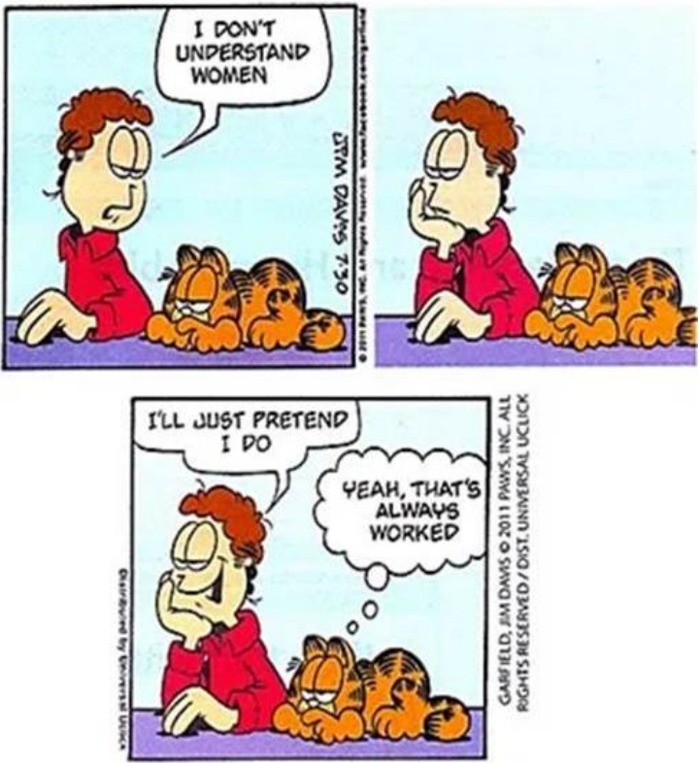
In relation to the elements from the comic strip, Text VI, consider the following statements.
I. In the utterance “I don’t understand women”, the word “women” is the plural form of woman, and is classified as an irregular noun whose plural is formed by mutation, in other words, a change in the vowel of the singular form. Other examples of plural nouns formed by mutation include “man/men”, “tooth/teeth”, and “mouse/mice”.
II. In the clause “that’s always worked”, replacing the verb “worked” with the phrasal verb “given up” would preserve the original meaning of the sentence, as both expressions convey the idea of successful effort or effectiveness over time.
III. The term "yeah" is a conjunction that expresses surprise or disbelief, commonly used in formal written English to indicate hesitation or irony.
IV. In “I’ll pretend I do”, the term “do” refers to “understand women” and is used to avoid unnecessary repetition.
V. In the clause “Yeah, that’s always worked”, the apostrophe+s (´s) is a contraction of the verb “to be” in the present tense (that is), forming a structure that indicates an action that began in the past and continues into the present.
Mark the alternative in which the statements are correct.
Provas
Use Text VI to answer questions 33 and 34.
Text VI
TUDO SALA DE AULA. Portal educacional com recursos didáticos para professores da Educação Básica. Available at: https://www.tudosaladeaula.com. Accessed on: Mar. 21, 2025.
In the context of the comic strip, Text VI, it is possible to infer that the human:
Provas
Over time, several methodologies have shaped English Language Teaching (ELT), each with a distinct view of how languages are learned and taught. Regarding these methodologies, relate the items in Column A to those in Column B and then mark the alternative with the correct sequence.
Column A:
I. Audiolingual method
II. Grammar translation method
III. The direct method
IV. The lexical approach
Column B:
( ) This method relied heavily on drills to form some habits; substitution was built into these drills so that, in small steps, the student was constantly learning and, moreover, was shielded from the possibility of making mistakes by the design of the drill.
( ) In this method, students were given (in their own language) explanations of individual points of grammar, and then they were given sentences which exemplified these points. These sentences had to be translated from the target language (L2) back to the students’ first language (L1) and vice versa.
( ) This method arrived at the end of the nineteenth century. It was the product of a reform movement which was reacting to the restrictions of grammar translation. Translation was abandoned in favor of the teacher and the students speaking together, relating the grammatical forms they should be learning to objects and pictures, etc. in order to establish their meaning.
( ) This method is based on the assertion that “language consists not of traditional grammar and vocabulary but often of multi-word prefabricated chunks”.
Provas
During the school year, Ms. Taylor, an English teacher, gives her students a short quiz before starting a new grammar topic to identify what they already know. She also provides continuous feedback on their performance during writing tasks and, at the end of each unit, she assigns a final test to determine their level of achievement and assign grades.
Considering the situation described select the alternative that shows the correct match between the assessment practices and their respective functions.
Provas
Caderno Container