Foram encontradas 45.474 questões.
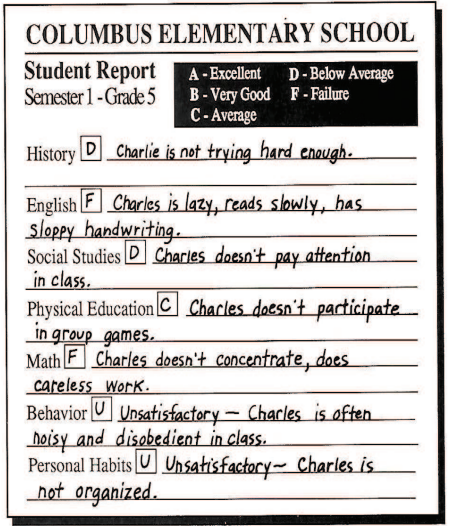
Fassman, Paula & Suzanne Tavares. Gallery 1. Oxford University Press: England, 2006. Adaptado.
De acordo com o boletim escolar, durante o semestre, no quesito comportamento, o aluno Charles foi, muitas vezes, considerado
Provas
Questão presente nas seguintes provas


Dan Phillips likes to help people. He builds houses for artists and other low-income people in Huntsville, Texas, in the United States. One house, the “tree house”, is in a large tree in the forest. It has windows on the floor! It also has a small kitchen. The bed is on the upstairs floor. There is a woodburning stove from an old ship in the living room. Phillips teaches people how to build houses with recycled materials.
Richards, Jack C. Interchange Intro. Cambridge University Press: UK, 2012. Adaptado.
De acordo com o texto, a casa construída por Dan Phillips tem
Provas
Questão presente nas seguintes provas
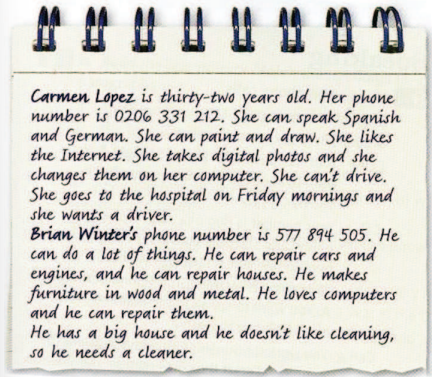
Foley, Mark & Hall, Diane. New Total English. Pearson: London, 2011. Adaptado.
As perguntas correspondentes às frases “Carmen Lopes is thirty-two years old.” e “Brian Winter makes furniture in wood and metal.” são, respectivamente,
Provas
Questão presente nas seguintes provas
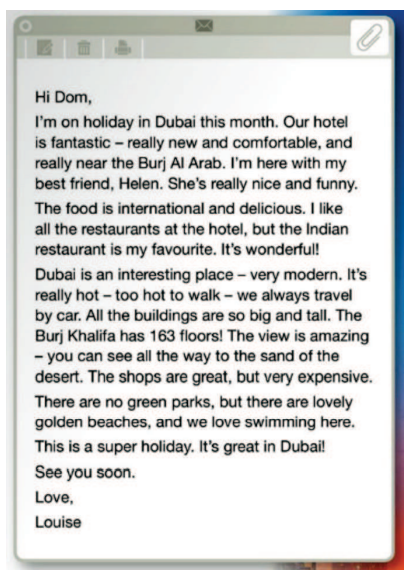
Soars, Liz; Soars, John. Headway - Beginner. Oxford University Press: England, 2019. Adaptado.
Na mensagem de Louise para Dom, ela aborda vários aspectos da viagem de férias em Dubai, entre os quais se incluem
Provas
Questão presente nas seguintes provas

Jessica: Where in England are you from?
Charles: We´re from here, from Oxford.
Jim: Oxford´s a beautiful city!
Rachel: Yes, it is. Are you on holiday?
Jim: No, we aren´t, we´re on business. But today´s a free day.
Jessica: Yes, we´re tourists today! Ooh. What´s that?
Jim: Oh… Are they your dogs?
Charles: Yeah, they are. Sit. Sit!
Jessica: They´re very nice. But I'm not very good with dogs.
Jim: Look! A free table. Over there.
Jessica: Nice to meet you. Have a nice day.
Charles: Thanks. Nice to meet you, too.
Rachel: Bye. Good dogs, good dogs.
Oxenden, Clive et all. English File Beginners. Oxford University Press: England, 2018. Adaptado.
Depreende-se do diálogo que
Provas
Questão presente nas seguintes provas
TEXTO PARA A QUESTÃO

Richards, Jack C. Interchange Intro. Cambridge University Press: UK, 2012.Adaptado.
Provas
Questão presente nas seguintes provas
TEXTO PARA A QUESTÃO
Richards, Jack C. Interchange Intro. Cambridge University Press: UK, 2012.Adaptado.
Provas
Questão presente nas seguintes provas
The Internet overtook print media as a primary source of
information for national and international news in the United
States in 2008. Television was still far in the lead, but
especially among younger demographics, the Internet and
social media are primary ways to learn about the day’s news.
With 40 percent of the public receiving their news from the
Internet, media outlets had to shift focus to make their
presence known on the web. One of the most remarkable
shifts out of that rush was the establishment of online-only
news sources.
The conventional argument claims that the anonymity and
the echo chamber of the Internet undermine worthwhile
news reporting, especially for topics that are expensive to
report on. The ability of large news organizations to put
reporters in the field is one of their most important
contributions and (because of its cost) is often one of the first
things to be cut back during times of budget problems.
However, as the Internet has become a primary news source
for more and more people, new media outlets—publications
existing entirely online—have begun to appear.
In 2006, two reporters for the Washington Post, John F.
Harris and Jim VandeHei, left the newspaper to start a
politically centered website called POLITICO. Rather than
simply repeating the day’s news in a blog, they were
determined to start a journalistically viable news organization
on the web. The different ways that POLITICO reaches out to
its supporters—blogs, Twitter feeds, regular news articles,
and now even a print edition—show how media convergence
has even occurred within the Internet itself. The interactive
nature of its services and the active comment boards on the
site also show how the media have become a two-way street:
more of a public forum than a straight news service.
https://boisestate.pressbooks.pub/soc122/Van Ry, Veronica. Sociological
Communication. Pressbooks, 2023. Adaptado.
Provas
Questão presente nas seguintes provas
The Internet overtook print media as a primary source of
information for national and international news in the United
States in 2008. Television was still far in the lead, but
especially among younger demographics, the Internet and
social media are primary ways to learn about the day’s news.
With 40 percent of the public receiving their news from the
Internet, media outlets had to shift focus to make their
presence known on the web. One of the most remarkable
shifts out of that rush was the establishment of online-only
news sources.
The conventional argument claims that the anonymity and
the echo chamber of the Internet undermine worthwhile
news reporting, especially for topics that are expensive to
report on. The ability of large news organizations to put
reporters in the field is one of their most important
contributions and (because of its cost) is often one of the first
things to be cut back during times of budget problems.
However, as the Internet has become a primary news source
for more and more people, new media outlets—publications
existing entirely online—have begun to appear.
In 2006, two reporters for the Washington Post, John F.
Harris and Jim VandeHei, left the newspaper to start a
politically centered website called POLITICO. Rather than
simply repeating the day’s news in a blog, they were
determined to start a journalistically viable news organization
on the web. The different ways that POLITICO reaches out to
its supporters—blogs, Twitter feeds, regular news articles,
and now even a print edition—show how media convergence
has even occurred within the Internet itself. The interactive
nature of its services and the active comment boards on the
site also show how the media have become a two-way street:
more of a public forum than a straight news service.
https://boisestate.pressbooks.pub/soc122/Van Ry, Veronica. Sociological
Communication. Pressbooks, 2023. Adaptado.
Provas
Questão presente nas seguintes provas
The Internet overtook print media as a primary source of
information for national and international news in the United
States in 2008. Television was still far in the lead, but
especially among younger demographics, the Internet and
social media are primary ways to learn about the day’s news.
With 40 percent of the public receiving their news from the
Internet, media outlets had to shift focus to make their
presence known on the web. One of the most remarkable
shifts out of that rush was the establishment of online-only
news sources.
The conventional argument claims that the anonymity and
the echo chamber of the Internet undermine worthwhile
news reporting, especially for topics that are expensive to
report on. The ability of large news organizations to put
reporters in the field is one of their most important
contributions and (because of its cost) is often one of the first
things to be cut back during times of budget problems.
However, as the Internet has become a primary news source
for more and more people, new media outlets—publications
existing entirely online—have begun to appear.
In 2006, two reporters for the Washington Post, John F.
Harris and Jim VandeHei, left the newspaper to start a
politically centered website called POLITICO. Rather than
simply repeating the day’s news in a blog, they were
determined to start a journalistically viable news organization
on the web. The different ways that POLITICO reaches out to
its supporters—blogs, Twitter feeds, regular news articles,
and now even a print edition—show how media convergence
has even occurred within the Internet itself. The interactive
nature of its services and the active comment boards on the
site also show how the media have become a two-way street:
more of a public forum than a straight news service.
https://boisestate.pressbooks.pub/soc122/Van Ry, Veronica. Sociological
Communication. Pressbooks, 2023. Adaptado.
Provas
Questão presente nas seguintes provas
Cadernos
Caderno Container