Foram encontradas 45.435 questões.
Disciplina: Inglês (Língua Inglesa)
Banca: AMEOSC
Orgão: Pref. Princesa-SC
O texto seguinte servirá de base para responder às questões de 1 a 9.
Valdivia Figurines and the appeal of 'the oldest'
(1º§) The logo for the Ecuadorian Ministry of Culture website is about my favourite thing of the afternoon which is saying a lot since I spent much of the day reading about giant Olmec heads. Three Valdivia Figurines in the colours of the Ecuadorian flag? I am sold! Golly, I love Valdivia figurines for all the right and all the wrong reasons.
(2º§) There are two things that can easily be said about Valdivia figurines: they are VERY Ecuadorian and they are VERY looted. The first explains why they appear prominently on the Ministry of Culture website (and on stencilled graffiti around Quito circa 2007). Ancient Ecuador has played second fiddle to Ancient Peru since the early days of archaeology. The Valdivia culture, however, represents something that Peru doesn't have, 'the oldest'. Everyone loves 'the oldest', national pride, etc. etc.
(3º§) Who else loves 'the oldest'? Collectors and Museums. If the Valdivia pottery sequence is the oldest in the new world, collectors want a slice of that pie. Heck, even better than some junky pottery, the Valdivia made interesting figurines: lovely ladies that look good on stark black backgrounds in auction catalogues. They are part of 'the oldest' yet they also look good.
(4º§) Valdivia sites are famously looted and Valdivia figurines are famously faked. A few years back I started doing some initial work into looting in Ecuador (which led to fieldwork in Quito and the cloud forest that didn't really go anywhere as of yet) and I, like anyone else going down that road, came across Bruhns and Hammond's 1983 Journal of Field Archaeology piece 'A Visit to Valdivia'. Knowing nothing at all about Ecuador at the time, I had never heard of Valdivia, a wonder since the only Ecuadorian archaeology books that Cambridge owns are a few by the late Betty Meggars and Emilio Estrada from the 1950s and 1960s which link uber-ancient Ecuador to Jomon Period Japan (yeah...I know). As Bruhns and Hammond relate, Meggars detected faking at Valdivia immediately after the start of her excavations: practical jokers who discovered a market for their copies. As the market for the pieces grew, the presumed fakes get more and more elaborate and fanciful...and Valdivia sites were just looted to pieces.
(5º§) So really with Valdivia we are left with a situation where we don't know what is real. It is directly comparable to the Cycladic Figurine problem: the corpus is mostly looted, it contains tons of forms not found in the limited archaeological excavations that have been conducted, and we intellectual consumers of artefacts don't know what to believe. To me Valdivia figurines are the perfect looting Catch 22: they warrant study so that the interested public can learn about 'the oldest', but they can't be studied because collectors wanted 'the oldest' so sites were looted and buckets of fakes were produced.
(6º§) In 2007 I bought a fake Valdivia figurine in Otavalo which now stands in a Spondylus shell on my counter and watches me cook. The fella selling it to me told me it was real. I knew it wasn't but made to put it back saying something along the lines that law breaking makes me sick. He quickly agreed that it wasn't real and cut his asking price by a ton. Que Sera. Three cheers, Ecuadorian Ministry of Culture, your logo is the best.
https://www.anonymousswisscollector.com/2012/09/valdivia-figurines-a
nd-appeal-of-oldest.html
What is the genre of the text "Valdivia Figurines and the appeal of 'the oldest'"?
Provas

Disciplina: Inglês (Língua Inglesa)
Banca: AMEOSC
Orgão: Pref. Princesa-SC
O texto seguinte servirá de base para responder às questões de 1 a 9.
Valdivia Figurines and the appeal of 'the oldest'
(1º§) The logo for the Ecuadorian Ministry of Culture website is about my favourite thing of the afternoon which is saying a lot since I spent much of the day reading about giant Olmec heads. Three Valdivia Figurines in the colours of the Ecuadorian flag? I am sold! Golly, I love Valdivia figurines for all the right and all the wrong reasons.
(2º§) There are two things that can easily be said about Valdivia figurines: they are VERY Ecuadorian and they are VERY looted. The first explains why they appear prominently on the Ministry of Culture website (and on stencilled graffiti around Quito circa 2007). Ancient Ecuador has played second fiddle to Ancient Peru since the early days of archaeology. The Valdivia culture, however, represents something that Peru doesn't have, 'the oldest'. Everyone loves 'the oldest', national pride, etc. etc.
(3º§) Who else loves 'the oldest'? Collectors and Museums. If the Valdivia pottery sequence is the oldest in the new world, collectors want a slice of that pie. Heck, even better than some junky pottery, the Valdivia made interesting figurines: lovely ladies that look good on stark black backgrounds in auction catalogues. They are part of 'the oldest' yet they also look good.
(4º§) Valdivia sites are famously looted and Valdivia figurines are famously faked. A few years back I started doing some initial work into looting in Ecuador (which led to fieldwork in Quito and the cloud forest that didn't really go anywhere as of yet) and I, like anyone else going down that road, came across Bruhns and Hammond's 1983 Journal of Field Archaeology piece 'A Visit to Valdivia'. Knowing nothing at all about Ecuador at the time, I had never heard of Valdivia, a wonder since the only Ecuadorian archaeology books that Cambridge owns are a few by the late Betty Meggars and Emilio Estrada from the 1950s and 1960s which link uber-ancient Ecuador to Jomon Period Japan (yeah...I know). As Bruhns and Hammond relate, Meggars detected faking at Valdivia immediately after the start of her excavations: practical jokers who discovered a market for their copies. As the market for the pieces grew, the presumed fakes get more and more elaborate and fanciful...and Valdivia sites were just looted to pieces.
(5º§) So really with Valdivia we are left with a situation where we don't know what is real. It is directly comparable to the Cycladic Figurine problem: the corpus is mostly looted, it contains tons of forms not found in the limited archaeological excavations that have been conducted, and we intellectual consumers of artefacts don't know what to believe. To me Valdivia figurines are the perfect looting Catch 22: they warrant study so that the interested public can learn about 'the oldest', but they can't be studied because collectors wanted 'the oldest' so sites were looted and buckets of fakes were produced.
(6º§) In 2007 I bought a fake Valdivia figurine in Otavalo which now stands in a Spondylus shell on my counter and watches me cook. The fella selling it to me told me it was real. I knew it wasn't but made to put it back saying something along the lines that law breaking makes me sick. He quickly agreed that it wasn't real and cut his asking price by a ton. Que Sera. Three cheers, Ecuadorian Ministry of Culture, your logo is the best.
https://www.anonymousswisscollector.com/2012/09/valdivia-figurines-a
nd-appeal-of-oldest.html
According to the passage, why are Valdivia figurines prominently featured on the Ministry of Culture website?
Provas
Disciplina: Inglês (Língua Inglesa)
Banca: Avança SP
Orgão: Pref. Águas Lindóia-SP
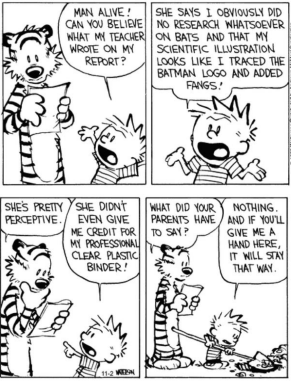
Disponível em: https://www.gocomics.com/calvinandhobbes/20 19/11/02
In the comic strip, Calvin is upset because his teacher did not give him credit for his research on bats. What is the likely reason he is digging a hole?
Provas
Disciplina: Inglês (Língua Inglesa)
Banca: Avança SP
Orgão: Pref. Águas Lindóia-SP
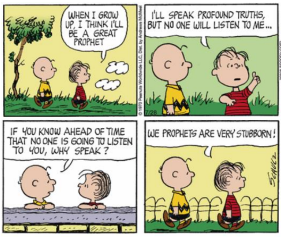
Disponível em: https://www.gocomics.com/peanuts/2017/07/28
The expression "stubborn" in the last panel of the comic strip could be replaced without changing the meaning by:
Provas
Disciplina: Inglês (Língua Inglesa)
Banca: Avança SP
Orgão: Pref. Águas Lindóia-SP
Provas
Disciplina: Inglês (Língua Inglesa)
Banca: Avança SP
Orgão: Pref. Águas Lindóia-SP
- Ensino da Língua Estrangeira Inglesa
- Gramática - Língua InglesaPalavras conectivas | Connective words
Coherence and cohesion are two essential concepts in English language teaching. They refer to the way that sentences and clauses are connected together to form a coherent and logical text. Coherence is the overall sense of unity and meaning in a text. It is created by the use of logical connections between ideas, such as causeand-effect, comparison, contrast, and sequence. Cohesion is the use of grammatical devices to connect sentences and clauses together. It is created by the use of words and phrases such as pronouns, conjunctions, and transition words. Both coherence and cohesion are important for effective communication in English. They help to make texts clear, concise, and easy to understand. The use of pronouns, conjunctions, and transition words to connect sentences and clauses together is known as:
Provas
Disciplina: Inglês (Língua Inglesa)
Banca: Avança SP
Orgão: Pref. Águas Lindóia-SP
And on his head he had a cap as broad as a buckler,
The brims were splayed out like the sails of a ship.
He wore a gray coat with pouches hanging down, Which were stuffed full of pardons from Rome. He had a pouch full of relics too,
Which he would show to people for a fee."
Chaucer, Geoffrey. The Canterbury Tales.. London: Penguin Classics, 1951.
In the passage from "The Canterbury Tales" by Geoffrey Chaucer, the speaker is describing the:
Provas
Disciplina: Inglês (Língua Inglesa)
Banca: Avança SP
Orgão: Pref. Águas Lindóia-SP
"The window panes were blurred, the trees were blurred; the leaves were blurred in the breeze. The breeze came in faint puffs, then died away. The sun became brighter, and now a single bird chirped, and another answered, and another, and others, and the first bird sang out loud and clear, and another answered, and another, and others, and the air was filled with chirping and with the humming of bees and the whirring of wings."
Which of the following statements best describes the use of imagery in these lines?
Provas
Disciplina: Inglês (Língua Inglesa)
Banca: Avança SP
Orgão: Pref. Águas Lindóia-SP
Provas
Disciplina: Inglês (Língua Inglesa)
Banca: Avança SP
Orgão: Pref. Águas Lindóia-SP
_ The focus is on the development of communicative competence, which is the ability to use language in real-life situations.
_ Students are encouraged to use the language for real purposes, such as giving presentations, participating in discussions, and writing emails.
_ The teacher plays the role of facilitator, providing opportunities for students to practice using the language.
Which of the following is NOT a principle of the communicative approach to English language teaching?
Provas
Caderno Container