Foram encontradas 45.388 questões.
Disciplina: Inglês (Língua Inglesa)
Banca: FGV
Orgão: Pref. Caraguatatuba-SP
Text
Digital Inclusion for All
Shaping our Digital Future
Digital technologies – the internet, mobile phones, and all the other tools to collect, store, analyze, and share information digitally – have spread rapidly in much of the world. Many of us depend on them to work, to educate the young, and reach out to our friends and family. These technologies have enabled digital public services, digital payments, online learning, telehealth, online shopping and more. However, about half the world's people access and use the Internet, the other half do not. Millions of people cannot work or go to school remotely or access technology and its benefits. Many of the unconnected live in least developed countries, landlocked developing countries and small island developing states, and within countries in rural and remote areas or urban impoverished areas.
Digital divide still persists between more and less connected countries, communities, and people. Enabling all the world's people to access and use digital technologies (the Internet including mobile technologies) – and closing digital divides – remains a challenge that needs to be addressed if the world community is to achieve the United Nations Sustainable Development Goals (SDGs) by 2030.
Adapted from: https://www.un.org/development/desa/dspd/wp-content/uploads/sites/22/2021/02/Draft-DigitalInclusion4All-OnlineGlobalForum2021-12Feb.pdf
“However” in “However, about half the world's people access and use the Internet, the other half do not” (1st paragraph) introduces a:
Provas

Disciplina: Inglês (Língua Inglesa)
Banca: FGV
Orgão: Pref. Caraguatatuba-SP
Text
Digital Inclusion for All
Shaping our Digital Future
Digital technologies – the internet, mobile phones, and all the other tools to collect, store, analyze, and share information digitally – have spread rapidly in much of the world. Many of us depend on them to work, to educate the young, and reach out to our friends and family. These technologies have enabled digital public services, digital payments, online learning, telehealth, online shopping and more. However, about half the world's people access and use the Internet, the other half do not. Millions of people cannot work or go to school remotely or access technology and its benefits. Many of the unconnected live in least developed countries, landlocked developing countries and small island developing states, and within countries in rural and remote areas or urban impoverished areas.
Digital divide still persists between more and less connected countries, communities, and people. Enabling all the world's people to access and use digital technologies (the Internet including mobile technologies) – and closing digital divides – remains a challenge that needs to be addressed if the world community is to achieve the United Nations Sustainable Development Goals (SDGs) by 2030.
Adapted from: https://www.un.org/development/desa/dspd/wp-content/uploads/sites/22/2021/02/Draft-DigitalInclusion4All-OnlineGlobalForum2021-12Feb.pdf
The opposite of “least” in “least developed countries” (1st paragraph) is:
Provas
Disciplina: Inglês (Língua Inglesa)
Banca: FGV
Orgão: Pref. Caraguatatuba-SP
Text
Digital Inclusion for All
Shaping our Digital Future
Digital technologies – the internet, mobile phones, and all the other tools to collect, store, analyze, and share information digitally – have spread rapidly in much of the world. Many of us depend on them to work, to educate the young, and reach out to our friends and family. These technologies have enabled digital public services, digital payments, online learning, telehealth, online shopping and more. However, about half the world's people access and use the Internet, the other half do not. Millions of people cannot work or go to school remotely or access technology and its benefits. Many of the unconnected live in least developed countries, landlocked developing countries and small island developing states, and within countries in rural and remote areas or urban impoverished areas.
Digital divide still persists between more and less connected countries, communities, and people. Enabling all the world's people to access and use digital technologies (the Internet including mobile technologies) – and closing digital divides – remains a challenge that needs to be addressed if the world community is to achieve the United Nations Sustainable Development Goals (SDGs) by 2030.
Adapted from: https://www.un.org/development/desa/dspd/wp-content/uploads/sites/22/2021/02/Draft-DigitalInclusion4All-OnlineGlobalForum2021-12Feb.pdf
The word “challenge” in “remains a challenge” (2nd paragraph) means something:
Provas
Disciplina: Inglês (Língua Inglesa)
Banca: FGV
Orgão: Pref. Caraguatatuba-SP
Text
Digital Inclusion for All
Shaping our Digital Future
Digital technologies – the internet, mobile phones, and all the other tools to collect, store, analyze, and share information digitally – have spread rapidly in much of the world. Many of us depend on them to work, to educate the young, and reach out to our friends and family. These technologies have enabled digital public services, digital payments, online learning, telehealth, online shopping and more. However, about half the world's people access and use the Internet, the other half do not. Millions of people cannot work or go to school remotely or access technology and its benefits. Many of the unconnected live in least developed countries, landlocked developing countries and small island developing states, and within countries in rural and remote areas or urban impoverished areas.
Digital divide still persists between more and less connected countries, communities, and people. Enabling all the world's people to access and use digital technologies (the Internet including mobile technologies) – and closing digital divides – remains a challenge that needs to be addressed if the world community is to achieve the United Nations Sustainable Development Goals (SDGs) by 2030.
Adapted from: https://www.un.org/development/desa/dspd/wp-content/uploads/sites/22/2021/02/Draft-DigitalInclusion4All-OnlineGlobalForum2021-12Feb.pdf
The text concludes that to reach the United Nations Sustainable Development Goals (SDGs) by 2030 the world community should:
Provas
Disciplina: Inglês (Língua Inglesa)
Banca: FGV
Orgão: Pref. Caraguatatuba-SP
Text
Digital Inclusion for All
Shaping our Digital Future
Digital technologies – the internet, mobile phones, and all the other tools to collect, store, analyze, and share information digitally – have spread rapidly in much of the world. Many of us depend on them to work, to educate the young, and reach out to our friends and family. These technologies have enabled digital public services, digital payments, online learning, telehealth, online shopping and more. However, about half the world's people access and use the Internet, the other half do not. Millions of people cannot work or go to school remotely or access technology and its benefits. Many of the unconnected live in least developed countries, landlocked developing countries and small island developing states, and within countries in rural and remote areas or urban impoverished areas.
Digital divide still persists between more and less connected countries, communities, and people. Enabling all the world's people to access and use digital technologies (the Internet including mobile technologies) – and closing digital divides – remains a challenge that needs to be addressed if the world community is to achieve the United Nations Sustainable Development Goals (SDGs) by 2030.
Adapted from: https://www.un.org/development/desa/dspd/wp-content/uploads/sites/22/2021/02/Draft-DigitalInclusion4All-OnlineGlobalForum2021-12Feb.pdf
Based on the text, mark the statements below as TRUE (T) or FALSE (F).
( ) Digital technologies have undergone fast proliferation.
( ) Every place in the world has access to the internet.
( ) Digital exclusion needs to come to an end.
The statements are, respectively,
Provas
Disciplina: Inglês (Língua Inglesa)
Banca: FGV
Orgão: Pref. Caraguatatuba-SP
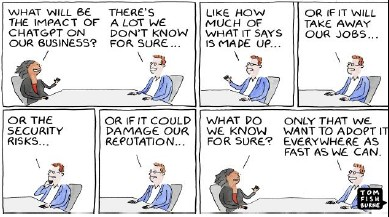
From: https://marketoonist.com/2023/06/impact-of-chatgpt.html
“For sure” in the last panel is similar in meaning to:
Provas
Disciplina: Inglês (Língua Inglesa)
Banca: FGV
Orgão: Pref. Caraguatatuba-SP
From: https://marketoonist.com/2023/06/impact-of-chatgpt.html
Regarding the fast adoption of CHATGPT, this cartoon aims at:
Provas
Text IV
Diversity and Inclusive Teaching
Teaching to engage diversity, to include all learners, and to seek equity is essential for preparing civically engaged adults and for creating a campus and society that recognizes the contributions of all people. Teaching for diversity refers to acknowledging a range of differences in the classroom. Teaching for inclusion signifies embracing difference. Teaching for equity allows the differences to transform the way we think, teach, learn and act such that all experiences and ways of being are handled with fairness and justice. These ideas complement each other and enhance educational opportunities for all students when simultaneously engaged. […]
Inclusive teaching strategies are intended to ensure that all students feel supported such that they freely learn and explore new ideas, feel safe to express their views in a civil manner, and are respected as individuals and members of groups. Intentionally incorporating inclusive teaching strategies helps students view themselves as people who belong to the community of learners in a classroom and university.
Adapted from https://ctal.udel.edu/resources-2/inclusive-teaching/
Provas
Text IV
Diversity and Inclusive Teaching
Teaching to engage diversity, to include all learners, and to seek equity is essential for preparing civically engaged adults and for creating a campus and society that recognizes the contributions of all people. Teaching for diversity refers to acknowledging a range of differences in the classroom. Teaching for inclusion signifies embracing difference. Teaching for equity allows the differences to transform the way we think, teach, learn and act such that all experiences and ways of being are handled with fairness and justice. These ideas complement each other and enhance educational opportunities for all students when simultaneously engaged. […]
Inclusive teaching strategies are intended to ensure that all students feel supported such that they freely learn and explore new ideas, feel safe to express their views in a civil manner, and are respected as individuals and members of groups. Intentionally incorporating inclusive teaching strategies helps students view themselves as people who belong to the community of learners in a classroom and university.
Adapted from https://ctal.udel.edu/resources-2/inclusive-teaching/
Provas
Text IV
Diversity and Inclusive Teaching
Teaching to engage diversity, to include all learners, and to seek equity is essential for preparing civically engaged adults and for creating a campus and society that recognizes the contributions of all people. Teaching for diversity refers to acknowledging a range of differences in the classroom. Teaching for inclusion signifies embracing difference. Teaching for equity allows the differences to transform the way we think, teach, learn and act such that all experiences and ways of being are handled with fairness and justice. These ideas complement each other and enhance educational opportunities for all students when simultaneously engaged. […]
Inclusive teaching strategies are intended to ensure that all students feel supported such that they freely learn and explore new ideas, feel safe to express their views in a civil manner, and are respected as individuals and members of groups. Intentionally incorporating inclusive teaching strategies helps students view themselves as people who belong to the community of learners in a classroom and university.
Adapted from https://ctal.udel.edu/resources-2/inclusive-teaching/
Provas
Caderno Container