Magna Concursos

Foram encontradas 45.388 questões.

3337054 Ano: 2024
Disciplina: Inglês (Língua Inglesa)
Banca: UFF
Orgão: Pref. Maricá-RJ
Provas:
Answer question according to TEXT 1 below.
TEXT 1
TRUE STORIES – The School teacher
1 IT'S HAPPENED TO me half a dozen times, lately. I'm walking home through the Edinburgh Gardens and I see them heading towards me. Heavy kids, eight of them, maybe ten. I keep walking, but I keep my eyes on them, and my feet wait for the sign to take off.
2 They are Greeks and Italians, all adolescents, all wearing green or maroon cardigans with a double black stripe round the chest, Levis or Wranglers that fit just right, showing a bit of sock and reddish shoes with big heels. I move across to the outside of the footpath to let them pass. They spread out a little. They're close enough now in the almost-dark for me to see their faces.
3 And it's all right, because the front one is Chris, from Fitzroy High, and he says, 'Hello, miss!' and the others are kids who have grinned and nodded at me a hundred times in the yard at school.
4 I had taught migrants before, but Fitzroy High is one of those legendary inner-suburban schools which can no longer be properly described as Australian. In none of the classes I took were there more than four kids with Australian names. A blond head was a surprise. The administration battled to assimilate these kids into recognizable moulds. In a hundred subtle ways they were defeated.
5 Most of the girls had pierced ears and had worn gold earrings since they were babies. The line was that plain gold sleepers were the only ear decorations allowed. At the time when it was fashionable, in Australia, to wear a zillion colored plastic bangles up your arm, teachers strove hopelessly to prevent this display of gaiety at school. The girls went on wearing them and pulled their sleeves down when they saw a senior mistress coming.
6 There were weekly segregated assemblies. I don't know what they told the boys, but at one girls' assembly I actually heard the senior mistress say, 'As girls we must be modest, quiet, hardworking and well-groomed at all times'.
7 What astonished me was the stubbornness of the kids' resistance to the rules. They didn't organize or protest. They defied. If the pressure got too much for them, they stayed away. And yet they hated to be suspended. One boy was suspended for a week, and every day I'd see him leaning against my front fence, staring wistfully at the school where his mates were tight-roping their way dangerously through the day.
8 In the three other schools I'd taught at, I'd been an authoritarian, a good disciplinarian. It wasn't only political or educational thinking that changed my attitude at Fitzroy High. It was the kids themselves. I suppose I fell in love with the whole nine hundred of them. In other schools, I'd known kids who were 'trouble-makers' or 'over-achievers', or ‘irresponsible' or 'antisocial. But somehow the kids at Fitzroy cut right through those categories.
9 To begin with, they made me laugh. I can't remember ever knowing such exuberant, merry kids. Every class had more than its share of natural clowns. The plays they invented were full of hilarious delight. In a second-form class I had for a year, two Italian boys called Claudio and Joseph used to present weekly plays so excruciatingly funny that we lay across the desks aching and wiping our eyes.
10 A kid called Ilya wrote wonderful, magical stories; he could write fairy tales his grandparents had told him in Yugoslavia. Lemonia could break your heart with a story about a lost fountain pen, and Dora with an account of her dreams. Their English may have been rocky, but there was a pure, delicate humour lying bone-deep in them that nothing could corrupt.
GARNER, Helen. True Stories. Melbourne, Australia: The Publishing Company, 2013, pp. 26-28. Adapted.
What is referred, by the narrator, as the “stubbornness of the kids’ resistance to the rules” (paragraph 7) is exemplified, in the text, by:
 

Provas

Questão presente nas seguintes provas
3337053 Ano: 2024
Disciplina: Inglês (Língua Inglesa)
Banca: UFF
Orgão: Pref. Maricá-RJ
Provas:
Answer question according to TEXT 1 below.
TEXT 1
TRUE STORIES – The School teacher
1 IT'S HAPPENED TO me half a dozen times, lately. I'm walking home through the Edinburgh Gardens and I see them heading towards me. Heavy kids, eight of them, maybe ten. I keep walking, but I keep my eyes on them, and my feet wait for the sign to take off.
2 They are Greeks and Italians, all adolescents, all wearing green or maroon cardigans with a double black stripe round the chest, Levis or Wranglers that fit just right, showing a bit of sock and reddish shoes with big heels. I move across to the outside of the footpath to let them pass. They spread out a little. They're close enough now in the almost-dark for me to see their faces.
3 And it's all right, because the front one is Chris, from Fitzroy High, and he says, 'Hello, miss!' and the others are kids who have grinned and nodded at me a hundred times in the yard at school.
4 I had taught migrants before, but Fitzroy High is one of those legendary inner-suburban schools which can no longer be properly described as Australian. In none of the classes I took were there more than four kids with Australian names. A blond head was a surprise. The administration battled to assimilate these kids into recognizable moulds. In a hundred subtle ways they were defeated.
5 Most of the girls had pierced ears and had worn gold earrings since they were babies. The line was that plain gold sleepers were the only ear decorations allowed. At the time when it was fashionable, in Australia, to wear a zillion colored plastic bangles up your arm, teachers strove hopelessly to prevent this display of gaiety at school. The girls went on wearing them and pulled their sleeves down when they saw a senior mistress coming.
6 There were weekly segregated assemblies. I don't know what they told the boys, but at one girls' assembly I actually heard the senior mistress say, 'As girls we must be modest, quiet, hardworking and well-groomed at all times'.
7 What astonished me was the stubbornness of the kids' resistance to the rules. They didn't organize or protest. They defied. If the pressure got too much for them, they stayed away. And yet they hated to be suspended. One boy was suspended for a week, and every day I'd see him leaning against my front fence, staring wistfully at the school where his mates were tight-roping their way dangerously through the day.
8 In the three other schools I'd taught at, I'd been an authoritarian, a good disciplinarian. It wasn't only political or educational thinking that changed my attitude at Fitzroy High. It was the kids themselves. I suppose I fell in love with the whole nine hundred of them. In other schools, I'd known kids who were 'trouble-makers' or 'over-achievers', or ‘irresponsible' or 'antisocial. But somehow the kids at Fitzroy cut right through those categories.
9 To begin with, they made me laugh. I can't remember ever knowing such exuberant, merry kids. Every class had more than its share of natural clowns. The plays they invented were full of hilarious delight. In a second-form class I had for a year, two Italian boys called Claudio and Joseph used to present weekly plays so excruciatingly funny that we lay across the desks aching and wiping our eyes.
10 A kid called Ilya wrote wonderful, magical stories; he could write fairy tales his grandparents had told him in Yugoslavia. Lemonia could break your heart with a story about a lost fountain pen, and Dora with an account of her dreams. Their English may have been rocky, but there was a pure, delicate humour lying bone-deep in them that nothing could corrupt.
GARNER, Helen. True Stories. Melbourne, Australia: The Publishing Company, 2013, pp. 26-28. Adapted.
Question refer to the following passage, in paragraph 4:

A blond head was a surprise. The administration battled to assimilate these kids into recognizable moulds. In a hundred subtle ways they were defeated.

The pronoun they (third sentence) refers to:
 

Provas

Questão presente nas seguintes provas
3337052 Ano: 2024
Disciplina: Inglês (Língua Inglesa)
Banca: UFF
Orgão: Pref. Maricá-RJ
Provas:
Answer question according to TEXT 1 below.
TEXT 1
TRUE STORIES – The School teacher
1 IT'S HAPPENED TO me half a dozen times, lately. I'm walking home through the Edinburgh Gardens and I see them heading towards me. Heavy kids, eight of them, maybe ten. I keep walking, but I keep my eyes on them, and my feet wait for the sign to take off.
2 They are Greeks and Italians, all adolescents, all wearing green or maroon cardigans with a double black stripe round the chest, Levis or Wranglers that fit just right, showing a bit of sock and reddish shoes with big heels. I move across to the outside of the footpath to let them pass. They spread out a little. They're close enough now in the almost-dark for me to see their faces.
3 And it's all right, because the front one is Chris, from Fitzroy High, and he says, 'Hello, miss!' and the others are kids who have grinned and nodded at me a hundred times in the yard at school.
4 I had taught migrants before, but Fitzroy High is one of those legendary inner-suburban schools which can no longer be properly described as Australian. In none of the classes I took were there more than four kids with Australian names. A blond head was a surprise. The administration battled to assimilate these kids into recognizable moulds. In a hundred subtle ways they were defeated.
5 Most of the girls had pierced ears and had worn gold earrings since they were babies. The line was that plain gold sleepers were the only ear decorations allowed. At the time when it was fashionable, in Australia, to wear a zillion colored plastic bangles up your arm, teachers strove hopelessly to prevent this display of gaiety at school. The girls went on wearing them and pulled their sleeves down when they saw a senior mistress coming.
6 There were weekly segregated assemblies. I don't know what they told the boys, but at one girls' assembly I actually heard the senior mistress say, 'As girls we must be modest, quiet, hardworking and well-groomed at all times'.
7 What astonished me was the stubbornness of the kids' resistance to the rules. They didn't organize or protest. They defied. If the pressure got too much for them, they stayed away. And yet they hated to be suspended. One boy was suspended for a week, and every day I'd see him leaning against my front fence, staring wistfully at the school where his mates were tight-roping their way dangerously through the day.
8 In the three other schools I'd taught at, I'd been an authoritarian, a good disciplinarian. It wasn't only political or educational thinking that changed my attitude at Fitzroy High. It was the kids themselves. I suppose I fell in love with the whole nine hundred of them. In other schools, I'd known kids who were 'trouble-makers' or 'over-achievers', or ‘irresponsible' or 'antisocial. But somehow the kids at Fitzroy cut right through those categories.
9 To begin with, they made me laugh. I can't remember ever knowing such exuberant, merry kids. Every class had more than its share of natural clowns. The plays they invented were full of hilarious delight. In a second-form class I had for a year, two Italian boys called Claudio and Joseph used to present weekly plays so excruciatingly funny that we lay across the desks aching and wiping our eyes.
10 A kid called Ilya wrote wonderful, magical stories; he could write fairy tales his grandparents had told him in Yugoslavia. Lemonia could break your heart with a story about a lost fountain pen, and Dora with an account of her dreams. Their English may have been rocky, but there was a pure, delicate humour lying bone-deep in them that nothing could corrupt.
GARNER, Helen. True Stories. Melbourne, Australia: The Publishing Company, 2013, pp. 26-28. Adapted.
Question refer to the following passage, in paragraph 4:

A blond head was a surprise. The administration battled to assimilate these kids into recognizable moulds. In a hundred subtle ways they were defeated.

A metonymy, and two metaphorical expressions related to the concept of war are, respectively,
 

Provas

Questão presente nas seguintes provas
3337051 Ano: 2024
Disciplina: Inglês (Língua Inglesa)
Banca: UFF
Orgão: Pref. Maricá-RJ
Provas:
Answer question according to TEXT 1 below.
TEXT 1
TRUE STORIES – The School teacher
1 IT'S HAPPENED TO me half a dozen times, lately. I'm walking home through the Edinburgh Gardens and I see them heading towards me. Heavy kids, eight of them, maybe ten. I keep walking, but I keep my eyes on them, and my feet wait for the sign to take off.
2 They are Greeks and Italians, all adolescents, all wearing green or maroon cardigans with a double black stripe round the chest, Levis or Wranglers that fit just right, showing a bit of sock and reddish shoes with big heels. I move across to the outside of the footpath to let them pass. They spread out a little. They're close enough now in the almost-dark for me to see their faces.
3 And it's all right, because the front one is Chris, from Fitzroy High, and he says, 'Hello, miss!' and the others are kids who have grinned and nodded at me a hundred times in the yard at school.
4 I had taught migrants before, but Fitzroy High is one of those legendary inner-suburban schools which can no longer be properly described as Australian. In none of the classes I took were there more than four kids with Australian names. A blond head was a surprise. The administration battled to assimilate these kids into recognizable moulds. In a hundred subtle ways they were defeated.
5 Most of the girls had pierced ears and had worn gold earrings since they were babies. The line was that plain gold sleepers were the only ear decorations allowed. At the time when it was fashionable, in Australia, to wear a zillion colored plastic bangles up your arm, teachers strove hopelessly to prevent this display of gaiety at school. The girls went on wearing them and pulled their sleeves down when they saw a senior mistress coming.
6 There were weekly segregated assemblies. I don't know what they told the boys, but at one girls' assembly I actually heard the senior mistress say, 'As girls we must be modest, quiet, hardworking and well-groomed at all times'.
7 What astonished me was the stubbornness of the kids' resistance to the rules. They didn't organize or protest. They defied. If the pressure got too much for them, they stayed away. And yet they hated to be suspended. One boy was suspended for a week, and every day I'd see him leaning against my front fence, staring wistfully at the school where his mates were tight-roping their way dangerously through the day.
8 In the three other schools I'd taught at, I'd been an authoritarian, a good disciplinarian. It wasn't only political or educational thinking that changed my attitude at Fitzroy High. It was the kids themselves. I suppose I fell in love with the whole nine hundred of them. In other schools, I'd known kids who were 'trouble-makers' or 'over-achievers', or ‘irresponsible' or 'antisocial. But somehow the kids at Fitzroy cut right through those categories.
9 To begin with, they made me laugh. I can't remember ever knowing such exuberant, merry kids. Every class had more than its share of natural clowns. The plays they invented were full of hilarious delight. In a second-form class I had for a year, two Italian boys called Claudio and Joseph used to present weekly plays so excruciatingly funny that we lay across the desks aching and wiping our eyes.
10 A kid called Ilya wrote wonderful, magical stories; he could write fairy tales his grandparents had told him in Yugoslavia. Lemonia could break your heart with a story about a lost fountain pen, and Dora with an account of her dreams. Their English may have been rocky, but there was a pure, delicate humour lying bone-deep in them that nothing could corrupt.
GARNER, Helen. True Stories. Melbourne, Australia: The Publishing Company, 2013, pp. 26-28. Adapted.
The utterance, extracted from the text, which contributes to the rupture of the somewhat tense atmosphere created in the 1st and 2nd paragraphs is:
 

Provas

Questão presente nas seguintes provas
3337050 Ano: 2024
Disciplina: Inglês (Língua Inglesa)
Banca: UFF
Orgão: Pref. Maricá-RJ
Provas:
Answer question according to TEXT 1 below.
TEXT 1
TRUE STORIES – The School teacher
1 IT'S HAPPENED TO me half a dozen times, lately. I'm walking home through the Edinburgh Gardens and I see them heading towards me. Heavy kids, eight of them, maybe ten. I keep walking, but I keep my eyes on them, and my feet wait for the sign to take off.
2 They are Greeks and Italians, all adolescents, all wearing green or maroon cardigans with a double black stripe round the chest, Levis or Wranglers that fit just right, showing a bit of sock and reddish shoes with big heels. I move across to the outside of the footpath to let them pass. They spread out a little. They're close enough now in the almost-dark for me to see their faces.
3 And it's all right, because the front one is Chris, from Fitzroy High, and he says, 'Hello, miss!' and the others are kids who have grinned and nodded at me a hundred times in the yard at school.
4 I had taught migrants before, but Fitzroy High is one of those legendary inner-suburban schools which can no longer be properly described as Australian. In none of the classes I took were there more than four kids with Australian names. A blond head was a surprise. The administration battled to assimilate these kids into recognizable moulds. In a hundred subtle ways they were defeated.
5 Most of the girls had pierced ears and had worn gold earrings since they were babies. The line was that plain gold sleepers were the only ear decorations allowed. At the time when it was fashionable, in Australia, to wear a zillion colored plastic bangles up your arm, teachers strove hopelessly to prevent this display of gaiety at school. The girls went on wearing them and pulled their sleeves down when they saw a senior mistress coming.
6 There were weekly segregated assemblies. I don't know what they told the boys, but at one girls' assembly I actually heard the senior mistress say, 'As girls we must be modest, quiet, hardworking and well-groomed at all times'.
7 What astonished me was the stubbornness of the kids' resistance to the rules. They didn't organize or protest. They defied. If the pressure got too much for them, they stayed away. And yet they hated to be suspended. One boy was suspended for a week, and every day I'd see him leaning against my front fence, staring wistfully at the school where his mates were tight-roping their way dangerously through the day.
8 In the three other schools I'd taught at, I'd been an authoritarian, a good disciplinarian. It wasn't only political or educational thinking that changed my attitude at Fitzroy High. It was the kids themselves. I suppose I fell in love with the whole nine hundred of them. In other schools, I'd known kids who were 'trouble-makers' or 'over-achievers', or ‘irresponsible' or 'antisocial. But somehow the kids at Fitzroy cut right through those categories.
9 To begin with, they made me laugh. I can't remember ever knowing such exuberant, merry kids. Every class had more than its share of natural clowns. The plays they invented were full of hilarious delight. In a second-form class I had for a year, two Italian boys called Claudio and Joseph used to present weekly plays so excruciatingly funny that we lay across the desks aching and wiping our eyes.
10 A kid called Ilya wrote wonderful, magical stories; he could write fairy tales his grandparents had told him in Yugoslavia. Lemonia could break your heart with a story about a lost fountain pen, and Dora with an account of her dreams. Their English may have been rocky, but there was a pure, delicate humour lying bone-deep in them that nothing could corrupt.
GARNER, Helen. True Stories. Melbourne, Australia: The Publishing Company, 2013, pp. 26-28. Adapted.
In the first and second paragraphs, the narrator describes a scene which may provoke, in the reader, a feeling of suspenseful expectation. This may be explained by readers’ ‘shared preconceived notions’ involving:
 

Provas

Questão presente nas seguintes provas
3337049 Ano: 2024
Disciplina: Inglês (Língua Inglesa)
Banca: UFF
Orgão: Pref. Maricá-RJ
Provas:
Answer question according to TEXT 1 below.
TEXT 1
TRUE STORIES – The School teacher
1 IT'S HAPPENED TO me half a dozen times, lately. I'm walking home through the Edinburgh Gardens and I see them heading towards me. Heavy kids, eight of them, maybe ten. I keep walking, but I keep my eyes on them, and my feet wait for the sign to take off.
2 They are Greeks and Italians, all adolescents, all wearing green or maroon cardigans with a double black stripe round the chest, Levis or Wranglers that fit just right, showing a bit of sock and reddish shoes with big heels. I move across to the outside of the footpath to let them pass. They spread out a little. They're close enough now in the almost-dark for me to see their faces.
3 And it's all right, because the front one is Chris, from Fitzroy High, and he says, 'Hello, miss!' and the others are kids who have grinned and nodded at me a hundred times in the yard at school.
4 I had taught migrants before, but Fitzroy High is one of those legendary inner-suburban schools which can no longer be properly described as Australian. In none of the classes I took were there more than four kids with Australian names. A blond head was a surprise. The administration battled to assimilate these kids into recognizable moulds. In a hundred subtle ways they were defeated.
5 Most of the girls had pierced ears and had worn gold earrings since they were babies. The line was that plain gold sleepers were the only ear decorations allowed. At the time when it was fashionable, in Australia, to wear a zillion colored plastic bangles up your arm, teachers strove hopelessly to prevent this display of gaiety at school. The girls went on wearing them and pulled their sleeves down when they saw a senior mistress coming.
6 There were weekly segregated assemblies. I don't know what they told the boys, but at one girls' assembly I actually heard the senior mistress say, 'As girls we must be modest, quiet, hardworking and well-groomed at all times'.
7 What astonished me was the stubbornness of the kids' resistance to the rules. They didn't organize or protest. They defied. If the pressure got too much for them, they stayed away. And yet they hated to be suspended. One boy was suspended for a week, and every day I'd see him leaning against my front fence, staring wistfully at the school where his mates were tight-roping their way dangerously through the day.
8 In the three other schools I'd taught at, I'd been an authoritarian, a good disciplinarian. It wasn't only political or educational thinking that changed my attitude at Fitzroy High. It was the kids themselves. I suppose I fell in love with the whole nine hundred of them. In other schools, I'd known kids who were 'trouble-makers' or 'over-achievers', or ‘irresponsible' or 'antisocial. But somehow the kids at Fitzroy cut right through those categories.
9 To begin with, they made me laugh. I can't remember ever knowing such exuberant, merry kids. Every class had more than its share of natural clowns. The plays they invented were full of hilarious delight. In a second-form class I had for a year, two Italian boys called Claudio and Joseph used to present weekly plays so excruciatingly funny that we lay across the desks aching and wiping our eyes.
10 A kid called Ilya wrote wonderful, magical stories; he could write fairy tales his grandparents had told him in Yugoslavia. Lemonia could break your heart with a story about a lost fountain pen, and Dora with an account of her dreams. Their English may have been rocky, but there was a pure, delicate humour lying bone-deep in them that nothing could corrupt.
GARNER, Helen. True Stories. Melbourne, Australia: The Publishing Company, 2013, pp. 26-28. Adapted.
The two overall themes which emerge from the narrative in text 1 are:
 

Provas

Questão presente nas seguintes provas
3333977 Ano: 2024
Disciplina: Inglês (Língua Inglesa)
Banca: FUNDEP
Orgão: Pref. Montes Claros-MG
Provas:
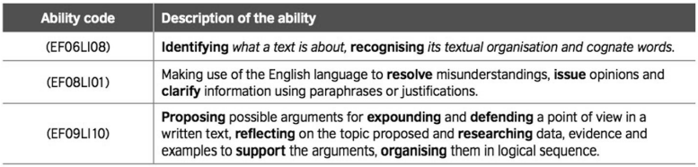
Learning goals, which are referred to in version 3 of the BNCC as abilities, are intended to list the basic knowledge to be acquired by students, and to serve as a reference for drafting and updating the regional, state and municipal curricula.
[…]
Enunciado 3786019-1


Available at: https://www.britishcouncil.org.br/sites/default/files/leitura_critica_bncc_-_en_-_v4_final.pdf. [Fragment]. Accessed on May 6, 2024.
To develop the BNCC ability of identifying what a text is about and recognising its textual organization and cognate words, English teachers are recommended to exploit different textual genres in the language classroom. Examples of such texts range from a menu, a text message or a poem to a book review.
To develop the BNCC ability EF06LI08, which includes identifying what a text is about, an English teacher should make use of
 

Provas

Questão presente nas seguintes provas
3333976 Ano: 2024
Disciplina: Inglês (Língua Inglesa)
Banca: FUNDEP
Orgão: Pref. Montes Claros-MG
Provas:

Read the following text to answer the question.

By Leo Selivan

In this article, informed by the Lexical Approach, I reflect on grammar instruction in the classroom […]. I consider the problems with ‘traditional’ grammar teaching before arguing that what we actually need is more grammar input as well as showing how lexis can provide necessary ‘crutches’ for the learner.

Lexis = vocabulary + grammar

The shift in ELT from grammar to lexis mirrors a similar change in the attitude of linguists. In the past linguists were preoccupied with the grammar of language; however the advances in corpus linguistics have pushed lexis to the forefront. The term ‘lexis’, which was traditionally used by linguists, is a common word these days and frequently used even in textbooks.

Why use a technical term borrowed from the realm of linguistics instead of the word ‘vocabulary’? Quite simply because vocabulary is typically seen as individual words (often presented in lists) whereas lexis is a somewhat wider concept and consists of collocations, chunks and formulaic expressions. It also includes certain patterns that were traditionally associated with the grammar of a language, e.g. If I were you…, I haven’t seen you for ages etc.

Recognising certain grammar structures as lexical items means that they can be introduced much earlier, without structural analysis or elaboration. Indeed, since the concept of notions and functions made its way into language teaching, particularly as Communicative Language Teaching (CLT) gained prominence, some structures associated with grammar started to be taught lexically (or functionally). I’d like to is not taught as ‹the conditional› but as a chunk expressing desire. Similarly many other ‹traditional› grammar items can be introduced lexically relatively early on.


Less grammar or more grammar?

You are, no doubt, all familiar with students who on one hand seem to know the ‘rules’ of grammar but still fail to produce grammatically correct sentences when speaking or, on the other, sound unnatural and foreign-like even when their sentences are grammatically correct. Michael Lewis, who might be considered the founder of the Lexical Approach, once claimed that there was no direct relationship between the knowledge of grammar and speaking. In contrast, the knowledge of formulaic language has been shown by research to have a significant bearing on the natural language production.

Furthermore, certain grammar rules are practically impossible to learn. Dave Willis cites the grammar of orientation (which includes the notoriously difficult present perfect and the uses of certain modal verbs) as particularly resistant to teaching. The only way to grasp their meaning is through continuous exposure and use.

Finally, even the most authoritative English grammars never claim to provide a comprehensive description of all the grammar, hence the word ‘introduction’ often used in their titles (for instance, Huddleston & Pullum’s A Student’s Introduction to English Grammar or Halliday’s An Introduction to Functional Grammar).

If grammarians do not even attempt to address all areas of grammar, how can we, practitioners, cover all the aspects of grammar in our teaching, especially if all we seem to focus on is a limited selection of discrete items, comprised mostly of tenses and a handful of modal verbs? It would seem that we need to expose our students to a lot of naturally occurring language and frequently draw their attention to various grammar points as they arise.

For example, while teaching the expression fall asleep / be asleep you can ask your students:

• Don’t make any noise – she’s fallen asleep.

• Don’t make any noise – she’s asleep.

What does’s stand for in each of these cases (is or has)?

One of the fathers of the Communicative Language Teaching Henry Widdowson advocated using lexical items as a starting point and then ‘showing how they need to be grammatically modified to be communicatively effective’ (1990:95). For example, when exploring a text with your students, you may come across a sentence like this:

They’ve been married for seven years.

You can ask your students: When did they get married? How should you change the sentence if the couple you are talking about is no longer married?

The above demonstrates how the teacher should be constantly on the ball and take every opportunity to draw students’ attention to grammar. Such short but frequent ‘grammar spots’ will help to slowly raise students’ awareness and build their understanding of the English grammar system.

[…]

Conclusion

So is there room for grammar instruction in the classroom? Certainly yes. But the grammar practice should always start with the exploitation of lexical items. Exposing students to a lot of natural and contextualised examples will offer a lexical way into the grammar of the language.

To sum up, grammar should play some role in language teaching but should not occupy a big part of class time. Instead grammar should be delivered in small but frequent portions. Students should be encouraged to collect a lot of examples of a particular structure before being invited to analyse it. Hence, analysis should be preceded by synthesis.

Lastly, language practitioners should bear in mind that grammar acquisition is an incremental process which requires frequent focus and refocus on the items already studied.

Available at: https://www.teachingenglish.org.uk/professionaldevelopment/teachers/knowing-subject/articles/grammar-vs-lexisor-grammar-through. Accessed on: April 29, 2024.

Which sentence does not refer to lexis?
 

Provas

Questão presente nas seguintes provas
3333975 Ano: 2024
Disciplina: Inglês (Língua Inglesa)
Banca: FUNDEP
Orgão: Pref. Montes Claros-MG
Provas:

Read the following text to answer the question.

By Leo Selivan

In this article, informed by the Lexical Approach, I reflect on grammar instruction in the classroom […]. I consider the problems with ‘traditional’ grammar teaching before arguing that what we actually need is more grammar input as well as showing how lexis can provide necessary ‘crutches’ for the learner.

Lexis = vocabulary + grammar

The shift in ELT from grammar to lexis mirrors a similar change in the attitude of linguists. In the past linguists were preoccupied with the grammar of language; however the advances in corpus linguistics have pushed lexis to the forefront. The term ‘lexis’, which was traditionally used by linguists, is a common word these days and frequently used even in textbooks.

Why use a technical term borrowed from the realm of linguistics instead of the word ‘vocabulary’? Quite simply because vocabulary is typically seen as individual words (often presented in lists) whereas lexis is a somewhat wider concept and consists of collocations, chunks and formulaic expressions. It also includes certain patterns that were traditionally associated with the grammar of a language, e.g. If I were you…, I haven’t seen you for ages etc.

Recognising certain grammar structures as lexical items means that they can be introduced much earlier, without structural analysis or elaboration. Indeed, since the concept of notions and functions made its way into language teaching, particularly as Communicative Language Teaching (CLT) gained prominence, some structures associated with grammar started to be taught lexically (or functionally). I’d like to is not taught as ‹the conditional› but as a chunk expressing desire. Similarly many other ‹traditional› grammar items can be introduced lexically relatively early on.


Less grammar or more grammar?

You are, no doubt, all familiar with students who on one hand seem to know the ‘rules’ of grammar but still fail to produce grammatically correct sentences when speaking or, on the other, sound unnatural and foreign-like even when their sentences are grammatically correct. Michael Lewis, who might be considered the founder of the Lexical Approach, once claimed that there was no direct relationship between the knowledge of grammar and speaking. In contrast, the knowledge of formulaic language has been shown by research to have a significant bearing on the natural language production.

Furthermore, certain grammar rules are practically impossible to learn. Dave Willis cites the grammar of orientation (which includes the notoriously difficult present perfect and the uses of certain modal verbs) as particularly resistant to teaching. The only way to grasp their meaning is through continuous exposure and use.

Finally, even the most authoritative English grammars never claim to provide a comprehensive description of all the grammar, hence the word ‘introduction’ often used in their titles (for instance, Huddleston & Pullum’s A Student’s Introduction to English Grammar or Halliday’s An Introduction to Functional Grammar).

If grammarians do not even attempt to address all areas of grammar, how can we, practitioners, cover all the aspects of grammar in our teaching, especially if all we seem to focus on is a limited selection of discrete items, comprised mostly of tenses and a handful of modal verbs? It would seem that we need to expose our students to a lot of naturally occurring language and frequently draw their attention to various grammar points as they arise.

For example, while teaching the expression fall asleep / be asleep you can ask your students:

• Don’t make any noise – she’s fallen asleep.

• Don’t make any noise – she’s asleep.

What does’s stand for in each of these cases (is or has)?

One of the fathers of the Communicative Language Teaching Henry Widdowson advocated using lexical items as a starting point and then ‘showing how they need to be grammatically modified to be communicatively effective’ (1990:95). For example, when exploring a text with your students, you may come across a sentence like this:

They’ve been married for seven years.

You can ask your students: When did they get married? How should you change the sentence if the couple you are talking about is no longer married?

The above demonstrates how the teacher should be constantly on the ball and take every opportunity to draw students’ attention to grammar. Such short but frequent ‘grammar spots’ will help to slowly raise students’ awareness and build their understanding of the English grammar system.

[…]

Conclusion

So is there room for grammar instruction in the classroom? Certainly yes. But the grammar practice should always start with the exploitation of lexical items. Exposing students to a lot of natural and contextualised examples will offer a lexical way into the grammar of the language.

To sum up, grammar should play some role in language teaching but should not occupy a big part of class time. Instead grammar should be delivered in small but frequent portions. Students should be encouraged to collect a lot of examples of a particular structure before being invited to analyse it. Hence, analysis should be preceded by synthesis.

Lastly, language practitioners should bear in mind that grammar acquisition is an incremental process which requires frequent focus and refocus on the items already studied.

Available at: https://www.teachingenglish.org.uk/professionaldevelopment/teachers/knowing-subject/articles/grammar-vs-lexisor-grammar-through. Accessed on: April 29, 2024.

The conjunction whereas in “Quite simply because vocabulary is typically seen as individual words (often presented in lists) whereas lexis is a somewhat wider concept and consists of collocations, chunks and formulaic expressions.” is closest in meaning to
 

Provas

Questão presente nas seguintes provas
3333974 Ano: 2024
Disciplina: Inglês (Língua Inglesa)
Banca: FUNDEP
Orgão: Pref. Montes Claros-MG
Provas:

Read the following text to answer the question.

By Leo Selivan

In this article, informed by the Lexical Approach, I reflect on grammar instruction in the classroom […]. I consider the problems with ‘traditional’ grammar teaching before arguing that what we actually need is more grammar input as well as showing how lexis can provide necessary ‘crutches’ for the learner.

Lexis = vocabulary + grammar

The shift in ELT from grammar to lexis mirrors a similar change in the attitude of linguists. In the past linguists were preoccupied with the grammar of language; however the advances in corpus linguistics have pushed lexis to the forefront. The term ‘lexis’, which was traditionally used by linguists, is a common word these days and frequently used even in textbooks.

Why use a technical term borrowed from the realm of linguistics instead of the word ‘vocabulary’? Quite simply because vocabulary is typically seen as individual words (often presented in lists) whereas lexis is a somewhat wider concept and consists of collocations, chunks and formulaic expressions. It also includes certain patterns that were traditionally associated with the grammar of a language, e.g. If I were you…, I haven’t seen you for ages etc.

Recognising certain grammar structures as lexical items means that they can be introduced much earlier, without structural analysis or elaboration. Indeed, since the concept of notions and functions made its way into language teaching, particularly as Communicative Language Teaching (CLT) gained prominence, some structures associated with grammar started to be taught lexically (or functionally). I’d like to is not taught as ‹the conditional› but as a chunk expressing desire. Similarly many other ‹traditional› grammar items can be introduced lexically relatively early on.


Less grammar or more grammar?

You are, no doubt, all familiar with students who on one hand seem to know the ‘rules’ of grammar but still fail to produce grammatically correct sentences when speaking or, on the other, sound unnatural and foreign-like even when their sentences are grammatically correct. Michael Lewis, who might be considered the founder of the Lexical Approach, once claimed that there was no direct relationship between the knowledge of grammar and speaking. In contrast, the knowledge of formulaic language has been shown by research to have a significant bearing on the natural language production.

Furthermore, certain grammar rules are practically impossible to learn. Dave Willis cites the grammar of orientation (which includes the notoriously difficult present perfect and the uses of certain modal verbs) as particularly resistant to teaching. The only way to grasp their meaning is through continuous exposure and use.

Finally, even the most authoritative English grammars never claim to provide a comprehensive description of all the grammar, hence the word ‘introduction’ often used in their titles (for instance, Huddleston & Pullum’s A Student’s Introduction to English Grammar or Halliday’s An Introduction to Functional Grammar).

If grammarians do not even attempt to address all areas of grammar, how can we, practitioners, cover all the aspects of grammar in our teaching, especially if all we seem to focus on is a limited selection of discrete items, comprised mostly of tenses and a handful of modal verbs? It would seem that we need to expose our students to a lot of naturally occurring language and frequently draw their attention to various grammar points as they arise.

For example, while teaching the expression fall asleep / be asleep you can ask your students:

• Don’t make any noise – she’s fallen asleep.

• Don’t make any noise – she’s asleep.

What does’s stand for in each of these cases (is or has)?

One of the fathers of the Communicative Language Teaching Henry Widdowson advocated using lexical items as a starting point and then ‘showing how they need to be grammatically modified to be communicatively effective’ (1990:95). For example, when exploring a text with your students, you may come across a sentence like this:

They’ve been married for seven years.

You can ask your students: When did they get married? How should you change the sentence if the couple you are talking about is no longer married?

The above demonstrates how the teacher should be constantly on the ball and take every opportunity to draw students’ attention to grammar. Such short but frequent ‘grammar spots’ will help to slowly raise students’ awareness and build their understanding of the English grammar system.

[…]

Conclusion

So is there room for grammar instruction in the classroom? Certainly yes. But the grammar practice should always start with the exploitation of lexical items. Exposing students to a lot of natural and contextualised examples will offer a lexical way into the grammar of the language.

To sum up, grammar should play some role in language teaching but should not occupy a big part of class time. Instead grammar should be delivered in small but frequent portions. Students should be encouraged to collect a lot of examples of a particular structure before being invited to analyse it. Hence, analysis should be preceded by synthesis.

Lastly, language practitioners should bear in mind that grammar acquisition is an incremental process which requires frequent focus and refocus on the items already studied.

Available at: https://www.teachingenglish.org.uk/professionaldevelopment/teachers/knowing-subject/articles/grammar-vs-lexisor-grammar-through. Accessed on: April 29, 2024.

The author states that research findings have demonstrated that
 

Provas

Questão presente nas seguintes provas