Magna Concursos

Foram encontradas 45.388 questões.

3333973 Ano: 2024
Disciplina: Inglês (Língua Inglesa)
Banca: FUNDEP
Orgão: Pref. Montes Claros-MG
Provas:

Read the following text to answer the question.

By Leo Selivan

In this article, informed by the Lexical Approach, I reflect on grammar instruction in the classroom […]. I consider the problems with ‘traditional’ grammar teaching before arguing that what we actually need is more grammar input as well as showing how lexis can provide necessary ‘crutches’ for the learner.

Lexis = vocabulary + grammar

The shift in ELT from grammar to lexis mirrors a similar change in the attitude of linguists. In the past linguists were preoccupied with the grammar of language; however the advances in corpus linguistics have pushed lexis to the forefront. The term ‘lexis’, which was traditionally used by linguists, is a common word these days and frequently used even in textbooks.

Why use a technical term borrowed from the realm of linguistics instead of the word ‘vocabulary’? Quite simply because vocabulary is typically seen as individual words (often presented in lists) whereas lexis is a somewhat wider concept and consists of collocations, chunks and formulaic expressions. It also includes certain patterns that were traditionally associated with the grammar of a language, e.g. If I were you…, I haven’t seen you for ages etc.

Recognising certain grammar structures as lexical items means that they can be introduced much earlier, without structural analysis or elaboration. Indeed, since the concept of notions and functions made its way into language teaching, particularly as Communicative Language Teaching (CLT) gained prominence, some structures associated with grammar started to be taught lexically (or functionally). I’d like to is not taught as ‹the conditional› but as a chunk expressing desire. Similarly many other ‹traditional› grammar items can be introduced lexically relatively early on.


Less grammar or more grammar?

You are, no doubt, all familiar with students who on one hand seem to know the ‘rules’ of grammar but still fail to produce grammatically correct sentences when speaking or, on the other, sound unnatural and foreign-like even when their sentences are grammatically correct. Michael Lewis, who might be considered the founder of the Lexical Approach, once claimed that there was no direct relationship between the knowledge of grammar and speaking. In contrast, the knowledge of formulaic language has been shown by research to have a significant bearing on the natural language production.

Furthermore, certain grammar rules are practically impossible to learn. Dave Willis cites the grammar of orientation (which includes the notoriously difficult present perfect and the uses of certain modal verbs) as particularly resistant to teaching. The only way to grasp their meaning is through continuous exposure and use.

Finally, even the most authoritative English grammars never claim to provide a comprehensive description of all the grammar, hence the word ‘introduction’ often used in their titles (for instance, Huddleston & Pullum’s A Student’s Introduction to English Grammar or Halliday’s An Introduction to Functional Grammar).

If grammarians do not even attempt to address all areas of grammar, how can we, practitioners, cover all the aspects of grammar in our teaching, especially if all we seem to focus on is a limited selection of discrete items, comprised mostly of tenses and a handful of modal verbs? It would seem that we need to expose our students to a lot of naturally occurring language and frequently draw their attention to various grammar points as they arise.

For example, while teaching the expression fall asleep / be asleep you can ask your students:

• Don’t make any noise – she’s fallen asleep.

• Don’t make any noise – she’s asleep.

What does’s stand for in each of these cases (is or has)?

One of the fathers of the Communicative Language Teaching Henry Widdowson advocated using lexical items as a starting point and then ‘showing how they need to be grammatically modified to be communicatively effective’ (1990:95). For example, when exploring a text with your students, you may come across a sentence like this:

They’ve been married for seven years.

You can ask your students: When did they get married? How should you change the sentence if the couple you are talking about is no longer married?

The above demonstrates how the teacher should be constantly on the ball and take every opportunity to draw students’ attention to grammar. Such short but frequent ‘grammar spots’ will help to slowly raise students’ awareness and build their understanding of the English grammar system.

[…]

Conclusion

So is there room for grammar instruction in the classroom? Certainly yes. But the grammar practice should always start with the exploitation of lexical items. Exposing students to a lot of natural and contextualised examples will offer a lexical way into the grammar of the language.

To sum up, grammar should play some role in language teaching but should not occupy a big part of class time. Instead grammar should be delivered in small but frequent portions. Students should be encouraged to collect a lot of examples of a particular structure before being invited to analyse it. Hence, analysis should be preceded by synthesis.

Lastly, language practitioners should bear in mind that grammar acquisition is an incremental process which requires frequent focus and refocus on the items already studied.

Available at: https://www.teachingenglish.org.uk/professionaldevelopment/teachers/knowing-subject/articles/grammar-vs-lexisor-grammar-through. Accessed on: April 29, 2024.

As far as grammar instruction is considered, the author of this text, who is a teacher, contends that
 

Provas

Questão presente nas seguintes provas
3333972 Ano: 2024
Disciplina: Inglês (Língua Inglesa)
Banca: FUNDEP
Orgão: Pref. Montes Claros-MG
Provas:

Empowering language learning through assessment

By Liying Cheng & Janna Fox
Introduction

Like you, we are teachers. We both began our careers teaching English to students ______ first languages were not English. We taught many of these students in Asia, the Middle East, Africa, and North America, navigating our way through the teaching, learning, and assessment of our students with little guidance from theory or resources. Over the years, we became increasingly sensitive to the negative influence and consequences of ill-considered assessment and testing practices. Although we could increasingly find resources on language teaching methods, strategies, and techniques, very few of these resources provided systematic and coherent support for our day-to-day assessment practices. There were no ready answers to our questions in the research literature either – researchers tended to write for other researchers, and their findings, although interesting, were not readily applicable in our classrooms. Years later, our long-term interest in assessment led us to teaching courses to pre-service and in-service teachers: helping them to support their students’ learning through sound assessment practices. This thread has centrally run through our work. Again, we searched for resources that could answer the questions and address the issues arising in the classroom; we realised that the narrow scope of resources on classroom assessment rarely moved beyond test design and test analysis, and was more appropriate for large-scale testing than for on-going classroom assessment.

In the present educational climate, we are continually faced with complex assessment issues. For example, there is a great deal of discussion now about alignment as a guiding principle for high quality assessment: that is, the degree of agreement amongst standards, curriculum, learning outcomes, assessment tasks (including tests), and instruction. Alignment, validity, reliability, fairness, consequences, and practicality are viewed as central aspects of assessment practice that supports learning.

The alignment of learning goals, assessment, and classroom activity
Enunciado 3786014-1

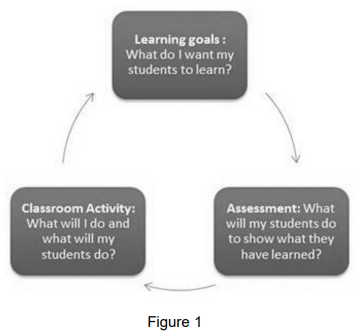
Figure 1 depicts assessment practices three-dimensionally and asks us as teachers to revisit our own classroom practices. Think about what it means to us in achieving instructional goals through teaching and assessment. In the center of this triangle is our students’ learning. The first question we need to ask relates to the learning goals we have for our students: What do I want my students to learn? What do I want them to know, value, and / or be able to do as an outcome of my teaching? Moving to the next question in Figure 1, on assessment, we need to ask how we will monitor and evaluate learning – or what information is essential in order to determine whether our students have met or exceeded the required expectations: What will my students do to show what they have learned? Given the evidence that we plan to collect during a course, we then need to identify the actual classroom activities that will support our students’ learning and development: What will I do as a teacher, and what will my students do as learners?

Assessment serves as the key to check on learning, providing essential information to teachers. This is an on-going, iterative, and cyclical way of supporting learners through assessment and teaching. In this sense, teaching and assessment are one integral and interconnected process. Teachers need to constantly ask themselves: Have my students learned? And how well have they progressed as a result of my assessment practices?


Assessment of, as, and for learning

For teachers to support student learning through assessment, teachers need to engage themselves as well as their students in the discussion of assessment of learning, assessment for learning, and assessment as learning. We argue that it is inaccurate to view assessment only as judgments on learner progress at the conclusion of a unit of teaching and learning. Rather, it should also be viewed as a way of obtaining evidence for where students are in reaching their learning goals and what they need in order to progress towards these goals. Assessment as learning puts the focus on the students themselves taking responsibility for their own learning through self and peer-assessment, monitoring their own progress toward their goals and employing strategies for achieving them. We know that alignment and assessment of, for, and as learning ultimately empower our students’ language development.


Available at: https://www.onestopenglish.com/methodology-theworld-of-elt/applied-linguistics-empowering-language-learningthrough-assessment/555928.article. Accessed on: April 29, 2024.
The conjunction although in “Although we could increasingly find resources on language teaching methods, strategies, and techniques, very few of these resources provided systematic and coherent support for our day-to-day assessment practices.” is closest in meaning to
 

Provas

Questão presente nas seguintes provas
3333971 Ano: 2024
Disciplina: Inglês (Língua Inglesa)
Banca: FUNDEP
Orgão: Pref. Montes Claros-MG
Provas:

Empowering language learning through assessment


By Liying Cheng & Janna Fox
Introduction

Like you, we are teachers. We both began our careers teaching English to students ______ first languages were not English. We taught many of these students in Asia, the Middle East, Africa, and North America, navigating our way through the teaching, learning, and assessment of our students with little guidance from theory or resources. Over the years, we became increasingly sensitive to the negative influence and consequences of ill-considered assessment and testing practices. Although we could increasingly find resources on language teaching methods, strategies, and techniques, very few of these resources provided systematic and coherent support for our day-to-day assessment practices. There were no ready answers to our questions in the research literature either – researchers tended to write for other researchers, and their findings, although interesting, were not readily applicable in our classrooms. Years later, our long-term interest in assessment led us to teaching courses to pre-service and in-service teachers: helping them to support their students’ learning through sound assessment practices. This thread has centrally run through our work. Again, we searched for resources that could answer the questions and address the issues arising in the classroom; we realised that the narrow scope of resources on classroom assessment rarely moved beyond test design and test analysis, and was more appropriate for large-scale testing than for on-going classroom assessment.

In the present educational climate, we are continually faced with complex assessment issues. For example, there is a great deal of discussion now about alignment as a guiding principle for high quality assessment: that is, the degree of agreement amongst standards, curriculum, learning outcomes, assessment tasks (including tests), and instruction. Alignment, validity, reliability, fairness, consequences, and practicality are viewed as central aspects of assessment practice that supports learning.

The alignment of learning goals, assessment, and classroom activity
Enunciado 3786013-1

Figure 1 depicts assessment practices three-dimensionally and asks us as teachers to revisit our own classroom practices. Think about what it means to us in achieving instructional goals through teaching and assessment. In the center of this triangle is our students’ learning. The first question we need to ask relates to the learning goals we have for our students: What do I want my students to learn? What do I want them to know, value, and / or be able to do as an outcome of my teaching? Moving to the next question in Figure 1, on assessment, we need to ask how we will monitor and evaluate learning – or what information is essential in order to determine whether our students have met or exceeded the required expectations: What will my students do to show what they have learned? Given the evidence that we plan to collect during a course, we then need to identify the actual classroom activities that will support our students’ learning and development: What will I do as a teacher, and what will my students do as learners?

Assessment serves as the key to check on learning, providing essential information to teachers. This is an on-going, iterative, and cyclical way of supporting learners through assessment and teaching. In this sense, teaching and assessment are one integral and interconnected process. Teachers need to constantly ask themselves: Have my students learned? And how well have they progressed as a result of my assessment practices?


Assessment of, as, and for learning

For teachers to support student learning through assessment, teachers need to engage themselves as well as their students in the discussion of assessment of learning, assessment for learning, and assessment as learning. We argue that it is inaccurate to view assessment only as judgments on learner progress at the conclusion of a unit of teaching and learning. Rather, it should also be viewed as a way of obtaining evidence for where students are in reaching their learning goals and what they need in order to progress towards these goals. Assessment as learning puts the focus on the students themselves taking responsibility for their own learning through self and peer-assessment, monitoring their own progress toward their goals and employing strategies for achieving them. We know that alignment and assessment of, for, and as learning ultimately empower our students’ language development.


Available at: https://www.onestopenglish.com/methodology-theworld-of-elt/applied-linguistics-empowering-language-learningthrough-assessment/555928.article. Accessed on: April 29, 2024.
The authors state that “Alignment, validity, reliability, fairness, consequences, and practicality are viewed as central aspects of assessment practice that supports learning.”.
The word reliability is closest in meaning to
 

Provas

Questão presente nas seguintes provas
3333970 Ano: 2024
Disciplina: Inglês (Língua Inglesa)
Banca: FUNDEP
Orgão: Pref. Montes Claros-MG
Provas:

Empowering language learning through assessment


By Liying Cheng & Janna Fox
Introduction

Like you, we are teachers. We both began our careers teaching English to students ______ first languages were not English. We taught many of these students in Asia, the Middle East, Africa, and North America, navigating our way through the teaching, learning, and assessment of our students with little guidance from theory or resources. Over the years, we became increasingly sensitive to the negative influence and consequences of ill-considered assessment and testing practices. Although we could increasingly find resources on language teaching methods, strategies, and techniques, very few of these resources provided systematic and coherent support for our day-to-day assessment practices. There were no ready answers to our questions in the research literature either – researchers tended to write for other researchers, and their findings, although interesting, were not readily applicable in our classrooms. Years later, our long-term interest in assessment led us to teaching courses to pre-service and in-service teachers: helping them to support their students’ learning through sound assessment practices. This thread has centrally run through our work. Again, we searched for resources that could answer the questions and address the issues arising in the classroom; we realised that the narrow scope of resources on classroom assessment rarely moved beyond test design and test analysis, and was more appropriate for large-scale testing than for on-going classroom assessment.

In the present educational climate, we are continually faced with complex assessment issues. For example, there is a great deal of discussion now about alignment as a guiding principle for high quality assessment: that is, the degree of agreement amongst standards, curriculum, learning outcomes, assessment tasks (including tests), and instruction. Alignment, validity, reliability, fairness, consequences, and practicality are viewed as central aspects of assessment practice that supports learning.

The alignment of learning goals, assessment, and classroom activity
Enunciado 3786012-1

Figure 1 depicts assessment practices three-dimensionally and asks us as teachers to revisit our own classroom practices. Think about what it means to us in achieving instructional goals through teaching and assessment. In the center of this triangle is our students’ learning. The first question we need to ask relates to the learning goals we have for our students: What do I want my students to learn? What do I want them to know, value, and / or be able to do as an outcome of my teaching? Moving to the next question in Figure 1, on assessment, we need to ask how we will monitor and evaluate learning – or what information is essential in order to determine whether our students have met or exceeded the required expectations: What will my students do to show what they have learned? Given the evidence that we plan to collect during a course, we then need to identify the actual classroom activities that will support our students’ learning and development: What will I do as a teacher, and what will my students do as learners?

Assessment serves as the key to check on learning, providing essential information to teachers. This is an on-going, iterative, and cyclical way of supporting learners through assessment and teaching. In this sense, teaching and assessment are one integral and interconnected process. Teachers need to constantly ask themselves: Have my students learned? And how well have they progressed as a result of my assessment practices?


Assessment of, as, and for learning

For teachers to support student learning through assessment, teachers need to engage themselves as well as their students in the discussion of assessment of learning, assessment for learning, and assessment as learning. We argue that it is inaccurate to view assessment only as judgments on learner progress at the conclusion of a unit of teaching and learning. Rather, it should also be viewed as a way of obtaining evidence for where students are in reaching their learning goals and what they need in order to progress towards these goals. Assessment as learning puts the focus on the students themselves taking responsibility for their own learning through self and peer-assessment, monitoring their own progress toward their goals and employing strategies for achieving them. We know that alignment and assessment of, for, and as learning ultimately empower our students’ language development.


Available at: https://www.onestopenglish.com/methodology-theworld-of-elt/applied-linguistics-empowering-language-learningthrough-assessment/555928.article. Accessed on: April 29, 2024.
The correct relative pronoun to complete the sentence: “Like you, we are teachers. We both began our careers teaching English to students ______ first languages were not English.” is
 

Provas

Questão presente nas seguintes provas
3333969 Ano: 2024
Disciplina: Inglês (Língua Inglesa)
Banca: FUNDEP
Orgão: Pref. Montes Claros-MG
Provas:

Empowering language learning through assessment


By Liying Cheng & Janna Fox
Introduction

Like you, we are teachers. We both began our careers teaching English to students ______ first languages were not English. We taught many of these students in Asia, the Middle East, Africa, and North America, navigating our way through the teaching, learning, and assessment of our students with little guidance from theory or resources. Over the years, we became increasingly sensitive to the negative influence and consequences of ill-considered assessment and testing practices. Although we could increasingly find resources on language teaching methods, strategies, and techniques, very few of these resources provided systematic and coherent support for our day-to-day assessment practices. There were no ready answers to our questions in the research literature either – researchers tended to write for other researchers, and their findings, although interesting, were not readily applicable in our classrooms. Years later, our long-term interest in assessment led us to teaching courses to pre-service and in-service teachers: helping them to support their students’ learning through sound assessment practices. This thread has centrally run through our work. Again, we searched for resources that could answer the questions and address the issues arising in the classroom; we realised that the narrow scope of resources on classroom assessment rarely moved beyond test design and test analysis, and was more appropriate for large-scale testing than for on-going classroom assessment.

In the present educational climate, we are continually faced with complex assessment issues. For example, there is a great deal of discussion now about alignment as a guiding principle for high quality assessment: that is, the degree of agreement amongst standards, curriculum, learning outcomes, assessment tasks (including tests), and instruction. Alignment, validity, reliability, fairness, consequences, and practicality are viewed as central aspects of assessment practice that supports learning.

The alignment of learning goals, assessment, and classroom activity
Enunciado 3786011-1

Figure 1 depicts assessment practices three-dimensionally and asks us as teachers to revisit our own classroom practices. Think about what it means to us in achieving instructional goals through teaching and assessment. In the center of this triangle is our students’ learning. The first question we need to ask relates to the learning goals we have for our students: What do I want my students to learn? What do I want them to know, value, and / or be able to do as an outcome of my teaching? Moving to the next question in Figure 1, on assessment, we need to ask how we will monitor and evaluate learning – or what information is essential in order to determine whether our students have met or exceeded the required expectations: What will my students do to show what they have learned? Given the evidence that we plan to collect during a course, we then need to identify the actual classroom activities that will support our students’ learning and development: What will I do as a teacher, and what will my students do as learners?

Assessment serves as the key to check on learning, providing essential information to teachers. This is an on-going, iterative, and cyclical way of supporting learners through assessment and teaching. In this sense, teaching and assessment are one integral and interconnected process. Teachers need to constantly ask themselves: Have my students learned? And how well have they progressed as a result of my assessment practices?


Assessment of, as, and for learning

For teachers to support student learning through assessment, teachers need to engage themselves as well as their students in the discussion of assessment of learning, assessment for learning, and assessment as learning. We argue that it is inaccurate to view assessment only as judgments on learner progress at the conclusion of a unit of teaching and learning. Rather, it should also be viewed as a way of obtaining evidence for where students are in reaching their learning goals and what they need in order to progress towards these goals. Assessment as learning puts the focus on the students themselves taking responsibility for their own learning through self and peer-assessment, monitoring their own progress toward their goals and employing strategies for achieving them. We know that alignment and assessment of, for, and as learning ultimately empower our students’ language development.


Available at: https://www.onestopenglish.com/methodology-theworld-of-elt/applied-linguistics-empowering-language-learningthrough-assessment/555928.article. Accessed on: April 29, 2024.
According to the authors, ensuring that students’ learning is effectively supported mainly involves
 

Provas

Questão presente nas seguintes provas
3333968 Ano: 2024
Disciplina: Inglês (Língua Inglesa)
Banca: FUNDEP
Orgão: Pref. Montes Claros-MG
Provas:

Empowering language learning through assessment


By Liying Cheng & Janna Fox
Introduction

Like you, we are teachers. We both began our careers teaching English to students ______ first languages were not English. We taught many of these students in Asia, the Middle East, Africa, and North America, navigating our way through the teaching, learning, and assessment of our students with little guidance from theory or resources. Over the years, we became increasingly sensitive to the negative influence and consequences of ill-considered assessment and testing practices. Although we could increasingly find resources on language teaching methods, strategies, and techniques, very few of these resources provided systematic and coherent support for our day-to-day assessment practices. There were no ready answers to our questions in the research literature either – researchers tended to write for other researchers, and their findings, although interesting, were not readily applicable in our classrooms. Years later, our long-term interest in assessment led us to teaching courses to pre-service and in-service teachers: helping them to support their students’ learning through sound assessment practices. This thread has centrally run through our work. Again, we searched for resources that could answer the questions and address the issues arising in the classroom; we realised that the narrow scope of resources on classroom assessment rarely moved beyond test design and test analysis, and was more appropriate for large-scale testing than for on-going classroom assessment.

In the present educational climate, we are continually faced with complex assessment issues. For example, there is a great deal of discussion now about alignment as a guiding principle for high quality assessment: that is, the degree of agreement amongst standards, curriculum, learning outcomes, assessment tasks (including tests), and instruction. Alignment, validity, reliability, fairness, consequences, and practicality are viewed as central aspects of assessment practice that supports learning.

The alignment of learning goals, assessment, and classroom activity
Enunciado 3786010-1

Figure 1 depicts assessment practices three-dimensionally and asks us as teachers to revisit our own classroom practices. Think about what it means to us in achieving instructional goals through teaching and assessment. In the center of this triangle is our students’ learning. The first question we need to ask relates to the learning goals we have for our students: What do I want my students to learn? What do I want them to know, value, and / or be able to do as an outcome of my teaching? Moving to the next question in Figure 1, on assessment, we need to ask how we will monitor and evaluate learning – or what information is essential in order to determine whether our students have met or exceeded the required expectations: What will my students do to show what they have learned? Given the evidence that we plan to collect during a course, we then need to identify the actual classroom activities that will support our students’ learning and development: What will I do as a teacher, and what will my students do as learners?

Assessment serves as the key to check on learning, providing essential information to teachers. This is an on-going, iterative, and cyclical way of supporting learners through assessment and teaching. In this sense, teaching and assessment are one integral and interconnected process. Teachers need to constantly ask themselves: Have my students learned? And how well have they progressed as a result of my assessment practices?


Assessment of, as, and for learning

For teachers to support student learning through assessment, teachers need to engage themselves as well as their students in the discussion of assessment of learning, assessment for learning, and assessment as learning. We argue that it is inaccurate to view assessment only as judgments on learner progress at the conclusion of a unit of teaching and learning. Rather, it should also be viewed as a way of obtaining evidence for where students are in reaching their learning goals and what they need in order to progress towards these goals. Assessment as learning puts the focus on the students themselves taking responsibility for their own learning through self and peer-assessment, monitoring their own progress toward their goals and employing strategies for achieving them. We know that alignment and assessment of, for, and as learning ultimately empower our students’ language development.


Available at: https://www.onestopenglish.com/methodology-theworld-of-elt/applied-linguistics-empowering-language-learningthrough-assessment/555928.article. Accessed on: April 29, 2024.
The authors of the text claim that assessment serves as a fundamental tool for
 

Provas

Questão presente nas seguintes provas

Read Text I and answer the eight questions that follow it:

Text I

Shock of the old: Believe it or not, battery-powered vehicles

have been around since Victorian times.

The history of the electric car is surprisingly enraging. If you imagine early electric vehicles at all (full disclosure: I didn’t until recently), it will probably be as the quixotic and possibly dangerous dream of a few eccentrics, maybe in the 1920s or 1930s, when domestic electrification became widespread. It’s easy to imagine some stiff-collared proto-Musk getting bored of hunting and affairs, eyeing his newly installed electric lights speculatively, then wreaking untold havoc and mass electrocutions. The reality is entirely different.

By 1900, a third of all cars on the road in the US were electric; we’re looking at the history of a cruelly missed opportunity, and it started astonishingly early. The Scottish engineer Robert Anderson had a go at an electric car of sorts way back in the 1830s, though his invention was somewhat stymied by the fact rechargeable batteries were not invented until 1859, making his crude carriage something of a one-trick pony (and far less useful than an actual pony).

It’s debatable whether or not Scotland was ready for this brave new world anyway: in 1842, Robert Davidson (another Scot, who had, a few years earlier, also tried his hand at an electric vehicle) saw his electric locomotive Galvani “broken by some malicious hands almost beyond repair” in Perth. The contemporary consensus was that it was attacked by railway workers fearful for their jobs.

Despite this unpromising start, electric vehicles had entered widespread commercial circulation by the start of the 20th century, particularly in the US. Electric cabs crisscrossed Manhattan, 1897’s bestselling US car was electric and, when he was shot in 1901, President McKinley was taken to hospital in an electric ambulance. London had Walter Bersey’s electric taxis, and Berlin’s fire engines went electric in 1908; the future looked bright, clean and silent.

By the 1930s, however, the tide had definitively turned against electric, cursed by range limitations and impractical charging times while petrol gained the upper hand thanks partly – and ironically – to the electric starter motor. The Horseless Age magazine, which vehemently backed the petrol non-horse, would have been delighted. There was a brief resurgence of interest in the late 1960s, when the US Congress passed a bill promoting electrical vehicle development, but nothing much actually happened until the Nissan Leaf sparked interest in 2009. Electric still isn’t quite there yet, battling infrastructure and battery problems that might have been familiar to Anderson and friends.

Adapted from The Guardian, Tuesday 24 October 2023, p. 6 https://www.theguardian.com/lifeandstyle/series/shock-of-the-old/2023/oct/24/all

Based on the text, mark the statements below as TRUE (T) or FALSE (F).

( ) The history of electric cars has been fraught with flawed assumptions.

( ) Robert Anderson’s invention in the 1830s was triggered off by the launching of rechargeable batteries.

( ) The 19th century Scottish locomotive engineer is said to have quashed social resistance.

The statements are, respectively,


Provas

Questão presente nas seguintes provas

Read Text II and answer the four questions that follow it:

Text II

A river in flux

MANAUS, BRAZIL—Jochen Schöngart darts back and forth along an escarpment just above the Amazon River, a short water taxi ride from downtown Manaus, Brazil. It’s still early this October morning in 2023, but it’s already hot and his face is beaded with sweat. “Look, there’s a piece of ceramic!” he says, nodding to a worn shard lodged between boulders, likely a relic of an earlier civilization. It’s not the only one.

Schöngart, a forest scientist at the National Institute of Amazon Research (INPA), stoops and stares at the bedrock at his feet. Well below the river’s normal level for this time of year, the rock bears a gallery of life-size faces, perhaps carved during a megadrought 1000 years ago. Now, they have been exposed again by a new drought, the worst in the region’s modern history.

In the previous 4 months, only a few millimeters of rain have fallen in this city of 2 million at the confluence of the Negro and Amazon rivers. Normally it gets close to a half a meter during the same period. The Amazon sank steadily beginning in June, as it does most years during the dry season. But by mid-October, the port’s river gauge reached the lowest level observed since the record began in 1902. Freighters coming up from the Atlantic Ocean—the city’s primary supply line—were blocked by shoals. Factories furloughed workers.

Making matters worse, the drought coincided with a series of week-long heat waves. In September and October, withering conditions persisted across the Amazon, and temperatures here peaked at 39°C, 6°C above normal. Desiccated jungle set ablaze by farmers enveloped the city in choking smoke. Then, in the season’s most freakish episode, a sandstorm blotted out the Sun.

Drought and heat are only half of the story of the changes unfolding in the heart of the world’s largest rainforest. Schöngart and collaborators’ research on the river here has shown that for decades, while dry-season low water has been plummeting, rainyseason high water has been rising. The city has experienced frequent major flooding in recent years because of heavy rains across much of the Amazon Basin, forcing the officials to erect temporary wooden walkways above streets of the historic waterfront.

Schöngart and other researchers expect such changes to intensify as global climate warms. The current drought provided a grim preview, killing river dolphins and fish, and threatening livelihoods for communities along the river. If the combination of higher highs and lower lows becomes the new norm, the ramifications could extend throughout the Amazon Basin and even beyond, threatening the very existence of the forest—which harbors much of the planet’s biodiversity, has a far-reaching influence over regional and global climate, and sustains millions of people.

“We are undergoing massive changes in the hydrological cycle” of the Amazon Basin, Schöngart says. The question now, he says, is whether its ecosystems and people can adapt.

Adapted from: https://www.science.org/content/article/amazon-river-may-alteredforever-climate-change

The situation described in the 5th paragraph is:


Provas

Questão presente nas seguintes provas

Read Text II and answer the four questions that follow it:

Text II

A river in flux

MANAUS, BRAZIL—Jochen Schöngart darts back and forth along an escarpment just above the Amazon River, a short water taxi ride from downtown Manaus, Brazil. It’s still early this October morning in 2023, but it’s already hot and his face is beaded with sweat. “Look, there’s a piece of ceramic!” he says, nodding to a worn shard lodged between boulders, likely a relic of an earlier civilization. It’s not the only one.

Schöngart, a forest scientist at the National Institute of Amazon Research (INPA), stoops and stares at the bedrock at his feet. Well below the river’s normal level for this time of year, the rock bears a gallery of life-size faces, perhaps carved during a megadrought 1000 years ago. Now, they have been exposed again by a new drought, the worst in the region’s modern history.

In the previous 4 months, only a few millimeters of rain have fallen in this city of 2 million at the confluence of the Negro and Amazon rivers. Normally it gets close to a half a meter during the same period. The Amazon sank steadily beginning in June, as it does most years during the dry season. But by mid-October, the port’s river gauge reached the lowest level observed since the record began in 1902. Freighters coming up from the Atlantic Ocean—the city’s primary supply line—were blocked by shoals. Factories furloughed workers.

Making matters worse, the drought coincided with a series of week-long heat waves. In September and October, withering conditions persisted across the Amazon, and temperatures here peaked at 39°C, 6°C above normal. Desiccated jungle set ablaze by farmers enveloped the city in choking smoke. Then, in the season’s most freakish episode, a sandstorm blotted out the Sun.

Drought and heat are only half of the story of the changes unfolding in the heart of the world’s largest rainforest. Schöngart and collaborators’ research on the river here has shown that for decades, while dry-season low water has been plummeting, rainyseason high water has been rising. The city has experienced frequent major flooding in recent years because of heavy rains across much of the Amazon Basin, forcing the officials to erect temporary wooden walkways above streets of the historic waterfront.

Schöngart and other researchers expect such changes to intensify as global climate warms. The current drought provided a grim preview, killing river dolphins and fish, and threatening livelihoods for communities along the river. If the combination of higher highs and lower lows becomes the new norm, the ramifications could extend throughout the Amazon Basin and even beyond, threatening the very existence of the forest—which harbors much of the planet’s biodiversity, has a far-reaching influence over regional and global climate, and sustains millions of people.

“We are undergoing massive changes in the hydrological cycle” of the Amazon Basin, Schöngart says. The question now, he says, is whether its ecosystems and people can adapt.

Adapted from: https://www.science.org/content/article/amazon-river-may-alteredforever-climate-change

Due to global warming, experts believe the changes described will tend to


Provas

Questão presente nas seguintes provas

Read Text II and answer the four questions that follow it:

Text II

A river in flux

MANAUS, BRAZIL—Jochen Schöngart darts back and forth along an escarpment just above the Amazon River, a short water taxi ride from downtown Manaus, Brazil. It’s still early this October morning in 2023, but it’s already hot and his face is beaded with sweat. “Look, there’s a piece of ceramic!” he says, nodding to a worn shard lodged between boulders, likely a relic of an earlier civilization. It’s not the only one.

Schöngart, a forest scientist at the National Institute of Amazon Research (INPA), stoops and stares at the bedrock at his feet. Well below the river’s normal level for this time of year, the rock bears a gallery of life-size faces, perhaps carved during a megadrought 1000 years ago. Now, they have been exposed again by a new drought, the worst in the region’s modern history.

In the previous 4 months, only a few millimeters of rain have fallen in this city of 2 million at the confluence of the Negro and Amazon rivers. Normally it gets close to a half a meter during the same period. The Amazon sank steadily beginning in June, as it does most years during the dry season. But by mid-October, the port’s river gauge reached the lowest level observed since the record began in 1902. Freighters coming up from the Atlantic Ocean—the city’s primary supply line—were blocked by shoals. Factories furloughed workers.

Making matters worse, the drought coincided with a series of week-long heat waves. In September and October, withering conditions persisted across the Amazon, and temperatures here peaked at 39°C, 6°C above normal. Desiccated jungle set ablaze by farmers enveloped the city in choking smoke. Then, in the season’s most freakish episode, a sandstorm blotted out the Sun.

Drought and heat are only half of the story of the changes unfolding in the heart of the world’s largest rainforest. Schöngart and collaborators’ research on the river here has shown that for decades, while dry-season low water has been plummeting, rainyseason high water has been rising. The city has experienced frequent major flooding in recent years because of heavy rains across much of the Amazon Basin, forcing the officials to erect temporary wooden walkways above streets of the historic waterfront.

Schöngart and other researchers expect such changes to intensify as global climate warms. The current drought provided a grim preview, killing river dolphins and fish, and threatening livelihoods for communities along the river. If the combination of higher highs and lower lows becomes the new norm, the ramifications could extend throughout the Amazon Basin and even beyond, threatening the very existence of the forest—which harbors much of the planet’s biodiversity, has a far-reaching influence over regional and global climate, and sustains millions of people.

“We are undergoing massive changes in the hydrological cycle” of the Amazon Basin, Schöngart says. The question now, he says, is whether its ecosystems and people can adapt.

Adapted from: https://www.science.org/content/article/amazon-river-may-alteredforever-climate-change

In the opening sentence, the forest scientist is described as moving


Provas

Questão presente nas seguintes provas
