Magna Concursos

Foram encontradas 45.349 questões.

3079040 Ano: 2024
Disciplina: Inglês (Língua Inglesa)
Banca: FUNDATEC
Orgão: CETENE

Things to do in Ireland


Enunciado 3345177-1


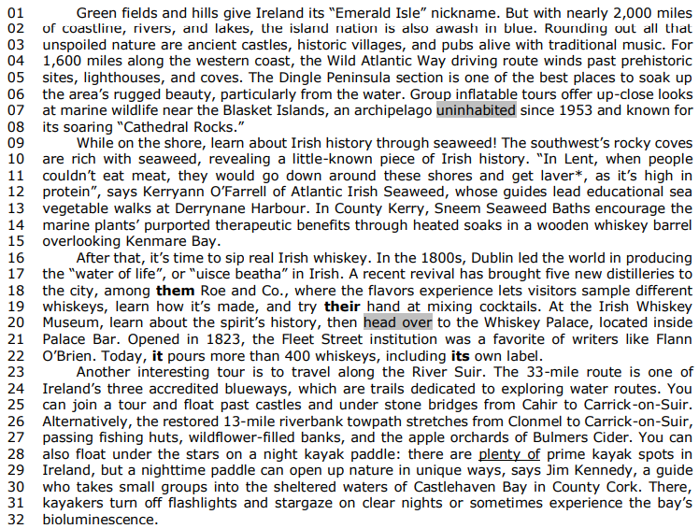
*laver: a type of seaweed / seaweed: alga marinha

(Available at: www.nationalgeographic.com/travel/article/10-best-things-to-do-ireland – text specially adapted for this test).

Analyse the statements below about the excerpt “wooden whiskey barrel” (l. 14):

I. “Wooden” means “made of wood”.
II. “Wooden” is an adjective that modifies/describes the word “whiskey”.
III. “Whiskey” specifies what kind of barrel it is.

Which statements are correct?
 

Provas

Questão presente nas seguintes provas
3079039 Ano: 2024
Disciplina: Inglês (Língua Inglesa)
Banca: FUNDATEC
Orgão: CETENE

Things to do in Ireland


Enunciado 3345176-1


*laver: a type of seaweed / seaweed: alga marinha

(Available at: www.nationalgeographic.com/travel/article/10-best-things-to-do-ireland – text specially adapted for this test).

Considering the context presented in the text, it is possible to say that the excerpt “In Lent, when people couldn’t eat meat, they would go down around these shores and get laver” (l. 10-11) describes:
 

Provas

Questão presente nas seguintes provas
3079038 Ano: 2024
Disciplina: Inglês (Língua Inglesa)
Banca: FUNDATEC
Orgão: CETENE

Things to do in Ireland


Enunciado 3345175-1


*laver: a type of seaweed / seaweed: alga marinha

(Available at: www.nationalgeographic.com/travel/article/10-best-things-to-do-ireland – text specially adapted for this test).

The highlighted word “uninhabited” (l. 07) suggests that the number of people living in Blasket Islands is:
 

Provas

Questão presente nas seguintes provas
3079037 Ano: 2024
Disciplina: Inglês (Língua Inglesa)
Banca: FUNDATEC
Orgão: CETENE

Things to do in Ireland


Enunciado 3345174-1


*laver: a type of seaweed / seaweed: alga marinha

(Available at: www.nationalgeographic.com/travel/article/10-best-things-to-do-ireland – text specially adapted for this test).

Mark the INCORRECT statement about the text.
 

Provas

Questão presente nas seguintes provas
3079036 Ano: 2024
Disciplina: Inglês (Língua Inglesa)
Banca: FUNDATEC
Orgão: CETENE

Things to do in Ireland


Enunciado 3345173-1


*laver: a type of seaweed / seaweed: alga marinha

(Available at: www.nationalgeographic.com/travel/article/10-best-things-to-do-ireland – text specially adapted for this test).

Analyse the statements below about the text and mark T, if true, or F, if false.

( ) Ireland is usually associated with the color green, but the author says it also has a lot of blue.
( ) The only way to get to Blasket Islands is by inflatable boats.
( ) Seaweed is popular in Irish traditional cuisine.

The correct order of filling the parentheses, from top to bottom, is:
 

Provas

Questão presente nas seguintes provas
Audit data analytics, machine learning, and full population testing
Technologies are evolving at an unprecedented pace and pose significant challenges and opportunities to companies and related parties, including the accounting profession. In today’s business environment, it is inevitable for companies to react quickly to changing conditions and markets. Many companies are seeking better ways to utilize emerging technologies to transform how they conduct business. We live in an age of information explosion, with technologies capable of making revolutionary changes in various industries and reshaping business models. At present, many companies view data as one of their most valuable assets. They amass an unprecedented amount of data from their daily business operation and strive to harness the power of data through analytics. Emerging technologies like robotic process automation, machine learning, and data analytics also impact the accounting profession. It is important for the profession to understand the impacts, opportunities, and challenges of these technologies.
Specifically, in audit and assurance areas, data analytics and machine learning will lead to many changes in the foreseeable future. Audit sampling is one such potential change. The use of sampling in audits has been criticized since it only provides a small snapshot of the entire population. To address this major issue, this study introduces the idea of applying audit data analytics and machine learning for full population testing through the concept of “audit-by-exception” and “exceptional exceptions.” In this way, the emphasis of audit work shifts from “transaction examination” to “exception examination” and prioritizes the exceptions based on different criteria. Consequently, auditors can assess the associated risk based on the entire population of the transactions and thus enhance the effectiveness and efficiency of the audit process.
Adapted from the introduction to a study published in: https://www.sciencedirect.com/science/article/pii/S240591882200006X
The verb form in “has been criticized” (2nd paragraph) is in the:
 

Provas

Questão presente nas seguintes provas
Audit data analytics, machine learning, and full population testing
Technologies are evolving at an unprecedented pace and pose significant challenges and opportunities to companies and related parties, including the accounting profession. In today’s business environment, it is inevitable for companies to react quickly to changing conditions and markets. Many companies are seeking better ways to utilize emerging technologies to transform how they conduct business. We live in an age of information explosion, with technologies capable of making revolutionary changes in various industries and reshaping business models. At present, many companies view data as one of their most valuable assets. They amass an unprecedented amount of data from their daily business operation and strive to harness the power of data through analytics. Emerging technologies like robotic process automation, machine learning, and data analytics also impact the accounting profession. It is important for the profession to understand the impacts, opportunities, and challenges of these technologies.
Specifically, in audit and assurance areas, data analytics and machine learning will lead to many changes in the foreseeable future. Audit sampling is one such potential change. The use of sampling in audits has been criticized since it only provides a small snapshot of the entire population. To address this major issue, this study introduces the idea of applying audit data analytics and machine learning for full population testing through the concept of “audit-by-exception” and “exceptional exceptions.” In this way, the emphasis of audit work shifts from “transaction examination” to “exception examination” and prioritizes the exceptions based on different criteria. Consequently, auditors can assess the associated risk based on the entire population of the transactions and thus enhance the effectiveness and efficiency of the audit process.
Adapted from the introduction to a study published in: https://www.sciencedirect.com/science/article/pii/S240591882200006X
A “foreseeable future” (2nd paragraph) is one that:
 

Provas

Questão presente nas seguintes provas
Audit data analytics, machine learning, and full population testing
Technologies are evolving at an unprecedented pace and pose significant challenges and opportunities to companies and related parties, including the accounting profession. In today’s business environment, it is inevitable for companies to react quickly to changing conditions and markets. Many companies are seeking better ways to utilize emerging technologies to transform how they conduct business. We live in an age of information explosion, with technologies capable of making revolutionary changes in various industries and reshaping business models. At present, many companies view data as one of their most valuable assets. They amass an unprecedented amount of data from their daily business operation and strive to harness the power of data through analytics. Emerging technologies like robotic process automation, machine learning, and data analytics also impact the accounting profession. It is important for the profession to understand the impacts, opportunities, and challenges of these technologies.
Specifically, in audit and assurance areas, data analytics and machine learning will lead to many changes in the foreseeable future. Audit sampling is one such potential change. The use of sampling in audits has been criticized since it only provides a small snapshot of the entire population. To address this major issue, this study introduces the idea of applying audit data analytics and machine learning for full population testing through the concept of “audit-by-exception” and “exceptional exceptions.” In this way, the emphasis of audit work shifts from “transaction examination” to “exception examination” and prioritizes the exceptions based on different criteria. Consequently, auditors can assess the associated risk based on the entire population of the transactions and thus enhance the effectiveness and efficiency of the audit process.
Adapted from the introduction to a study published in: https://www.sciencedirect.com/science/article/pii/S240591882200006X
In the sentence “Emerging technologies like robotic process automation” (1st paragraph), “like” expresses:
 

Provas

Questão presente nas seguintes provas
Audit data analytics, machine learning, and full population testing
Technologies are evolving at an unprecedented pace and pose significant challenges and opportunities to companies and related parties, including the accounting profession. In today’s business environment, it is inevitable for companies to react quickly to changing conditions and markets. Many companies are seeking better ways to utilize emerging technologies to transform how they conduct business. We live in an age of information explosion, with technologies capable of making revolutionary changes in various industries and reshaping business models. At present, many companies view data as one of their most valuable assets. They amass an unprecedented amount of data from their daily business operation and strive to harness the power of data through analytics. Emerging technologies like robotic process automation, machine learning, and data analytics also impact the accounting profession. It is important for the profession to understand the impacts, opportunities, and challenges of these technologies.
Specifically, in audit and assurance areas, data analytics and machine learning will lead to many changes in the foreseeable future. Audit sampling is one such potential change. The use of sampling in audits has been criticized since it only provides a small snapshot of the entire population. To address this major issue, this study introduces the idea of applying audit data analytics and machine learning for full population testing through the concept of “audit-by-exception” and “exceptional exceptions.” In this way, the emphasis of audit work shifts from “transaction examination” to “exception examination” and prioritizes the exceptions based on different criteria. Consequently, auditors can assess the associated risk based on the entire population of the transactions and thus enhance the effectiveness and efficiency of the audit process.
Adapted from the introduction to a study published in: https://www.sciencedirect.com/science/article/pii/S240591882200006X
In “They amass” (1st paragraph), the pronoun refers to:
 

Provas

Questão presente nas seguintes provas
Audit data analytics, machine learning, and full population testing
Technologies are evolving at an unprecedented pace and pose significant challenges and opportunities to companies and related parties, including the accounting profession. In today’s business environment, it is inevitable for companies to react quickly to changing conditions and markets. Many companies are seeking better ways to utilize emerging technologies to transform how they conduct business. We live in an age of information explosion, with technologies capable of making revolutionary changes in various industries and reshaping business models. At present, many companies view data as one of their most valuable assets. They amass an unprecedented amount of data from their daily business operation and strive to harness the power of data through analytics. Emerging technologies like robotic process automation, machine learning, and data analytics also impact the accounting profession. It is important for the profession to understand the impacts, opportunities, and challenges of these technologies.
Specifically, in audit and assurance areas, data analytics and machine learning will lead to many changes in the foreseeable future. Audit sampling is one such potential change. The use of sampling in audits has been criticized since it only provides a small snapshot of the entire population. To address this major issue, this study introduces the idea of applying audit data analytics and machine learning for full population testing through the concept of “audit-by-exception” and “exceptional exceptions.” In this way, the emphasis of audit work shifts from “transaction examination” to “exception examination” and prioritizes the exceptions based on different criteria. Consequently, auditors can assess the associated risk based on the entire population of the transactions and thus enhance the effectiveness and efficiency of the audit process.
Adapted from the introduction to a study published in: https://www.sciencedirect.com/science/article/pii/S240591882200006X
Based on the text, mark the statements below as TRUE (T) or FALSE (F):

( ) Many companies nowadays tend to overlook data gathering.
( ) The accounting profession has managed to resist the impact of technology.
( ) In the study mentioned by the text, full population testing is to be preferred to sampling.

The statements are, respectively:
 

Provas

Questão presente nas seguintes provas