Foram encontradas 45.349 questões.
How good is the U.S. economy? It’s beating pre-pandemic predictions.
Americans might be reluctant to believe it, but on paper, the U.S. economy is doing pretty well. So well, in fact, that we’re performing better than forecasts made even before the pandemic began.
The nation’s employers added another 199,000 jobs in November, the U.S. Bureau of Labor Statistics reported on Friday. This means that overall employment is now 2 million jobs higher than was expected by now in forecasts made way back in January 2020 by the nonpartisan Congressional Budget Office.
The job market isn’t the only front on which we have bested forecasts made before the pandemic. The overall size of the economy, as measured by gross domestic product, is larger than it was expected to be around now. The International Monetary Fund says that U.S. gross domestic product is higher today, in inflation-adjusted terms, than it had expected at the beginning of 2020. The IMF ran these calculations for countries around the world, and found the United States was an outlier in beating the organization’s pre-covid forecasts.
So why did well-regarded professional forecasters underestimate the strength of the economy? And how is it that jobs and GDP are doing better than they expected, even as inflation has been unmistakably worse?
To some extent, all these things are related. Forecasters obviously did not anticipate the pandemic. They also did not anticipate the unprecedentedly enormous government response to the coronavirus. When the public health crisis hit and disemployed millions of American workers, policymakers implemented unusually generous fiscal and monetary stimulus.
Such measures helped get people back to work sooner, and avoided the long, painful effort back to normal that had followed the Great Recession. Thus, faster job growth. They also massively amplified consumer demand, at a time when the productive capacity of the economy (i.e., companies’ ability to make and deliver the things their customers want) couldn’t keep up. Employers faced all kinds of shortages — of products, materials, workers — and consumers anxious to buy stuff raised the prices of whatever inventory companies actually had available. Thus, faster price growth.
If you had asked me back in January 2020 how Americans might feel about an economy with an “extra” 2 million jobs, unemployment less than 4 percent, and inflation just over 3 percent, I probably would have guessed the public would be pretty content. However people are still furious about the extra price growth they’ve already endured to date, and unimpressed by all that extra job growth. Maybe it’s human nature for people to view better jobs or pay as things they’ve earned, while a painful price increase is something inflicted upon them — even if both are, to some extent, two sides of the same coin.
Available at: https://www.washingtonpost.com/opinions/ 2023/12/08/jobs-report-economy-beats-pandemicpredictions/. Retrieved on: Dec. 12, 2023. Adapted.
In the sentence “Forecasters obviously did not anticipate the pandemic” (Text I, paragraph 5) the term anticipate could be replaced, with no change in meaning, by
Provas

How good is the U.S. economy? It’s beating pre-pandemic predictions.
Americans might be reluctant to believe it, but on paper, the U.S. economy is doing pretty well. So well, in fact, that we’re performing better than forecasts made even before the pandemic began.
The nation’s employers added another 199,000 jobs in November, the U.S. Bureau of Labor Statistics reported on Friday. This means that overall employment is now 2 million jobs higher than was expected by now in forecasts made way back in January 2020 by the nonpartisan Congressional Budget Office.
The job market isn’t the only front on which we have bested forecasts made before the pandemic. The overall size of the economy, as measured by gross domestic product, is larger than it was expected to be around now. The International Monetary Fund says that U.S. gross domestic product is higher today, in inflation-adjusted terms, than it had expected at the beginning of 2020. The IMF ran these calculations for countries around the world, and found the United States was an outlier in beating the organization’s pre-covid forecasts.
So why did well-regarded professional forecasters underestimate the strength of the economy? And how is it that jobs and GDP are doing better than they expected, even as inflation has been unmistakably worse?
To some extent, all these things are related. Forecasters obviously did not anticipate the pandemic. They also did not anticipate the unprecedentedly enormous government response to the coronavirus. When the public health crisis hit and disemployed millions of American workers, policymakers implemented unusually generous fiscal and monetary stimulus.
Such measures helped get people back to work sooner, and avoided the long, painful effort back to normal that had followed the Great Recession. Thus, faster job growth. They also massively amplified consumer demand, at a time when the productive capacity of the economy (i.e., companies’ ability to make and deliver the things their customers want) couldn’t keep up. Employers faced all kinds of shortages — of products, materials, workers — and consumers anxious to buy stuff raised the prices of whatever inventory companies actually had available. Thus, faster price growth.
If you had asked me back in January 2020 how Americans might feel about an economy with an “extra” 2 million jobs, unemployment less than 4 percent, and inflation just over 3 percent, I probably would have guessed the public would be pretty content. However people are still furious about the extra price growth they’ve already endured to date, and unimpressed by all that extra job growth. Maybe it’s human nature for people to view better jobs or pay as things they’ve earned, while a painful price increase is something inflicted upon them — even if both are, to some extent, two sides of the same coin.
Available at: https://www.washingtonpost.com/opinions/ 2023/12/08/jobs-report-economy-beats-pandemicpredictions/. Retrieved on: Dec. 12, 2023. Adapted.
In Text I, in paragraph 4, one of the questions is “why did well-regarded professional forecasters underestimate the strength of the economy?”.
The expression well-regarded professional forecasters can be rewritten, with no change in meaning, as
Provas
How good is the U.S. economy? It’s beating pre-pandemic predictions.
Americans might be reluctant to believe it, but on paper, the U.S. economy is doing pretty well. So well, in fact, that we’re performing better than forecasts made even before the pandemic began.
The nation’s employers added another 199,000 jobs in November, the U.S. Bureau of Labor Statistics reported on Friday. This means that overall employment is now 2 million jobs higher than was expected by now in forecasts made way back in January 2020 by the nonpartisan Congressional Budget Office.
The job market isn’t the only front on which we have bested forecasts made before the pandemic. The overall size of the economy, as measured by gross domestic product, is larger than it was expected to be around now. The International Monetary Fund says that U.S. gross domestic product is higher today, in inflation-adjusted terms, than it had expected at the beginning of 2020. The IMF ran these calculations for countries around the world, and found the United States was an outlier in beating the organization’s pre-covid forecasts.
So why did well-regarded professional forecasters underestimate the strength of the economy? And how is it that jobs and GDP are doing better than they expected, even as inflation has been unmistakably worse?
To some extent, all these things are related. Forecasters obviously did not anticipate the pandemic. They also did not anticipate the unprecedentedly enormous government response to the coronavirus. When the public health crisis hit and disemployed millions of American workers, policymakers implemented unusually generous fiscal and monetary stimulus.
Such measures helped get people back to work sooner, and avoided the long, painful effort back to normal that had followed the Great Recession. Thus, faster job growth. They also massively amplified consumer demand, at a time when the productive capacity of the economy (i.e., companies’ ability to make and deliver the things their customers want) couldn’t keep up. Employers faced all kinds of shortages — of products, materials, workers — and consumers anxious to buy stuff raised the prices of whatever inventory companies actually had available. Thus, faster price growth.
If you had asked me back in January 2020 how Americans might feel about an economy with an “extra” 2 million jobs, unemployment less than 4 percent, and inflation just over 3 percent, I probably would have guessed the public would be pretty content. However people are still furious about the extra price growth they’ve already endured to date, and unimpressed by all that extra job growth. Maybe it’s human nature for people to view better jobs or pay as things they’ve earned, while a painful price increase is something inflicted upon them — even if both are, to some extent, two sides of the same coin.
Available at: https://www.washingtonpost.com/opinions/ 2023/12/08/jobs-report-economy-beats-pandemicpredictions/. Retrieved on: Dec. 12, 2023. Adapted.
According to Text I,
Provas
Essen: Germany's 'ugly duckling' city success (by Norman Miller)
Thanks to an innovative approach, the Germany city has catapulted from an industrial wasteland to one of Europe’s greened cities.
Located in the heart of western Germany's long-time industrial Ruhr region, the city of Essen spent much of the past 150 years marred by pollution, tainted by filthy mines and belching factories and lined by poisoned waterways. In just one year in the 1960s, a study noted that some 1.5 million tons of toxic dust, ashes and soot rained down on Essen's inhabitants, along with four million tons of sulphur dioxide. But a remarkable transformation has seen Essen go from being Germany's ugly duckling to one of Europe's greenest cities.
"Green urban development has acted as a driving force in Essen over the last decade," explained Simone Raskob, who helped oversee Essen's transformation through a mix of so-called Blue Green solutions: "Blue" for water-focused initiatives, and "Green" for land-based projects. This two-pronged approach helped catapult Essen to be declared the European Green Capital for 2017.
Essen's most high-profile project is the transformation of the Zollverein industrial complex – once the world's largest coal and coke production facility – from toxin-spewing industrial blackspot to an inspiring eco-park granted Unesco World Heritage status. Inside its giant former coal washing building, the impressive Ruhr Museum enthrals visitors with displays on the site's history and transformation between towering old machinery. A short walk away, the Red Dot Design Museum showcases examples of innovative global design in a former boiler house building repurposed by renowned architect Norman Foster. Ever since mining at Zollverein and the surrounding region ended in the late 1980s, woodland has spread across the vast site, and its trail-laced expanses are now home to more than 800 animal and plant species.
Yet, Essen isn't resting on its green laurels and is continuing to add eco-friendly initiatives. A 100km cycling 'super-highway’ is slowly taking shape atop old industrial railways. A string of nature-walking trails have also been created in and around the city to help boost local engagement with – and appreciation of – natural habitats. All the trails are easily accessible by public transport.
Among the city's many transformations are the creation of lakes and ponds by harvesting rainwater. But perhaps the toughest of Essen's solutions involved restoring the River Emscher, considered a biologically dead "open sewer" since the end of the 19th Century, thanks to the dumping of mining and factory slurry and waste water. After a two-decade clean-up programme, trout once again returned to the rejuvenated river in 2015. A recent count found more than 1,000 fish and animal species living along the Emscher, including previously endangered lapwings, kingfishers and beavers.
Though humans aren't yet encouraged to join the trout in the Emscher, an arena for swimming and boating hums with activity at Lake Baldeney, a broad expanse of water created behind a 9m dam on the similarly cleaned-up Ruhr river. When swimmers splashed here back in 2017, it was the first time bathing had been officially allowed there for 46 years.
From German eyesore to proud green city, Essen's green-and-blue approach isn't just benefitting outdoor enthusiasts and the environment but is also providing a shining example of how other cities can look to their industrial past to embrace a cleaner future.
Adapted from: https://www.bbc.com/travel/article/20231106-essen-germanys-ugly-duckling-city-success. Access on: 13 nov. 2023.
Select the alternative which brings, according to the article, the most appropriate piece of advice to a tourist who wants to visit River Emscher and Lake Baldeney.
Provas
Essen: Germany's 'ugly duckling' city success (by Norman Miller)
Thanks to an innovative approach, the Germany city has catapulted from an industrial wasteland to one of Europe’s greened cities.
Located in the heart of western Germany's long-time industrial Ruhr region, the city of Essen spent much of the past 150 years marred by pollution, tainted by filthy mines and belching factories and lined by poisoned waterways. In just one year in the 1960s, a study noted that some 1.5 million tons of toxic dust, ashes and soot rained down on Essen's inhabitants, along with four million tons of sulphur dioxide. But a remarkable transformation has seen Essen go from being Germany's ugly duckling to one of Europe's greenest cities.
"Green urban development has acted as a driving force in Essen over the last decade," explained Simone Raskob, who helped oversee Essen's transformation through a mix of so-called Blue Green solutions: "Blue" for water-focused initiatives, and "Green" for land-based projects. This two-pronged approach helped catapult Essen to be declared the European Green Capital for 2017.
Essen's most high-profile project is the transformation of the Zollverein industrial complex – once the world's largest coal and coke production facility – from toxin-spewing industrial blackspot to an inspiring eco-park granted Unesco World Heritage status. Inside its giant former coal washing building, the impressive Ruhr Museum enthrals visitors with displays on the site's history and transformation between towering old machinery. A short walk away, the Red Dot Design Museum showcases examples of innovative global design in a former boiler house building repurposed by renowned architect Norman Foster. Ever since mining at Zollverein and the surrounding region ended in the late 1980s, woodland has spread across the vast site, and its trail-laced expanses are now home to more than 800 animal and plant species.
Yet, Essen isn't resting on its green laurels and is continuing to add eco-friendly initiatives. A 100km cycling 'super-highway’ is slowly taking shape atop old industrial railways. A string of nature-walking trails have also been created in and around the city to help boost local engagement with – and appreciation of – natural habitats. All the trails are easily accessible by public transport.
Among the city's many transformations are the creation of lakes and ponds by harvesting rainwater. But perhaps the toughest of Essen's solutions involved restoring the River Emscher, considered a biologically dead "open sewer" since the end of the 19th Century, thanks to the dumping of mining and factory slurry and waste water. After a two-decade clean-up programme, trout once again returned to the rejuvenated river in 2015. A recent count found more than 1,000 fish and animal species living along the Emscher, including previously endangered lapwings, kingfishers and beavers.
Though humans aren't yet encouraged to join the trout in the Emscher, an arena for swimming and boating hums with activity at Lake Baldeney, a broad expanse of water created behind a 9m dam on the similarly cleaned-up Ruhr river. When swimmers splashed here back in 2017, it was the first time bathing had been officially allowed there for 46 years.
From German eyesore to proud green city, Essen's green-and-blue approach isn't just benefitting outdoor enthusiasts and the environment but is also providing a shining example of how other cities can look to their industrial past to embrace a cleaner future.
Adapted from: https://www.bbc.com/travel/article/20231106-essen-germanys-ugly-duckling-city-success. Access on: 13 nov. 2023.
Consider the following extract from of the article:
“Ever since mining at Zollverein and the surrounding region ended in the late 1980s, woodland has spread across the vast site, and its trail-laced expanses are now home to more than 800 animal and plant species”.
Select the alternative which brings the most appropriate conclusion according to the extract of the article.
Provas
Essen: Germany's 'ugly duckling' city success (by Norman Miller)
Thanks to an innovative approach, the Germany city has catapulted from an industrial wasteland to one of Europe’s greened cities.
Located in the heart of western Germany's long-time industrial Ruhr region, the city of Essen spent much of the past 150 years marred by pollution, tainted by filthy mines and belching factories and lined by poisoned waterways. In just one year in the 1960s, a study noted that some 1.5 million tons of toxic dust, ashes and soot rained down on Essen's inhabitants, along with four million tons of sulphur dioxide. But a remarkable transformation has seen Essen go from being Germany's ugly duckling to one of Europe's greenest cities.
"Green urban development has acted as a driving force in Essen over the last decade," explained Simone Raskob, who helped oversee Essen's transformation through a mix of so-called Blue Green solutions: "Blue" for water-focused initiatives, and "Green" for land-based projects. This two-pronged approach helped catapult Essen to be declared the European Green Capital for 2017.
Essen's most high-profile project is the transformation of the Zollverein industrial complex – once the world's largest coal and coke production facility – from toxin-spewing industrial blackspot to an inspiring eco-park granted Unesco World Heritage status. Inside its giant former coal washing building, the impressive Ruhr Museum enthrals visitors with displays on the site's history and transformation between towering old machinery. A short walk away, the Red Dot Design Museum showcases examples of innovative global design in a former boiler house building repurposed by renowned architect Norman Foster. Ever since mining at Zollverein and the surrounding region ended in the late 1980s, woodland has spread across the vast site, and its trail-laced expanses are now home to more than 800 animal and plant species.
Yet, Essen isn't resting on its green laurels and is continuing to add eco-friendly initiatives. A 100km cycling 'super-highway’ is slowly taking shape atop old industrial railways. A string of nature-walking trails have also been created in and around the city to help boost local engagement with – and appreciation of – natural habitats. All the trails are easily accessible by public transport.
Among the city's many transformations are the creation of lakes and ponds by harvesting rainwater. But perhaps the toughest of Essen's solutions involved restoring the River Emscher, considered a biologically dead "open sewer" since the end of the 19th Century, thanks to the dumping of mining and factory slurry and waste water. After a two-decade clean-up programme, trout once again returned to the rejuvenated river in 2015. A recent count found more than 1,000 fish and animal species living along the Emscher, including previously endangered lapwings, kingfishers and beavers.
Though humans aren't yet encouraged to join the trout in the Emscher, an arena for swimming and boating hums with activity at Lake Baldeney, a broad expanse of water created behind a 9m dam on the similarly cleaned-up Ruhr river. When swimmers splashed here back in 2017, it was the first time bathing had been officially allowed there for 46 years.
From German eyesore to proud green city, Essen's green-and-blue approach isn't just benefitting outdoor enthusiasts and the environment but is also providing a shining example of how other cities can look to their industrial past to embrace a cleaner future.
Adapted from: https://www.bbc.com/travel/article/20231106-essen-germanys-ugly-duckling-city-success. Access on: 13 nov. 2023.
The following words / phrases have been underlined on the article. In the context of the text, all of them have a positive meaning, EXCEPT for
Provas
Essen: Germany's 'ugly duckling' city success (by Norman Miller)
Thanks to an innovative approach, the Germany city has catapulted from an industrial wasteland to one of Europe’s greened cities.
Located in the heart of western Germany's long-time industrial Ruhr region, the city of Essen spent much of the past 150 years marred by pollution, tainted by filthy mines and belching factories and lined by poisoned waterways. In just one year in the 1960s, a study noted that some 1.5 million tons of toxic dust, ashes and soot rained down on Essen's inhabitants, along with four million tons of sulphur dioxide. But a remarkable transformation has seen Essen go from being Germany's ugly duckling to one of Europe's greenest cities.
"Green urban development has acted as a driving force in Essen over the last decade," explained Simone Raskob, who helped oversee Essen's transformation through a mix of so-called Blue Green solutions: "Blue" for water-focused initiatives, and "Green" for land-based projects. This two-pronged approach helped catapult Essen to be declared the European Green Capital for 2017.
Essen's most high-profile project is the transformation of the Zollverein industrial complex – once the world's largest coal and coke production facility – from toxin-spewing industrial blackspot to an inspiring eco-park granted Unesco World Heritage status. Inside its giant former coal washing building, the impressive Ruhr Museum enthrals visitors with displays on the site's history and transformation between towering old machinery. A short walk away, the Red Dot Design Museum showcases examples of innovative global design in a former boiler house building repurposed by renowned architect Norman Foster. Ever since mining at Zollverein and the surrounding region ended in the late 1980s, woodland has spread across the vast site, and its trail-laced expanses are now home to more than 800 animal and plant species.
Yet, Essen isn't resting on its green laurels and is continuing to add eco-friendly initiatives. A 100km cycling 'super-highway’ is slowly taking shape atop old industrial railways. A string of nature-walking trails have also been created in and around the city to help boost local engagement with – and appreciation of – natural habitats. All the trails are easily accessible by public transport.
Among the city's many transformations are the creation of lakes and ponds by harvesting rainwater. But perhaps the toughest of Essen's solutions involved restoring the River Emscher, considered a biologically dead "open sewer" since the end of the 19th Century, thanks to the dumping of mining and factory slurry and waste water. After a two-decade clean-up programme, trout once again returned to the rejuvenated river in 2015. A recent count found more than 1,000 fish and animal species living along the Emscher, including previously endangered lapwings, kingfishers and beavers.
Though humans aren't yet encouraged to join the trout in the Emscher, an arena for swimming and boating hums with activity at Lake Baldeney, a broad expanse of water created behind a 9m dam on the similarly cleaned-up Ruhr river. When swimmers splashed here back in 2017, it was the first time bathing had been officially allowed there for 46 years.
From German eyesore to proud green city, Essen's green-and-blue approach isn't just benefitting outdoor enthusiasts and the environment but is also providing a shining example of how other cities can look to their industrial past to embrace a cleaner future.
Adapted from: https://www.bbc.com/travel/article/20231106-essen-germanys-ugly-duckling-city-success. Access on: 13 nov. 2023.
The article describes a green-and-blue approach to the renovation of the German city of Essen. Considering what green and blue solutions are, according to the text, decide whether the following initiatives are part of the green solution group or the blue solution group:
1. developing lakes with rainwater;
2. creating the Lake Baldeney arena;
3. transforming the Zollverein industrial complex;
4. restoring the River Emscher;
5. constructing of a cycling highway.
Now select the alternative which correctly matches each of these initiatives to their respective group.
Provas
Essen: Germany's 'ugly duckling' city success (by Norman Miller)
Thanks to an innovative approach, the Germany city has catapulted from an industrial wasteland to one of Europe’s greened cities.
Located in the heart of western Germany's long-time industrial Ruhr region, the city of Essen spent much of the past 150 years marred by pollution, tainted by filthy mines and belching factories and lined by poisoned waterways. In just one year in the 1960s, a study noted that some 1.5 million tons of toxic dust, ashes and soot rained down on Essen's inhabitants, along with four million tons of sulphur dioxide. But a remarkable transformation has seen Essen go from being Germany's ugly duckling to one of Europe's greenest cities.
"Green urban development has acted as a driving force in Essen over the last decade," explained Simone Raskob, who helped oversee Essen's transformation through a mix of so-called Blue Green solutions: "Blue" for water-focused initiatives, and "Green" for land-based projects. This two-pronged approach helped catapult Essen to be declared the European Green Capital for 2017.
Essen's most high-profile project is the transformation of the Zollverein industrial complex – once the world's largest coal and coke production facility – from toxin-spewing industrial blackspot to an inspiring eco-park granted Unesco World Heritage status. Inside its giant former coal washing building, the impressive Ruhr Museum enthrals visitors with displays on the site's history and transformation between towering old machinery. A short walk away, the Red Dot Design Museum showcases examples of innovative global design in a former boiler house building repurposed by renowned architect Norman Foster. Ever since mining at Zollverein and the surrounding region ended in the late 1980s, woodland has spread across the vast site, and its trail-laced expanses are now home to more than 800 animal and plant species.
Yet, Essen isn't resting on its green laurels and is continuing to add eco-friendly initiatives. A 100km cycling 'super-highway’ is slowly taking shape atop old industrial railways. A string of nature-walking trails have also been created in and around the city to help boost local engagement with – and appreciation of – natural habitats. All the trails are easily accessible by public transport.
Among the city's many transformations are the creation of lakes and ponds by harvesting rainwater. But perhaps the toughest of Essen's solutions involved restoring the River Emscher, considered a biologically dead "open sewer" since the end of the 19th Century, thanks to the dumping of mining and factory slurry and waste water. After a two-decade clean-up programme, trout once again returned to the rejuvenated river in 2015. A recent count found more than 1,000 fish and animal species living along the Emscher, including previously endangered lapwings, kingfishers and beavers.
Though humans aren't yet encouraged to join the trout in the Emscher, an arena for swimming and boating hums with activity at Lake Baldeney, a broad expanse of water created behind a 9m dam on the similarly cleaned-up Ruhr river. When swimmers splashed here back in 2017, it was the first time bathing had been officially allowed there for 46 years.
From German eyesore to proud green city, Essen's green-and-blue approach isn't just benefitting outdoor enthusiasts and the environment but is also providing a shining example of how other cities can look to their industrial past to embrace a cleaner future.
Adapted from: https://www.bbc.com/travel/article/20231106-essen-germanys-ugly-duckling-city-success. Access on: 13 nov. 2023.
Analyze the following statements according to the article:
I. Essen was heavily affected by pollution, experiencing significant environmental degradation for the last century and a half.
II. In the Zollverein complex, old buildings have been remodeled into modern, sustainable and environmentally-friendly industries.
III. Although a cycling highway is under development and places to go hiking and be in touch with nature are now available, there are still challenges for people to access them.
IV. Once deemed biologically lifeless, fish and other animal species can only be seen in the River Emscher again due to its restoration, which took twenty years.
V. People have not been able to go in the Lake Baldeney since 2017, but this is about to change because of Essen’s green-and-blue approach.
The statements which bring only completely accurate information are:
Provas
The Reasons Why We Dance
- As a choreographer, I get asked to share my opinion about a myriad of dance-related
- topics, from the practical, like “How can dance help you get in shape?” to the existential, like “Is
- my dancing a projection of my self-image?”. But the question I think matters most is: why do
- people dance? What is about moving our bodies to a song we love that is so joyfully Pavlovian?
- Why do we watch videos and take lessons on something that could be labeled as trivial? Why do
- we love it so?
- There are the obvious answers. We dance for physical fitness, mental clarity, emotional
- stability, and other such pluses. However, all these benefits could be attained by other means –
- though I confess I have yet to find a better alternative than a great “cha cha”* to lift both one’s
- heart rate and spirits. There must be something glorious about dancing that is more than just
- intangible. We cannot seem to explain it, yet we all know it so well that we do not hesitate to
- tap our feet to a Gershwin melody or pulse with the percussion of a samba rhythm.
- Perhaps dance is the way we express ourselves when words are insufficient. The joy we
- feel over newfound love, the determination we have in the face of great sorrow or adversity, the
- passionate fire of our youth, and the peacefulness of our softer and more graceful years – maybe
- they are never expressed more fully than through a waltz, or a tango, or a jive. We all want to
- be understood, and if we could truly speak the words that describe our feelings, how deep and
- powerful they would surely be. But alas, those words never seem to come to us just right. Maybe
- dance is simply a translator for the human heart.
- Perhaps dance is the medium through which we show the world who we truly are and who
- we can be. All of us, if we are honest, believe deep down that we are not ordinary. We know
- ourselves to be wonderfully unique, with many layers of personality and talent woven in such a
- way that no one on earth could possibly have our same make-up. We know it. We just do not
- always know how to prove it. Maybe dance gives us the opportunity. And perhaps dance is how
- we choose to remember, how we hold on to the past. It is how we relive __ fun-filled days of
- our youth or __ time we looked into their eyes and knew they were the one. It is our tribute to
- the heroes of yesterday who jitterbugged like carefree boys and girls, when tomorrow they would
- march as men and women to defend freedom’s cause. It is the chance to be __ princess again,
- waiting for __ outstretched hand and the call to __ romance that is graceful, true, and not as
- forgotten as the cynics say. When we dance, we can remember them all a little better, feel the
- butterflies once again, and if only for a moment, return to the purest part of our lives when time
- was of no matter…for we were dancing.
- Why do we dance? Every answer will be different, and that is as it should be. Perhaps the
- better question is, “Why would we not?”
*Cha Cha: an energetic modern dance.
(Available in: https://dancewithmeusa.com/why-we-dance-the-reasons/ – text especially adapted for this test).
In the image below we see a man who is taking dancing lessons and a woman who is saying “There are only two things stopping you from being a good dancer, Mr. Jones. Your feet!”
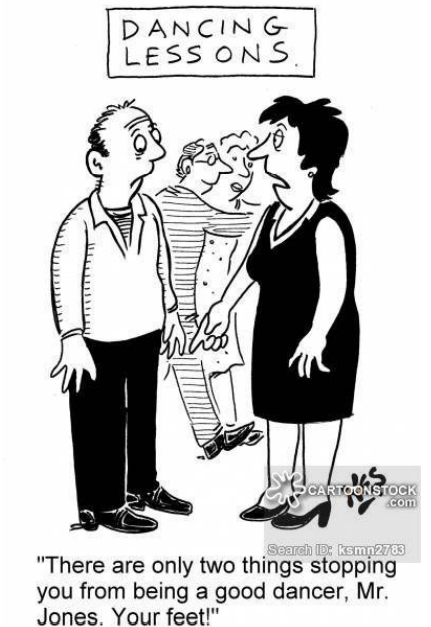
The word “dancer” is formed by adding a suffix to the verb “dance.” Which of the words below does NOT take the suffix -er when used as a noun describing professions?
Provas
The Reasons Why We Dance
- As a choreographer, I get asked to share my opinion about a myriad of dance-related
- topics, from the practical, like “How can dance help you get in shape?” to the existential, like “Is
- my dancing a projection of my self-image?”. But the question I think matters most is: why do
- people dance? What is about moving our bodies to a song we love that is so joyfully Pavlovian?
- Why do we watch videos and take lessons on something that could be labeled as trivial? Why do
- we love it so?
- There are the obvious answers. We dance for physical fitness, mental clarity, emotional
- stability, and other such pluses. However, all these benefits could be attained by other means –
- though I confess I have yet to find a better alternative than a great “cha cha”* to lift both one’s
- heart rate and spirits. There must be something glorious about dancing that is more than just
- intangible. We cannot seem to explain it, yet we all know it so well that we do not hesitate to
- tap our feet to a Gershwin melody or pulse with the percussion of a samba rhythm.
- Perhaps dance is the way we express ourselves when words are insufficient. The joy we
- feel over newfound love, the determination we have in the face of great sorrow or adversity, the
- passionate fire of our youth, and the peacefulness of our softer and more graceful years – maybe
- they are never expressed more fully than through a waltz, or a tango, or a jive. We all want to
- be understood, and if we could truly speak the words that describe our feelings, how deep and
- powerful they would surely be. But alas, those words never seem to come to us just right. Maybe
- dance is simply a translator for the human heart.
- Perhaps dance is the medium through which we show the world who we truly are and who
- we can be. All of us, if we are honest, believe deep down that we are not ordinary. We know
- ourselves to be wonderfully unique, with many layers of personality and talent woven in such a
- way that no one on earth could possibly have our same make-up. We know it. We just do not
- always know how to prove it. Maybe dance gives us the opportunity. And perhaps dance is how
- we choose to remember, how we hold on to the past. It is how we relive __ fun-filled days of
- our youth or __ time we looked into their eyes and knew they were the one. It is our tribute to
- the heroes of yesterday who jitterbugged like carefree boys and girls, when tomorrow they would
- march as men and women to defend freedom’s cause. It is the chance to be __ princess again,
- waiting for __ outstretched hand and the call to __ romance that is graceful, true, and not as
- forgotten as the cynics say. When we dance, we can remember them all a little better, feel the
- butterflies once again, and if only for a moment, return to the purest part of our lives when time
- was of no matter…for we were dancing.
- Why do we dance? Every answer will be different, and that is as it should be. Perhaps the
- better question is, “Why would we not?”
*Cha Cha: an energetic modern dance.
(Available in: https://dancewithmeusa.com/why-we-dance-the-reasons/ – text especially adapted for this test).
In the adapted excerpt “If we could truly speak the words that describe our feelings, they would surely be deep and powerful”, we have an example of:
Provas
Caderno Container