Foram encontradas 45.123 questões.
Leia o texto para responder às questões de números 31 a 35.
Discussions of Communicative Language Teaching (CLT) not infrequently lead to questions of grammatical or formal accuracy. The perceived displacement of attention to morphosyntactic features in learner expression in favor of a focus on meaning has led in some cases to the impression that grammar is unimportant or that proponents of CLT favor learner self-expression without regard to form. While involvement in communicative events is seen as central to language development, this involvement requires attention to form.
The nature of contribution to language development of both form-focused and meaning-focused classroom activity remains a question in ongoing research. Undoubtedly, the optimum combination of these activities in any given instructional setting depends on a number of factors such as learner age, nature and length of instructional sequence, opportunities for language contact outside the classroom, teacher preparation, among other factors. However, for the development of communicative ability, research findings overwhelmingly support the integration of form-focused exercises with meaning-focused experience. Learners seem to focus best on grammar when it relates to their communicative needs and experiences.
(Sandra J. Savignon. Communicative language teaching for the Twenty-first century. In: Marianne Cerce-Murcia(ed). Teaching English as a second or foreign language. Boston, Massachusstes: Heinle&Heinle. 3rd edition. 2001. Adaptado)
The prefixes in-, dis- and un- can be found in a large number of English words such as “infrequently”, “displacement” and “unimportant” (paragraph 1). Negative prefixes have been correctly added to words in alternative:
Provas

- Língua Inglesa - Compreensão e Interpretação de Texto
- Gramática - Língua InglesaAdvérbios e conjunções | Adverbs and conjunctions
Leia o texto para responder às questões de números 31 a 35.
Discussions of Communicative Language Teaching (CLT) not infrequently lead to questions of grammatical or formal accuracy. The perceived displacement of attention to morphosyntactic features in learner expression in favor of a focus on meaning has led in some cases to the impression that grammar is unimportant or that proponents of CLT favor learner self-expression without regard to form. While involvement in communicative events is seen as central to language development, this involvement requires attention to form.
The nature of contribution to language development of both form-focused and meaning-focused classroom activity remains a question in ongoing research. Undoubtedly, the optimum combination of these activities in any given instructional setting depends on a number of factors such as learner age, nature and length of instructional sequence, opportunities for language contact outside the classroom, teacher preparation, among other factors. However, for the development of communicative ability, research findings overwhelmingly support the integration of form-focused exercises with meaning-focused experience. Learners seem to focus best on grammar when it relates to their communicative needs and experiences.
(Sandra J. Savignon. Communicative language teaching for the Twenty-first century. In: Marianne Cerce-Murcia(ed). Teaching English as a second or foreign language. Boston, Massachusstes: Heinle&Heinle. 3rd edition. 2001. Adaptado)
Viewpoint adverbs express the author’s position about the statement made, modifying entire sentences rather than individual elements within them. The point-of-view adverb “Undoubtedly” means, in the context of the second paragraph,
Provas
Leia o texto para responder às questões de números 31 a 35.
Discussions of Communicative Language Teaching (CLT) not infrequently lead to questions of grammatical or formal accuracy. The perceived displacement of attention to morphosyntactic features in learner expression in favor of a focus on meaning has led in some cases to the impression that grammar is unimportant or that proponents of CLT favor learner self-expression without regard to form. While involvement in communicative events is seen as central to language development, this involvement requires attention to form.
The nature of contribution to language development of both form-focused and meaning-focused classroom activity remains a question in ongoing research. Undoubtedly, the optimum combination of these activities in any given instructional setting depends on a number of factors such as learner age, nature and length of instructional sequence, opportunities for language contact outside the classroom, teacher preparation, among other factors. However, for the development of communicative ability, research findings overwhelmingly support the integration of form-focused exercises with meaning-focused experience. Learners seem to focus best on grammar when it relates to their communicative needs and experiences.
(Sandra J. Savignon. Communicative language teaching for the Twenty-first century. In: Marianne Cerce-Murcia(ed). Teaching English as a second or foreign language. Boston, Massachusstes: Heinle&Heinle. 3rd edition. 2001. Adaptado)
When preparing a reading lesson, a teacher who believes in form-focused language learning experiences will give priority to activities which emphasize, for example, the ability to
Provas
Leia o texto para responder às questões de números 31 a 35.
Discussions of Communicative Language Teaching (CLT) not infrequently lead to questions of grammatical or formal accuracy. The perceived displacement of attention to morphosyntactic features in learner expression in favor of a focus on meaning has led in some cases to the impression that grammar is unimportant or that proponents of CLT favor learner self-expression without regard to form. While involvement in communicative events is seen as central to language development, this involvement requires attention to form.
The nature of contribution to language development of both form-focused and meaning-focused classroom activity remains a question in ongoing research. Undoubtedly, the optimum combination of these activities in any given instructional setting depends on a number of factors such as learner age, nature and length of instructional sequence, opportunities for language contact outside the classroom, teacher preparation, among other factors. However, for the development of communicative ability, research findings overwhelmingly support the integration of form-focused exercises with meaning-focused experience. Learners seem to focus best on grammar when it relates to their communicative needs and experiences.
(Sandra J. Savignon. Communicative language teaching for the Twenty-first century. In: Marianne Cerce-Murcia(ed). Teaching English as a second or foreign language. Boston, Massachusstes: Heinle&Heinle. 3rd edition. 2001. Adaptado)
It is an example of a meaning-focused classroom activity, aimed at fulfilling a genuine communicative purpose:
Provas
Leia o texto para responder às questões de números 31 a 35.
Discussions of Communicative Language Teaching (CLT) not infrequently lead to questions of grammatical or formal accuracy. The perceived displacement of attention to morphosyntactic features in learner expression in favor of a focus on meaning has led in some cases to the impression that grammar is unimportant or that proponents of CLT favor learner self-expression without regard to form. While involvement in communicative events is seen as central to language development, this involvement requires attention to form.
The nature of contribution to language development of both form-focused and meaning-focused classroom activity remains a question in ongoing research. Undoubtedly, the optimum combination of these activities in any given instructional setting depends on a number of factors such as learner age, nature and length of instructional sequence, opportunities for language contact outside the classroom, teacher preparation, among other factors. However, for the development of communicative ability, research findings overwhelmingly support the integration of form-focused exercises with meaning-focused experience. Learners seem to focus best on grammar when it relates to their communicative needs and experiences.
(Sandra J. Savignon. Communicative language teaching for the Twenty-first century. In: Marianne Cerce-Murcia(ed). Teaching English as a second or foreign language. Boston, Massachusstes: Heinle&Heinle. 3rd edition. 2001. Adaptado)
Depreende-se da leitura do texto que, para manter a coerência com os princípios do ensino comunicativo, a avaliação do desenvolvimento da competência comunicativa deverá
Provas
O cartum é um gênero textual que, frequentemente, ajuda a compor unidades de ensino em diferentes disciplinas. São exemplos de gêneros presentes em aulas de língua inglesa:
Provas
Leia o cartum.
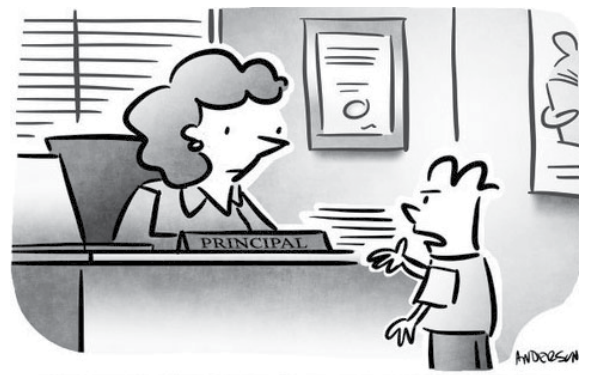
"Every yaer Hollywood makes tons of remakes and
nobody bats an eye. I remake someone else's
homework and now i'm here!"
(https://andertoons.com)
In the cartoon, the boy
Provas
Disciplina: Inglês (Língua Inglesa)
Banca: Aroeira
Orgão: Pref. Vianópolis-GO
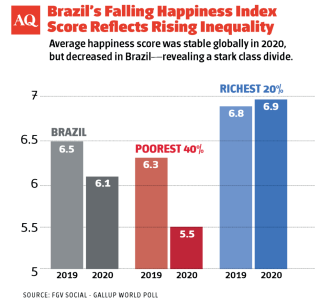
Disponível em: www.americasquarterly.org/article/inequality-is-
-brazils-achilles-heel/. Acesso em: 07 nov. 2023. (Adaptado)
Provas
Disciplina: Inglês (Língua Inglesa)
Banca: Aroeira
Orgão: Pref. Vianópolis-GO
Disponível em: www.americasquarterly.org/article/inequality-is-
-brazils-achilles-heel/. Acesso em: 07 nov. 2023. (Adaptado)
Provas
Disciplina: Inglês (Língua Inglesa)
Banca: Aroeira
Orgão: Pref. Vianópolis-GO

Disponível em: https://brainly.com.br/tarefa/40115941. Acesso em
07 nov. 2023. (Adaptado)
Provas
Caderno Container