Foram encontradas 64 questões.
Directions: Read the text below and answer question according to it.
TEXT
Howard Gardner: ‘Multiple intelligences’ are not ‘learning styles’ by Valerie Strauss
The fields of psychology and education were revolutionized 30 years ago when we now worldrenowned psychologist Howard Gardner published his 1983 book Frames of Mind: The Theory of Multiple Intelligences, which detailed a new model of human intelligence that went beyond the traditional view that there was a single kind that could be measured by standardized tests.
Gardner’s theory initially listed seven intelligences which work together: linguistic, logical-mathematical, musical, bodily-kinesthetic, interpersonal and intrapersonal; he later added an eighth, naturalist intelligence and says there may be a few more. The theory became highly popular with K-12 educators1 around the world seeking ways to reach students who did not respond to traditional approaches, but over time, ‘multiple intelligences’ somehow became synonymous with the concept of ‘learning styles’. In this important post, Gardner explains why the former is not the latter.
It’s been 30 years since I developed the notion of ‘multiple intelligences’. I have been gratified by the interest shown in this idea and the ways it’s been used in schools, museums, and business around the world. But one unanticipated consequence has driven me to distraction and that’s the tendency of many people, including persons whom I cherish, to credit me with the notion of ‘learning styles’ or to collapse ‘multiple intelligences’ with ‘learning styles’. It’s high time to relieve my pain and to set the record straight.
First a word about ‘MI theory’. On the basis of research in several disciplines, including the study of how human capacities are represented in the brain, I developed the idea that each of us has a number of relatively independent mental faculties, which can be termed our ‘multiple intelligences’. The basic idea is simplicity itself. A belief in a single intelligence assumes that we have one central, all-purpose computer, and it determines how well we perform in every sector of life. In contrast, a belief in multiple intelligences assumes that human beings have 7 to 10 distinct intelligences.
Even before I spoke and wrote about ‘MI’, the term ‘learning styles’ was being bandied about in educational circles. The idea, reasonable enough on the surface, is that all children (indeed all of us) have distinctive minds and personalities. Accordingly, it makes sense to find out about learners and to teach and nurture them in ways that are appropriate, that they value, and above all, are effective.
Two problems: first, the notion of ‘learning styles’ is itself not coherent. Those who use this term do not define the criteria for a style, nor where styles come from, how they are recognized/ assessed/ exploited. Say that Johnny is said to have a learning style that is ‘impulsive’. Does that mean that Johnny is ‘impulsive’ about everything? How do we know this? What does this imply about teaching? Should we teach ‘impulsively’, or should we compensate by ‘teaching reflectively’? What of learning style is ‘right-brained’ or visual or tactile? Same issues apply.
Problem #2: when researchers have tried to identify learning styles, teach consistently with those styles, and examine outcomes, there is not persuasive evidence that the learning style analysis produces more effective outcomes than a ‘one size fits all approach’. Of course, the learning style analysis might have been inadequate. Or even if it is on the mark, the fact that one intervention did not work does not mean that the concept of learning styles is fatally imperfect; another intervention might have proved effective. Absence of evidence does not prove non-existence of a phenomenon; it signals to educational researchers: ‘back to the drawing boards’.
Here’s my considered judgment about the best way to analyze this lexical terrain:
Intelligence: We all have the multiple intelligences. But we signed out, as a strong intelligence, an area where the person has considerable computational power.
Style or learning style: A hypothesis of how an individual approaches the range of materials. If an individual has a ‘reflective style’, he/she is hypothesized to be reflective about the full range of materials. We cannot assume that reflectiveness in writing necessarily signals reflectiveness in one’s interaction with the others.
Senses: Sometimes people speak about a ‘visual’ learner or an ‘auditory’ learner. The implication is that some people learn through their eyes, others through their ears. This notion is incoherent. Both spatial information and reading occur with the eyes, but they make use of entirely different cognitive faculties. What matters is the power of the mental computer, the intelligence that acts upon that sensory information once picked up.
These distinctions are consequential. If people want to talk about ‘an impulsive style’ or a ‘visual learner’, that’s their prerogative. But they should recognize that these labels may be unhelpful, at best, and ill-conceived at worst.
In contrast, there is strong evidence that human beings have a range of intelligences and that strength (or weakness) in one intelligence does not predict strength (or weakness) in any other intelligences. All of us exhibit jagged profiles of intelligences. There are common sense ways of assessing our own intelligences, and even if it seems appropriate, we can take a more formal test battery. And then, as teachers, parents, or selfassessors, we can decide how best to make use of this information.
(Adapted from https://www.washingtonpost.com/news/answer-sheet)
Glossary:
1. K-12 educators defend the adoption of an interdisciplinary curriculum and methods for teaching with objects.
According to the last paragraph
Provas
Questão presente nas seguintes provas

TEXTO VI
LEITE DERRAMADO
“Um homem muito velho está num leito de hospital. E desfia a quem quiser ouvir suas memórias. Uma saga familiar caracterizada pela decadência social e econômica, tendo como pano de fundo a história do Brasil dos últimos dois séculos.”
Não sei por que você não me alivia a dor. Todo dia a senhora levanta a persiana com bruteza e joga sol no meu rosto. Não sei que graça pode achar dos meus esgares, é uma pontada cada vez que respiro. Às vezes aspiro fundo e encho os pulmões de um ar insuportável, para ter alguns segundos de conforto, expelindo a dor. Mas bem antes da doença e da velhice, talvez minha vida já fosse um pouco assim, uma dorzinha chata a me espetar o tempo todo, e de repente uma lambada atroz. Quando perdi minha mulher, foi atroz. E qualquer coisa que eu recorde agora, vai doer, a memória é uma vasta ferida. Mas nem assim você me dá os remédios, você é meio desumana. Acho que nem é da enfermagem, nunca vi essa cara sua por aqui. Claro, você é a minha filha que estava na contraluz, me dê um beijo. Eu ia mesmo lhe telefonar para me fazer companhia, me ler jornais, romances russos. Fica essa televisão ligada o dia inteiro, as pessoas aqui não são sociáveis. Não estou me queixando de nada, seria uma ingratidão com você e com o seu filho. Mas se o garotão está tão rico, não sei por que diabos não me interna em uma casa de saúde tradicional, de religiosas. Eu próprio poderia arcar com viagem e tratamento no estrangeiro, se o seu marido não me tivesse arruinado.
(BUARQUE, Chico. Leite derramado. São Paulo: Companhia das Letras, 2009, p. 10 – 11.)
Assinale a alternativa que apresenta uma inferência INCORRETA.
Provas
Questão presente nas seguintes provas
Directions: Read the text below and answer question according to it.
TEXT
Howard Gardner: ‘Multiple intelligences’ are not ‘learning styles’ by Valerie Strauss
The fields of psychology and education were revolutionized 30 years ago when we now worldrenowned psychologist Howard Gardner published his 1983 book Frames of Mind: The Theory of Multiple Intelligences, which detailed a new model of human intelligence that went beyond the traditional view that there was a single kind that could be measured by standardized tests.
Gardner’s theory initially listed seven intelligences which work together: linguistic, logical-mathematical, musical, bodily-kinesthetic, interpersonal and intrapersonal; he later added an eighth, naturalist intelligence and says there may be a few more. The theory became highly popular with K-12 educators1 around the world seeking ways to reach students who did not respond to traditional approaches, but over time, ‘multiple intelligences’ somehow became synonymous with the concept of ‘learning styles’. In this important post, Gardner explains why the former is not the latter.
It’s been 30 years since I developed the notion of ‘multiple intelligences’. I have been gratified by the interest shown in this idea and the ways it’s been used in schools, museums, and business around the world. But one unanticipated consequence has driven me to distraction and that’s the tendency of many people, including persons whom I cherish, to credit me with the notion of ‘learning styles’ or to collapse ‘multiple intelligences’ with ‘learning styles’. It’s high time to relieve my pain and to set the record straight.
First a word about ‘MI theory’. On the basis of research in several disciplines, including the study of how human capacities are represented in the brain, I developed the idea that each of us has a number of relatively independent mental faculties, which can be termed our ‘multiple intelligences’. The basic idea is simplicity itself. A belief in a single intelligence assumes that we have one central, all-purpose computer, and it determines how well we perform in every sector of life. In contrast, a belief in multiple intelligences assumes that human beings have 7 to 10 distinct intelligences.
Even before I spoke and wrote about ‘MI’, the term ‘learning styles’ was being bandied about in educational circles. The idea, reasonable enough on the surface, is that all children (indeed all of us) have distinctive minds and personalities. Accordingly, it makes sense to find out about learners and to teach and nurture them in ways that are appropriate, that they value, and above all, are effective.
Two problems: first, the notion of ‘learning styles’ is itself not coherent. Those who use this term do not define the criteria for a style, nor where styles come from, how they are recognized/ assessed/ exploited. Say that Johnny is said to have a learning style that is ‘impulsive’. Does that mean that Johnny is ‘impulsive’ about everything? How do we know this? What does this imply about teaching? Should we teach ‘impulsively’, or should we compensate by ‘teaching reflectively’? What of learning style is ‘right-brained’ or visual or tactile? Same issues apply.
Problem #2: when researchers have tried to identify learning styles, teach consistently with those styles, and examine outcomes, there is not persuasive evidence that the learning style analysis produces more effective outcomes than a ‘one size fits all approach’. Of course, the learning style analysis might have been inadequate. Or even if it is on the mark, the fact that one intervention did not work does not mean that the concept of learning styles is fatally imperfect; another intervention might have proved effective. Absence of evidence does not prove non-existence of a phenomenon; it signals to educational researchers: ‘back to the drawing boards’.
Here’s my considered judgment about the best way to analyze this lexical terrain:
Intelligence: We all have the multiple intelligences. But we signed out, as a strong intelligence, an area where the person has considerable computational power.
Style or learning style: A hypothesis of how an individual approaches the range of materials. If an individual has a ‘reflective style’, he/she is hypothesized to be reflective about the full range of materials. We cannot assume that reflectiveness in writing necessarily signals reflectiveness in one’s interaction with the others.
Senses: Sometimes people speak about a ‘visual’ learner or an ‘auditory’ learner. The implication is that some people learn through their eyes, others through their ears. This notion is incoherent. Both spatial information and reading occur with the eyes, but they make use of entirely different cognitive faculties. What matters is the power of the mental computer, the intelligence that acts upon that sensory information once picked up.
These distinctions are consequential. If people want to talk about ‘an impulsive style’ or a ‘visual learner’, that’s their prerogative. But they should recognize that these labels may be unhelpful, at best, and ill-conceived at worst.
In contrast, there is strong evidence that human beings have a range of intelligences and that strength (or weakness) in one intelligence does not predict strength (or weakness) in any other intelligences. All of us exhibit jagged profiles of intelligences. There are common sense ways of assessing our own intelligences, and even if it seems appropriate, we can take a more formal test battery. And then, as teachers, parents, or selfassessors, we can decide how best to make use of this information.
(Adapted from https://www.washingtonpost.com/news/answer-sheet)
Glossary:
1. K-12 educators defend the adoption of an interdisciplinary curriculum and methods for teaching with objects.
In the sentence “there was a single kind that could be measured by standardized tests”, it is possible to find an option to substitute the pronoun accordingly in
Provas
Questão presente nas seguintes provas
Na situação da figura a seguir, os blocos A e B têm massas !$ m_A=3,0 \, kg !$ e !$ m_B=1,0 \, kg !$ . O atrito entre o bloco A e o plano horizontal de apoio é desprezível, e o coeficiente de atrito estático entre B e A vale !$ μ_e=0,4 !$ . O bloco A está preso numa mola ideal, inicialmente não deformada, de constante elástica K = 160N m que, por sua vez, está presa ao suporte S.
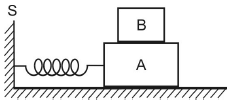
O conjunto formado pelos dois blocos pode ser movimentado produzindo uma deformação na mola e, quando solto, a mola produzirá uma certa aceleração nesse conjunto. Desconsiderando a resistência do ar, para que B não escorregue sobre A, a deformação máxima que a mola pode experimentar, em cm, vale
Provas
Questão presente nas seguintes provas
TEXTO II
ENVELHECER
Arnaldo Antunes/ Ortinho/ Marcelo Jeneci
A coisa mais moderna que existe nessa vida é
[envelhecer
A barba vai descendo e os cabelos vão caindo pra
[cabeça aparecer
Os filhos vão crescendo e o tempo vai dizendo que
[agora é pra valer
Os outros vão morrendo e a gente aprendendo a
[esquecer
Não quero morrer pois quero ver como será que deve
[ser envelhecer
Eu quero é viver para ver qual é e dizer venha pra o
[que vai acontecer
(...)
Pois ser eternamente adolescente nada é mais
[démodé* com os ralos fios de cabelo sobre a
[testa que não para de crescer
Não sei por que essa gente vira a cara pro presente e
[esquece de aprender
Que felizmente ou infelizmente sempre o tempo vai
[correr.
( www.arnaldoantunes.com.br/new/sec_discografia_sel.php?id=679)
* démodé: fora de moda.
Assinale a alternativa que apresenta uma inferência correta.
Provas
Questão presente nas seguintes provas
TEXTO V
PROMESSA CONTRA SINAIS DA IDADE
O tempo passa, e com ele os sinais da idade vão se espalhando!$ ^{(I)} !$ pelo nosso organismo. Entre eles, os mais evidentes ficam estampados em nossa pele, e rostos, na forma!$ ^{(II)} !$ de rugas, flacidez e perda de elasticidade. Um estudo publicado ontem no periódico científico “Journal of Investigative Dermatology”, no entanto, identificou um mecanismo molecular em células da pele que pode estar por trás deste processo, abrindo caminho para o desenvolvimento de novos tratamentos para, se não impedir, pelo menos retardar o envelhecimento delas e, talvez, as de outros tecidos e órgãos do corpo.
Na pesquisa, cientistas da Universidade de Newcastle, no Reino Unido, analisaram amostras de células da pele de vinte e sete doadores com entre seis e 72 anos, tiradas de locais protegidos do Sol, para determinar se havia alguma diferença no seu comportamento com a idade. Eles verificaram que, quanto mais velha a pessoa, menor era a atividade de suas mitocôndrias!$ ^{(III)} !$, as “usinas de energia” de nossas células. Essa queda, porém, era esperada!$ ^{(IV)} !$, já que há décadas a redução na capacidade de geração de energia!$ ^{(V)} !$ por essas organelas celulares e na sua eficiência neste trabalho com o tempo é uma das principais vertentes nas teorias sobre envelhecimento.
/.../
(BAIMA, César. O Globo,27 de fev.2016, p.24.)
Observe o uso da vírgula nos trechos abaixo destacados:
I. “O tempo passa, e com ele os sinais da idade vão se espalhando...”
II. “...ficam estampados em nossa pele, e rostos, na forma...”
III. “Eles verificaram que, quanto mais velha a pessoa, menor era a atividade de suas mitocôndrias...”
IV. “Essa queda, porém, era esperada...”
V. “...era esperada, já que há décadas a redução na capacidade de geração de energia...”
Assinale a opção que apresenta uma análise correta.
Provas
Questão presente nas seguintes provas
TEXTO III
ESTATUTO DO IDOSO (fragmentos)
Art. 2 – O idoso goza de todos os direitos fundamentais inerentes à pessoa humana, sem prejuízo da proteção integral de que trata esta Lei!$ ^{(D)} !$, assegurando-se-lhe!$ ^{(A)} !$, por lei ou por outros meios, todas as oportunidades e facilidades!$ ^{(B)} !$, para preservação de sua saúde!$ ^{(D)} !$ física e mental e seu aperfeiçoamento moral, intelectual, espiritual e social, em condições de liberdade e dignidade.
Art. 4 – Nenhum idoso será objeto de qualquer tipo de negligência, discriminação, violência, crueldade ou!$ ^{(C)} !$ opressão, e todo atentado aos seus direitos, por ação ou por omissão, será punido na forma da lei.
(www.planalto.gov.br/ccvil_03/leis/2003/L10.741.htm)
Assinale a opção correta sobre as análises apresentadas.
Provas
Questão presente nas seguintes provas
TEXTO V
PROMESSA CONTRA SINAIS DA IDADE
O tempo passa, e com ele os sinais da idade vão se espalhando pelo nosso organismo. Entre eles, os mais evidentes ficam estampados em nossa pele, e rostos, na forma de rugas, flacidez e perda de elasticidade. Um estudo publicado ontem no periódico científico “Journal of Investigative Dermatology”, no entanto, identificou um mecanismo molecular em células da pele que pode estar por trás deste processo, abrindo caminho para o desenvolvimento de novos tratamentos para, se não impedir, pelo menos retardar o envelhecimento delas e, talvez, as de outros tecidos e órgãos do corpo.
Na pesquisa, cientistas da Universidade de Newcastle, no Reino Unido, analisaram amostras de células da pele de vinte e sete doadores com entre seis e 72 anos, tiradas de locais protegidos do Sol, para determinar se havia alguma diferença no seu comportamento com a idade. Eles verificaram que, quanto mais velha a pessoa, menor era a atividade de suas mitocôndrias, as “usinas de energia” de nossas células. Essa queda, porém, era esperada, já que há décadas a redução na capacidade de geração de energia por essas organelas celulares e na sua eficiência neste trabalho com o tempo é uma das principais vertentes nas teorias sobre envelhecimento.
/.../
(BAIMA, César. O Globo,27 de fev.2016, p.24.)
Sabe-se que, ao divulgar informações de caráter científico em um texto, alguns recursos de linguagem podem ser empregados para transmitir ao leitor maior confiabilidade quanto ao conteúdo apresentado. Em relação ao texto V, assinale a alternativa que NÃO apresenta um desses recursos.
Provas
Questão presente nas seguintes provas
Dois pequenos corpos A e B são ligados a uma haste rígida através de fios ideais de comprimentos !$ \ell_A !$ e !$ \ell_B !$ , respectivamente, conforme figura a seguir.
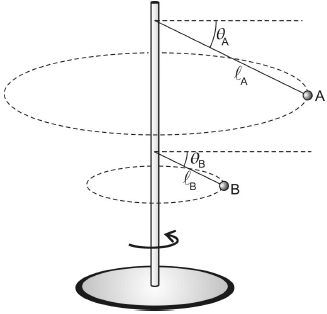
A e B giram em sincronia com a haste, com velocidades escalares constantes !$ V_A !$ e !$ V_B !$, e fazem com a direção horizontal ângulos !$ θ_A !$ e !$ θ_B !$, respectivamente.
Considerando !$ \ell_A=4 \ell_B !$, a razão !$ \large{V_A \over V_B} !$, em função de !$ θ_A !$ e !$ θ_B !$, é igual a
Provas
Questão presente nas seguintes provas
Durante 16 horas, desde a abertura de uma certa confeitaria, observou-se que a quantidade !$ q(t) !$ de unidades vendidas do doce “amor em pedaço”, entre os instantes !$ (t-1) !$ e !$ t !$, é dada pela lei !$ q(t)=\mid \left\vert t-8 \right\vert +t-14 \mid !$, em que !$ t !$ representa o tempo, em horas, e !$ t \, ∈ \, \{1,2,3, \cdots , 16 \} !$
É correto afirmar que
Provas
Questão presente nas seguintes provas
Cadernos
Caderno Container