Foram encontradas 223 questões.
Dados os conjuntos A = {1, 2, 3, 4} B = {1, 3, 5} C = {0} determine quais das seguintes afirmações são verdadeiras ou falsas
Item 2: (A!$ \cap !$B) X A tem mais de 5 e menos de 10 elementos.
Provas

Classifique como V ou F, a afirmativa abaixo:
Item 2: Para Keynes, era a rigidez do salário real o fator fundamental para explicar a possibilidade de uma economia capitalista operar com uma elevada taxa de desemprego durante um longo período de tempo.
Provas
Com relação à teoria do consumidor, pode-se afirmar que:
Item 4: Dados apenas dois bens, não poderá haver relação de complementariedade entre eles.
Provas
Numa economia tem-se determinado exercício:
|
ITEM |
VALOR EM MILHÕES DE US$ |
|
Exportações de bens (FOB) |
37.000 |
|
Importações de bens (FOB) |
17.000 |
|
Exportações de serviços não fatores |
1.000 |
|
Importações de serviços não fatores |
3.200 |
|
Juros pagos ao exterior |
10.500 |
|
Juros recebidos do exterior |
1.300 |
|
Remessa líquida de dividendos para o exterior |
1.100 |
|
Pagamentos ao exterior por royalties |
530 |
|
Donativos recebidos do exterior |
100 |
|
Financiamentos recebidos do exterior |
2.000 |
|
Amortizações pagas ao exterior |
1.800 |
|
Investimentos diretos vindos do exterior |
500 |
|
Repatriação de capitais |
800 |
Através dessas informações, classifique, como V ou F, a afirmativa abaixo:
Item 2: A transferência líquida de recursos para o exterior é igual a 10,63 bilhões de dólares
Provas
Classifique, como V ou F, a afirmativa abaixo:
Item 1: Quanto mais indexada for a economia, menor será o montante de desemprego gerado por um choque de oferta adverso.
Provas
Com relação às funções de produção, pode-se afirmar que:
Item 2: Quando a função de produção é homogênea linear, a taxa marginal de substituição é função apenas da razão entre fatores.
Provas
Se !$ f(x) = x^a !$, !$ x \ge 0 !$ e !$ 0 < a < 1 !$, examine as seguintes afirmações:
Item 4: Se !$ x > 0 !$, !$ y > 0 !$, então !$ { \large f(x) + f(y) \over 2} > f \begin{pmatrix} { \large x + y \over 2} \end{pmatrix} !$
Provas
ECONOMIC GROWTH
As long as the fruits of economic growth are taken in the form of higher income, economic growth will be accompanied by increases in the mean of the income distribution. However, poverty will not necessarily decrease if growth is accompanied by a sufficiently large, offsetting increase in inequality. Unfortunately the impact of growth on inequality is not nearly as clear, either theoretically or empirically, as its impact on the mean of the distribution.
Growth and the distribution of income are the joint results of a complicated set of underlying economic processes, reflected in changes in supplies of and demands for factors of production. Arguments that inequality is necessary for growth or that growth necessarily reduces inequality ignore the process generating growth and inequality simultaneously. Any correlation between these two variables is likely to be spurious - it is not growth per se, but how that growth is achieved, which determines inequality.
Technological change and increases in the supply of labor or capital offer two routes to economic growth. They are, however, not on equal footing. Since the amount of labor or capital cannot be increased indefinitely, only technological change can offer a permanent increase in the rate of growth of output. The two also differ in the ways in which they affect the distribution of income.
Technological change may increase or decrease inequality. The initial impact of technological change is to alter the demands for labor and capital. This in turn changes prices, which may call forth a supply response as workers flow to those jobs for which demand and, hence, wages are greater.
While technological change may increase the demand for all skill classes, this is by no means necessary. The result may be an increase in both economic growth and poverty. For example, a labor-saving technological change may lower the demand for low-skilled workers. The resulting decrease in wages of those at the bottom of the distribution will have two effects - some workers will drop out of the labor force, while others will be induced to gain skills in response to the drop in the relative wages of unskilled workers. Whether or not poverty increases depends on the relative magnitude of these two changes.
DANZIGER, Sheldon, GOTTSCHALK, Peter. Increasing inequality in the United States: what we know and what we don’t. Journal of Post Keynesian Economics, New York, 11(2): 181-182, 1988-89.
In the second paragraph:
Item 2: “underlying economic processes” can be understood as “processos econômicos adjacentes”.
Provas
Numa economia os balanços consolidados dos bancos comerciais e do Banco Central são:
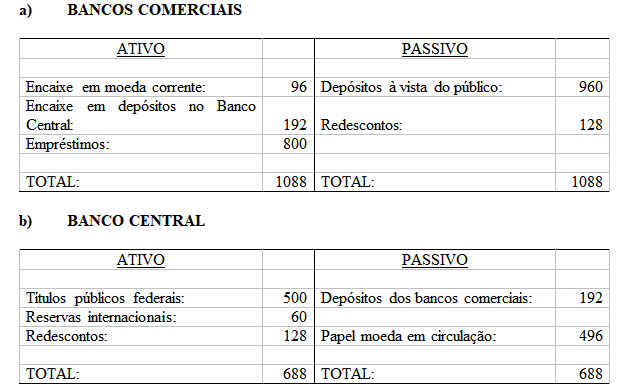
Através dessas informações, classifique, com V ou F a afirmativa abaixo:
Item 1: a base monetária é igual a 688.
Provas
Com relação às funções de produção, pode-se afirmar que:
Item 0: Quando a função de produção é de proporções fixas é sempre verdade que quando se aumenta a quantidade de um fator, haverá um aumento na quantidade do produto.
Provas
Caderno Container