Foram encontradas 294 questões.
THE EFFECTS OF DOMESTIC ENVIRONMENTAL POLICIES ON PATTERNS OF WORLD TRADE: AN EMPIRICAL TEST
James A. Tobey
In theory, environmental control costs encourage reduced specialization in the production of polluting outputs in countries with stringent environmental regulations (Pethig, 1976; Siebert, 1977; McGuire, 1982). In contrast, countries that fail to undertake an environmental protection program presumably increase their comparative advantage in the production of items that damage the invironment. This relationship between trade and environmental policy receives considerable attention whenever countries are in the process of passing new pollution control measures. Groups who oppose existing measures, of the implementation of stiffer measures, argue that they reduce the ability of polluting industries to compete internationally. With foreign trade an increasingly important sector in many of the world’s economies, the arguments of such groups are now frequently weighted very heavily.
The premise that trade suffers from the imposition of environmental policy has a strong element of a priori plausibility but, surprisingly, has little empirical support. Several macroeconometric models (D’Arge, 1974; Robison, 1986; OECD, 1985) have predicted that pollution control measures should lead to a small but discernible effect on the balance of trade, but there are few studies to confirm this prediction.
The location-of-industry studies (Leonard, 1988; Pearson, 1987, 1985; Walter, 1985) have explored the related ideas that stringent pollution control measures push industries out of the U.S. (the ‘industrial-flight’ hypothesis), and that less-developed countries compete to attract multinational industries by minimizing their own environmental policies (the ‘pollution-haven’ hypothesis). Their investigations, however, have been unable to find evidence in support of either hypothesis.
The present paper complement the results of the less rigorous location of industy studies by providing an empirical test of the hypothesis that stringent environmental policy has caused trade patterns to deviate in commodities produced by the world’s ‘dirty’ industries.
Extraído de: TOBEY, James A. The effects of domestic environmental policies on patterns of world trade: an empirical test. Kiklos; international review for social science, Basel, v.43, n.2, p.191-209.
As put in the third paragraph:
Item 2: according to these authors developing countries soften their environmental regulations in order to attract industries located elsewhere.
Provas

Sabendo-se que !$ A = [3 1 2] !$, !$ B = \begin{bmatrix} 4.1 \\ 5.1 \\ 6.1 \end{bmatrix} !$ e !$ C = \begin{bmatrix} 1 \\ 3 \end{bmatrix} !$, indique se as afirmativas abaixo são verdadeiras ou falsas.
Item 4: B tem duas linhas linearmente independentes.
Provas
Considerando os diferentes índices existentes, pode-se afirmar que:
Item 2: O índice de Paasche subestima o índice do custo de vida verdadeiro.
Provas
Considere uma economia Kaleckiana, com dois setores. No primeiro, todas as empresas agem de acordo com as regras de concorrência perfeita (é o setor “competitivo). O segundo setor, “oligopolizado”, é formado por empresas monopolistas, oligopolistas, e de concorrência monopolística. No setor “competitivo” os custos marginais (compostos apenas pelos custos salariais) são crescentes como nível de produção. A demanda pelos produtos dos setor depende de seus preços relativos, e do nível de renda global. No setor “oligopolizado”, os preços são dados por um mark-up sobre os custos salariais:
P = (1 + m) w/a
onde:
p = preço
m = mark-up
w = salário nominal
a = produtividade do trabalho (suposta constante)
O mark-up é fixado de forma a cobrir outros custos da empresa, e gerar liquidamente a taxa de lucro desejada sobre o capital. Por sua vez, a taxa de lucro desejada depende positivamente da taxa real de juros de longo prazo. O mark-up inicial é inferior ao mark-up neoclássico, ou seja, o lucro de curto prazo é inferior ao máximo.
Suponha que o investimento é composto por dois itens: o investimento no setor “competitivo”, que varia inversamente com a taxa real de juros, e o investimento no setor “oligopolizado”, que varia positivamente com a taxa de utilização da capacidade instalada.
Os trabalhadores consomem integralmente sua renda, mas a propensão a consumir dos capitalistas é menor do que a unidade.
Suponha um aumento na taxa real de juros. Assinale “Falsa” ou “Verdadeira” para cada uma das afirmações abaixo:
Item 2: O nível de atividade cai no setor “oligopolizado”.
Provas
O gráfico abaixo mostra uma curva de custo total de curto prazo.
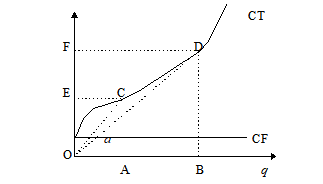
Item 3: Para o intervalo de produção O até OA, o custo marginal é crescente.
Provas
THE EFFECTS OF DOMESTIC ENVIRONMENTAL POLICIES ON PATTERNS OF WORLD TRADE: AN EMPIRICAL TEST
James A. Tobey
In theory, environmental control costs encourage reduced specialization in the production of polluting outputs in countries with stringent environmental regulations (Pethig, 1976; Siebert, 1977; McGuire, 1982). In contrast, countries that fail to undertake an environmental protection program presumably increase their comparative advantage in the production of items that damage the invironment. This relationship between trade and environmental policy receives considerable attention whenever countries are in the process of passing new pollution control measures. Groups who oppose existing measures, of the implementation of stiffer measures, argue that they reduce the ability of polluting industries to compete internationally. With foreign trade an increasingly important sector in many of the world’s economies, the arguments of such groups are now frequently weighted very heavily.
The premise that trade suffers from the imposition of environmental policy has a strong element of a priori plausibility but, surprisingly, has little empirical support. Several macroeconometric models (D’Arge, 1974; Robison, 1986; OECD, 1985) have predicted that pollution control measures should lead to a small but discernible effect on the balance of trade, but there are few studies to confirm this prediction.
The location-of-industry studies (Leonard, 1988; Pearson, 1987, 1985; Walter, 1985) have explored the related ideas that stringent pollution control measures push industries out of the U.S. (the ‘industrial-flight’ hypothesis), and that less-developed countries compete to attract multinational industries by minimizing their own environmental policies (the ‘pollution-haven’ hypothesis). Their investigations, however, have been unable to find evidence in support of either hypothesis.
The present paper complement the results of the less rigorous location of industy studies by providing an empirical test of the hypothesis that stringent environmental policy has caused trade patterns to deviate in commodities produced by the world’s ‘dirty’ industries.
Extraído de: TOBEY, James A. The effects of domestic environmental policies on patterns of world trade: an empirical test. Kiklos; international review for social science, Basel, v.43, n.2, p.191-209.
As found in the fourth and fifth paragraphs:
Item 3: “empirical approach” means “abordagem empírica”.
Provas
Considere a economia do tipo IS-LM aberta ao exterior, tanto em termos de fluxos de comércio como em termos de capitais, sob o regime de taxas de câmbio flutuantes. Desconsidere o papel das expectativas sobre a taxa de câmbio.
Item 0: A política monetária não pode afetar o nível de atividade nesta economia, através de alterações na taxa de juros, porque a taxa doméstica é igual à taxa internacional de juros.
Provas
Em uma economia os balanços consolidados dos bancos comerciais e das autoridades comerciais e das autoridades monetárias apresentam os seguintes resultados:
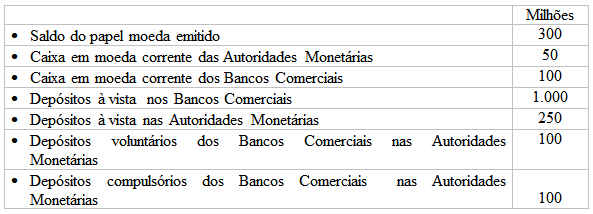
Item 3: O multiplicador dos meios de pagamentos é 4,63.
Provas
Ainda em relação à questão anterior pode-se concluir que, exceto por erro de arredondamento:
Item 2: A previsão do lucro para X = 10 é 26,5 milhões de cruzeiros.
Provas
Com relação à formação de preços de um insumo produto é correto afirmar que:
Item 0: Se o mercado for competitivo, uma elevação da demanda do produto final implica numa elevação do valor da produtividade marginal e da demanda pelo insumo.
Provas
Caderno Container