Foram encontradas 294 questões.
Considere uma amostra aleatória !$ y_1 !$, ....., !$ y_n !$ de uma variável normal Y de média !$ μ !$ e variância !$ σ^2 !$. Definem-se os seguintes estimadores:
!$ y = { \large \sum yi \over n} !$, !$ s^2 = { \large \sum (yi - y)^2 \over n} !$
Pode-se então afirmar que:
Item 0: E(!$ s^2 !$) = !$ σ^2 !$.
Provas

Considere uma amostra aleatória !$ y_1 !$, ....., !$ y_n !$ de uma variável normal Y de média !$ μ !$ e variância !$ σ^2 !$. Definem-se os seguintes estimadores:
!$ y = { \large \sum yi \over n} !$, !$ s^2 = { \large \sum (yi - y)^2 \over n} !$
Pode-se então afirmar que:
Item 1: Var(y) = 2s2 /n.
Provas
Com relação à formação de preços de um insumo produto é correto afirmar que:
Item 1: Se o mercado for monopolista, o preço do insumo é determinado pela oferta do insumo e, portanto, igual ao valor da produtividade marginal.
Provas
O gráfico abaixo mostra uma curva de custo total de curto prazo.
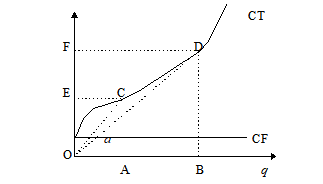
Item 0: O custo marginal para o nível de produção OA é dado pela tangente do ângulo a.
Provas
Para um modelo de monopólio com discriminação de preços em dois mercados diferentes,
Item 2: a maximização do lucro é obtida quando o custo por unidade do bem é igualado à receita por unidade do bem em cada mercado, calculados para pequenos acréscimos ou decréscimos da quantidade do bem.
Provas
THE EFFECTS OF DOMESTIC ENVIRONMENTAL POLICIES ON PATTERNS OF WORLD TRADE: AN EMPIRICAL TEST
James A. Tobey
In theory, environmental control costs encourage reduced specialization in the production of polluting outputs in countries with stringent environmental regulations (Pethig, 1976; Siebert, 1977; McGuire, 1982). In contrast, countries that fail to undertake an environmental protection program presumably increase their comparative advantage in the production of items that damage the invironment. This relationship between trade and environmental policy receives considerable attention whenever countries are in the process of passing new pollution control measures. Groups who oppose existing measures, of the implementation of stiffer measures, argue that they reduce the ability of polluting industries to compete internationally. With foreign trade an increasingly important sector in many of the world’s economies, the arguments of such groups are now frequently weighted very heavily.
The premise that trade suffers from the imposition of environmental policy has a strong element of a priori plausibility but, surprisingly, has little empirical support. Several macroeconometric models (D’Arge, 1974; Robison, 1986; OECD, 1985) have predicted that pollution control measures should lead to a small but discernible effect on the balance of trade, but there are few studies to confirm this prediction.
The location-of-industry studies (Leonard, 1988; Pearson, 1987, 1985; Walter, 1985) have explored the related ideas that stringent pollution control measures push industries out of the U.S. (the ‘industrial-flight’ hypothesis), and that less-developed countries compete to attract multinational industries by minimizing their own environmental policies (the ‘pollution-haven’ hypothesis). Their investigations, however, have been unable to find evidence in support of either hypothesis.
The present paper complement the results of the less rigorous location of industy studies by providing an empirical test of the hypothesis that stringent environmental policy has caused trade patterns to deviate in commodities produced by the world’s ‘dirty’ industries.
Extraído de: TOBEY, James A. The effects of domestic environmental policies on patterns of world trade: an empirical test. Kiklos; international review for social science, Basel, v.43, n.2, p.191-209.
As one may conclude by reading the text above:
Item 0: the study recommends that no environmental regulations should be passed in both developed or developing countries.
Provas
Classifique, como V ou F, as afirmativas abaixo:
Item 3: O saldo positivo do balanço de pagamentos em conta corrente reflete a parcela de poupança interna que financia investimentos no exterior.
Provas
Dada a equação !$ { \large d_y \over d_t} = - 0,5 y + 10 !$, indique se as afirmativas abaixo são verdadeiras ou falsas.
Item 4: A solução pode ter raízes complexas.
Provas
Ainda em relação à questão anterior pode-se concluir que, exceto por erro de arredondamento:
Item 3: O coeficiente do tempo é altamente significativo produzindo um valor observado da estatística t de Student de 27.
Provas
Classifique, como V ou F, as afirmativas abaixo:
Item 1: Quanto menor a elasticidade de juros da demanda por moeda, mais eficaz a política monetária.
Provas
Caderno Container