Foram encontradas 294 questões.
THE EFFECTS OF DOMESTIC ENVIRONMENTAL POLICIES ON PATTERNS OF WORLD TRADE: AN EMPIRICAL TEST
James A. Tobey
In theory, environmental control costs encourage reduced specialization in the production of polluting outputs in countries with stringent environmental regulations (Pethig, 1976; Siebert, 1977; McGuire, 1982). In contrast, countries that fail to undertake an environmental protection program presumably increase their comparative advantage in the production of items that damage the invironment. This relationship between trade and environmental policy receives considerable attention whenever countries are in the process of passing new pollution control measures. Groups who oppose existing measures, of the implementation of stiffer measures, argue that they reduce the ability of polluting industries to compete internationally. With foreign trade an increasingly important sector in many of the world’s economies, the arguments of such groups are now frequently weighted very heavily.
The premise that trade suffers from the imposition of environmental policy has a strong element of a priori plausibility but, surprisingly, has little empirical support. Several macroeconometric models (D’Arge, 1974; Robison, 1986; OECD, 1985) have predicted that pollution control measures should lead to a small but discernible effect on the balance of trade, but there are few studies to confirm this prediction.
The location-of-industry studies (Leonard, 1988; Pearson, 1987, 1985; Walter, 1985) have explored the related ideas that stringent pollution control measures push industries out of the U.S. (the ‘industrial-flight’ hypothesis), and that less-developed countries compete to attract multinational industries by minimizing their own environmental policies (the ‘pollution-haven’ hypothesis). Their investigations, however, have been unable to find evidence in support of either hypothesis.
The present paper complement the results of the less rigorous location of industy studies by providing an empirical test of the hypothesis that stringent environmental policy has caused trade patterns to deviate in commodities produced by the world’s ‘dirty’ industries.
Extraído de: TOBEY, James A. The effects of domestic environmental policies on patterns of world trade: an empirical test. Kiklos; international review for social science, Basel, v.43, n.2, p.191-209.
Still in the first paragraph:
Item 2: “stiffer measures” means “medidas imprecisas”.
Provas

Em uma economia os balanços consolidados dos bancos comerciais e das autoridades comerciais e das autoridades monetárias apresentam os seguintes resultados:
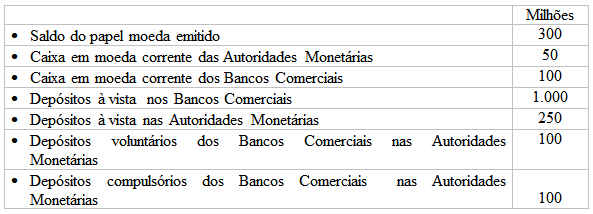
Item 0: O saldo de papel moeda em poder do público é 200 milhões de cruzeiros.
Provas
Classifique, como V ou F, as afirmativas abaixo:
Item 2: No modelo IS-LM tradicional, a forma de financiamento dos gastos públicos não afeta o produto de equilíbrio.
Provas
A demanda mensal de produtos de uma empresa é normalmente distribuída com média de 10 unidades e variância de 64. Se as demandas dos meses se comportam independentemente pode-se afirmar que:
Item 4: Não se pode calcular nenhuma das probabilidades acima.
Provas
Em determinado país e durante certo ano realizaram-se as seguintes transações entre residentes e não-residentes, medidas em milhões de dólares.
- Exportações de mercadorias (FOB) 12.000
- Importações de mercadorias (FOB) 14.000
- Gastos de turistas nacionais no exterior em Viagens Internacionais 1.000
- Gastos de não-residentes no país em Viagens de Turismo 500
- Juros pagos ao exterior 4.300
- Juros recebidos do exterior 1.200
- Remessa líquida de dividendos 1.100
- Empréstimos e financiamentos líquidos 600
- Pagamento de Amortizações 4.000
- Investimentos diretos 1.000
- Pagamentos de atrasados comerciais 800
Item 2: O saldo líquido da conta de capitais autônomos é US$ 3,8 bilhões de dólares.
Provas
Com respeito aos testes de hipóteses pode-se afirmar que:
Item 3: Dada uma população de indivíduos de tamanho n, deseja-se verificar se a população de empregados é de 0,5. Esta verificação pode ser feita através do teste de hipóteses: !$ H_0 : p = 1/2 !$ contra !$ H_1 : p \ne 1 / 2 !$ usando-se, para tanto, a distribuição normal como aproximação da binomial.
Provas
Em relação às distribuições de probabilidade pode-se afirmar que:
Item 3: A distribuição t de Student é caracterizada por um único parâmetro que representa os seus graus de liberdade.
Provas
THE EFFECTS OF DOMESTIC ENVIRONMENTAL POLICIES ON PATTERNS OF WORLD TRADE: AN EMPIRICAL TEST
James A. Tobey
In theory, environmental control costs encourage reduced specialization in the production of polluting outputs in countries with stringent environmental regulations (Pethig, 1976; Siebert, 1977; McGuire, 1982). In contrast, countries that fail to undertake an environmental protection program presumably increase their comparative advantage in the production of items that damage the invironment. This relationship between trade and environmental policy receives considerable attention whenever countries are in the process of passing new pollution control measures. Groups who oppose existing measures, of the implementation of stiffer measures, argue that they reduce the ability of polluting industries to compete internationally. With foreign trade an increasingly important sector in many of the world’s economies, the arguments of such groups are now frequently weighted very heavily.
The premise that trade suffers from the imposition of environmental policy has a strong element of a priori plausibility but, surprisingly, has little empirical support. Several macroeconometric models (D’Arge, 1974; Robison, 1986; OECD, 1985) have predicted that pollution control measures should lead to a small but discernible effect on the balance of trade, but there are few studies to confirm this prediction.
The location-of-industry studies (Leonard, 1988; Pearson, 1987, 1985; Walter, 1985) have explored the related ideas that stringent pollution control measures push industries out of the U.S. (the ‘industrial-flight’ hypothesis), and that less-developed countries compete to attract multinational industries by minimizing their own environmental policies (the ‘pollution-haven’ hypothesis). Their investigations, however, have been unable to find evidence in support of either hypothesis.
The present paper complement the results of the less rigorous location of industy studies by providing an empirical test of the hypothesis that stringent environmental policy has caused trade patterns to deviate in commodities produced by the world’s ‘dirty’ industries.
Extraído de: TOBEY, James A. The effects of domestic environmental policies on patterns of world trade: an empirical test. Kiklos; international review for social science, Basel, v.43, n.2, p.191-209.
Still in the first paragraph:
Item 2: the author also implies that the relationship between trade and environmental policy should not receive so much attention as it receives now.
Provas
Considere uma economia onde o ajustamento de preços é descrito pela Curva de Phillips. Classifique, como V ou F, a afirmativa abaixo:
Item 0: A curva de Phillips expandida pelas expectativas diz que quanto maior a expectativa de inflação maior será a inflação efetiva.
Provas
Supondo uma função de produção dada por q = aLbKc, onde a, b e c são constantes positivas, L representa o fator trabalho e K representa o fator capital:
Item 2: Para um dado nível de capital, o produto marginal do fator trabalho será decrescente e positivo.
Provas
Caderno Container