Foram encontradas 259 questões.
Responda certo ou errado:
Item 0 - De acordo com a equação de Fisher referente à taxa de juros, o crescimento monetário sustentado provoca aumentos imediatos na taxa de juros nominal, mas não tem qualquer efeito na taxa de juros real de longo prazo.
Provas

Indique se o item abaixo é certo ou errado, com base no texto a que se refere.
PART III
THE MANDARIN REVOLUTION
When the Great War came, Keynes was not attracted to the trenches. He went to the Treasury, where his job was to take British earnings from trade, proceeds from loans floated in the United States and returns from securities conscripted and sold abroad and make them cover all possible overseas war purchases. And he helped the French and the Russians do the same. No magic was involved, as many have since suggested. Economic skill does not extend to getting very much for nothing. but an adept and resourceful mind was useful, and this Keynes had. In the course of time Keynes received a notice to report for military service. He sent it back. When the war was over, he was a natural choice for the British delegation to the Peace Conference. That, from the official view, was an appalling mistake.
The mood in Paris in the early month of 1919 was vengeful, myopic, indifferent to economic realities, and it horrified Keynes. So did his fellow civil servants. So did the politicians. In June he resigned and came home, and, in the next two month, he composed the greatest polemical document of modern times. It was against the reparations clauses of the Treaty and, as he saw it, the Carthaginian peace.
Europe would only punish itself by exacting, or seeking to exact, more from the Germans than they had the practical capacity to pay. Restraint by the victors was not a matter ot compassion but of elementary self-interest. The case was documented with figures and written with passion. In memorable passages Keynes gave his impressions of the men who were writing the peace. Woodrow Wilson he called “this blind and deaf Don Quixote.” Of Clemenceau he said: “He had one illusion - France; and one desillusion, mankind ...” On Lloyd George he was rather severe: “How can I convey to the reader, who does not know him, any just impression of this extraordinary figure of our time, this syren, this goat-footed bard, this half-human visitor to our age from the hag-ridden magic and enchanted woods of Celtic antiquity.”
Alas, no man is of perfect courage. Keynes deleted this passage on Lloyd George at the last moment.
The Economic Consequences of Peace was published before the end of 1919. The judgement of the British Establishment was rendered by The Times: “Mr. Keynes may be a clever economist. He may have been a useful Treasury official. But in writing this book, he has rendered the Allies a disservice for which their enemies will, doubtless, be grateful. “In time there would be a responsible view that Keynes went too far - that in calculating the limits on Germany’s ability to pay, he was excessively orthodox. Perhaps he contributed to the German’s sense of persecution and injustice that Hitler so effectively exploited. But the technique of The Times attack should also be noticed. It was not that the great men of the Treaty and the Establishment were suffering under the onslaught, although that, of course, was the real point. Rather, the criticism was causing rejoicing to the nation’s enemies. It is a device to which highly respectable men regularly resort. “Even if you are right, it is only the Communists who will be pleased.” (John Kenneth Galbraith, 1977. The Age of Uncertainty. Houghton Mifflin Company, Boston, p.198-200).
According to the text:
Item 1 - Despite his disagreements with the leaders of the British delegation, Keynes held on to his post until the Treaty was signed.
Provas
Indique se o item abaixo é certo ou errado, com base no texto a que se refere.
PART II
Cambridge versus Cambridge
In most universities today, economics is booming. To undergraduates and businesspersons it spells money-making; to graduate students it offers a lucrative slot in a bank or a confortable billet in a university; to governments it promises technical wheezes for balancing the books and boosting industries. The dismal science, it seems, can do no wrong.
Harvard and Cambridge are ideally placed to exploit this boom. They can both lay claim to some of the most illustrious names in the history of the subject. And they both boast well-connected alumni and high-powered students. But nobody inside the profession doubts that Harvard is having a far better boom than Cambridge. An Oxford professor admits that Harvard has probably the best economics department in the world. A Princeton professor ranks Cambridge along, say, Phennsylvania State University. cambridge graduates frequently go on to Harvard’s graduate school; the compliment is rarely returned. What is wrong with Cambridge?
The decline of its economics department dates from its defeat in one of the noisiest battles in post-war economics - the so-called Cambridge versus Cambridge controversy. In the early 1960s a group of Cambridge economists led by Joan Robinson mounted a furious assault on neoclassical orthodoxy. The Massashusetts Institute of Technology (MIT) took up the case for the defense (Harvard being a gentlemanly backwater).
At stake was nothing less than the soul of the subject. Robinson et al. argued that neoclassical economics was interested in the wrong thing (the optimal allocation of given resources) and based on a false assumption (that man is a rational “utility maximizer.”) In the Cambridge view, the hottest subjects were te accumulation of capital and the distribution of income. To add spice to the debate, the Cambridges disagreed about method and ideology. MIT preferred mathematics and markets; Cambridge favoured elegant prose and state intervention. To the likes of Robinson, the paddy fields of China were far preferable to the skyscrapers of Manhattan.
The world went the Massachusetts way. Neoclassical economics is now international orthodoxy; the Cambridge tradition is taken seriously only in East Anglia and the Italian provinces. Economics is an over more mathematical subject. And state planning is dead.
The Cambridge controbersy did more than marginalise the dominant faction in the Cambridgeshire fens. It also divided the faculty and politicised appointments. Some senior figures, like Frank Hahn and James Meade, did the unpatriotic thing and sided with the other Cambridge. The result was civil war. It was impossible to change the syllabus or appoint a lecturer without an ideological feud. The divided faculty made a number of light-weight appointments. It also lost a generation of stars. Just three of the dozen or so who fled - Amartya Sen, Christopher Bliss and Jim Mirrlees - would make the nucleus of a world-class department.
That was almost two decades ago. Why has Cambridge taken so long to repair the damage? Partly because the place is so enthralled by its glorious past. Naming a road ofter Sidgwick, a building after Marshall and a seminar room after Keynes is dangerously close to ancestor worship. But even more important than its over-developed sense of history is its underdeveloped appetite for competition. While Cambridge sank into faction fighting, Harvard challenged MIT for the position as the best department in the world. To understand their different fates, you need to examine their rival philosophies of academic life.
(The Economist, Dec. 1991 - Jan. 1992, p.43).
According to the text:
Item 4 - Cambridge was more concerned with development issues that with the stock market.
Provas
Indique se o item abaixo é certo ou errado:
Item 2 - Os modelos da Nova Macroeconomia Clássica tipicamente postulam que, quando expectativas são formadas racionalmente, a curva de Phillips de longo prazo é perfeitamente inelástica ao nível da taxa natural de desemprego enquanto a inclinação da curva de Phillips de curto prazo pode se modificar dependendo do comportamento das autoridades monetárias.
Provas
Sejam A e B dois conjuntos quaisquer. Indique se o item é certo ou errado:
Item 2 - !$ (A \cup B) \cap (A \cup B^C)=(A \cup B) \cap (A^C \cup B) !$.
Provas
Indique se o item é certo ou errado, com base no Texto a que se refere.
PART I
Wage controls during the transition from central planning to a market economy
Freeing prices to alleviate imbalances has been a priority in most emerging market economies. It is therefore paradoxical that wage controls have been a key component of stabilization in many of these countries.
There is considerable skepticism among economist about the effectiveness of wage controls in general: they are intended to suppress market forces, introducing rigidities in the structure of wages and delaying adjustment to changing labor market conditions; they are often circumvented, and they are typically costly to administer. This pessimism is borne out by the experience of many countries with wage controls, as with other centralized means of wage determination. If wage controls are recommended during the transition to a market economy, therefore, their rationale must be predicated on exceptional circumstances.
As a brake on inflationary momentum, wage controls have figured in “heterodox” stabilization programs in Latin America and elsewhere. The object was to reduce the cost of adjusting an economy to lower rate of inflation by controlling a publicly visible price, limiting the extent to which inflationary expectations become sef-perpetuating. Formerly centrally planned economies have had an added and even more pressing reason for integrating incomes policies into their reform programs and maintaining them as an enduring feature of the economic regime: the weakness of governance of state enterprises by their legal owner, the state.
The weakness of governance has been especially serious at the “no-man’s land” stage, when central planning, with its detailed control of prices and wages, has been dismantled but before market forces have become an effective replacement. At this stage enterprise managers often owe their jobs to workers’ councils; the interests of capital, by contrast, have little representation. At the same time, the “soft-budget” problem - the perception that losses will ultimately be underwritten through subsidies and credit and that the firm will not be allowed to fail - is exacerbated when privatization is impending. Workers and managers, realizing that they have limited time to take advantage of their control of the firm, have little incentive to restrain their wage demands, since the benefits of such restraint would be reaped by the future owners and the state. The extent to which this occurs depends on how privatization is implemented - particularly whether existing stakeholders such as workers and managers are given a share of the privatized value of the firm.
(Coricelli, F. and T. Lane, 1993, The World Bank Research Observer, vol. 8, n°2, July: 195-196).
According to the text:
Item 2 - Wage controls are hard to implement.
Provas
Através da observação direta verificou-se que um consumidor fez as seguintes escolhas:
(i) quando prevaleceram os preços p1 e p2 para os bens 1 e 2, respectivamente, o consumidor escolheu a cesta x1 ;
(ii) quando os preços eram q1 e q2 o consumidor escolheu a cesta x2. As linhas orçamentárias AB e CD embutem os preços que prevaleceram nas situações (i) e (ii) respectivamente. Então:
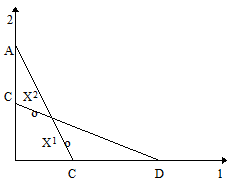
Item 0 - Por não se ter acesso à função utilidade do consumidor, nada se pode afirmar sobre a consistência das escolhas feitas.
Provas
Suponha uma economia caracterizada pelas seguintes relações:
C = 200 + 0,8Yd I = 300
T = 0,1Y M = 0,2Yd G = 240 X = 180
Em que:
Y = renda total; Yd = renda disponível após pagamento de impostos;
C = consumo, I = investimento, G = gasto do governo,
X = exportações, M = importações, T = imposto.
Indique se o item abaixo a respeito desta economia é certo ou errado:
Item 0 - O valor de equilíbrio da renda é $1500.
Provas
Indique se o item abaixo é certo ou errado, com base no texto a que se refere.
PART II
Cambridge versus Cambridge
In most universities today, economics is booming. To undergraduates and businesspersons it spells money-making; to graduate students it offers a lucrative slot in a bank or a confortable billet in a university; to governments it promises technical wheezes for balancing the books and boosting industries. The dismal science, it seems, can do no wrong.
Harvard and Cambridge are ideally placed to exploit this boom. They can both lay claim to some of the most illustrious names in the history of the subject. And they both boast well-connected alumni and high-powered students. But nobody inside the profession doubts that Harvard is having a far better boom than Cambridge. An Oxford professor admits that Harvard has probably the best economics department in the world. A Princeton professor ranks Cambridge along, say, Phennsylvania State University. cambridge graduates frequently go on to Harvard’s graduate school; the compliment is rarely returned. What is wrong with Cambridge?
The decline of its economics department dates from its defeat in one of the noisiest battles in post-war economics - the so-called Cambridge versus Cambridge controversy. In the early 1960s a group of Cambridge economists led by Joan Robinson mounted a furious assault on neoclassical orthodoxy. The Massashusetts Institute of Technology (MIT) took up the case for the defense (Harvard being a gentlemanly backwater).
At stake was nothing less than the soul of the subject. Robinson et al. argued that neoclassical economics was interested in the wrong thing (the optimal allocation of given resources) and based on a false assumption (that man is a rational “utility maximizer.”) In the Cambridge view, the hottest subjects were te accumulation of capital and the distribution of income. To add spice to the debate, the Cambridges disagreed about method and ideology. MIT preferred mathematics and markets; Cambridge favoured elegant prose and state intervention. To the likes of Robinson, the paddy fields of China were far preferable to the skyscrapers of Manhattan.
The world went the Massachusetts way. Neoclassical economics is now international orthodoxy; the Cambridge tradition is taken seriously only in East Anglia and the Italian provinces. Economics is an over more mathematical subject. And state planning is dead.
The Cambridge controbersy did more than marginalise the dominant faction in the Cambridgeshire fens. It also divided the faculty and politicised appointments. Some senior figures, like Frank Hahn and James Meade, did the unpatriotic thing and sided with the other Cambridge. The result was civil war. It was impossible to change the syllabus or appoint a lecturer without an ideological feud. The divided faculty made a number of light-weight appointments. It also lost a generation of stars. Just three of the dozen or so who fled - Amartya Sen, Christopher Bliss and Jim Mirrlees - would make the nucleus of a world-class department.
That was almost two decades ago. Why has Cambridge taken so long to repair the damage? Partly because the place is so enthralled by its glorious past. Naming a road ofter Sidgwick, a building after Marshall and a seminar room after Keynes is dangerously close to ancestor worship. But even more important than its over-developed sense of history is its underdeveloped appetite for competition. While Cambridge sank into faction fighting, Harvard challenged MIT for the position as the best department in the world. To understand their different fates, you need to examine their rival philosophies of academic life.
(The Economist, Dec. 1991 - Jan. 1992, p.43).
According to the text:
Item 3 - A Harvard student rarely return the compliment of a Cambridge student.
Provas
Assinale se o item é certo ou errado:
Item 1 - Dois pontos satisfazem as equações: !$ (x-4)^2+(y-4)^2-8=0 !$ e !$ x+y-4=0 !$.
Provas
Caderno Container