Foram encontradas 400 questões.
Indique se a proposição está certo ou errado:
Item 0 - Em uma economia que se encontra em um ponto acima do estado estacionário, o investimento supera a depreciação do capital.
Provas

A respeito do subconjunto A, B, C e D definido abaixo, no !$ \Re^2 !$, responda C (certo) ou E (errado):
Item 2 - !$ D ⊂ (B ∩ C) !$ em que !$ C = \{(x, y) ∈ \Re^2; |x - y| ≤ 1 \} !$
Provas
É correto afirmar a respeito do modelo de regressão linear clássico multivariado: !$ Y = Xγ + ε !$, com n observações e k > 2 variáveis explicativas, incluindo-se o intercepto.
Item 3 - Para testar a hipótese conjunta de que !$ γ_2 = γ_3 = ... = γ_k = 0 !$, pode-se utilizar o teste !$ F_{\alpha; (k-1),(n-k)} = { \large R^2 (k-1) \over [(1 - R^2) (n - k)]} !$, em que !$ R^2 !$ é o coeficiente de determinação do modelo.
Provas
BASED ON YOUR INTERPRETATION OF THE TEXT THAT FOLLOWS, DETERMINE IF EVERY STATEMENT IS RIGHT OR WRONG.
FIRST TEXT
At length, in 1776, our illustrious countryman, Adam Smith, published the “Wealth of Nations” – a work which has done for Political Economy what the Essay of Locke did for the philosophy of mind. In this work, the science was, for the first time, treated in its fullest extent; and the fundamental principles on which the production of wealth depends, established beyond the reach of cavil and dispute. In opposition to the Economists, Dr. Smith has shown that labor is the only source of wealth, and that the wish to augment our fortunes and to rise in the world – a wish that comes with us from the womb, and never leaves us till we go into the grave – is the cause of wealth being saved and accumulated: he has shown that labor is productive of wealth when employed in manufactures and commerce, as well as when it is employed in the cultivation of the land; he has traced the various means by which labor may be rendered most effective; and has given a most admirable analysis and exposition of the prodigious addition made to its powers by its division among different individuals and countries, and by the employment of accumulated wealth, or capital, in industrious undertakings. He has also shown, in opposition to the commonly received opinions of the merchants, politicians, and statesmen of his time, that wealth does not consist in the abundance of gold and silver, but enjoyments of human life; that it is in every case sound policy to leave individuals to pursue their own interest in their own way; that in prosecuting branches of industry advantageous to themselves, they necessarily prosecute such as are, at the same time, advantageous to the public; and that every regulation intended to force industry into particular channels, or to determine the species of commercial intercourse to be carried on between countries, is impolitic and pernicious – injurious to the rights of individuals – and adverse to the progress of real opulence and lasting prosperity.
J. R. McCulloch, on Adam Smith and Laissez-Faire from The Principles of Political Economy, 1830. Reprinted
in: Charles Dickens, Hard Times. W.W. Norton & Co, 1990: 318-319.
The text permits us to conclude that:
Item 2 - Humans desire to succeed is the major driving force of economic progress.
Provas
Assinale C (certo) ou E (errado):
Item 0 - Seja !$ f(x) = \begin{cases} e^-1/x^2, & \text{ x ≠ 0} \\ 0, & \text{ x = 0} \end{cases} !$ ; então !$ f'(0) = f''(0) = 0 !$.
Provas
Indique se a proposição está certo ou errado:
Item 1 - Se o capital atinge o nível definido pela regra de ouro, o consumo per capita no estado estacionário é máximo.
Provas
Sobre o mercado de trabalho e a Curva de Phillips, pode-se afirmar que:
Item 3 - A existência de uma taxa natural de desemprego implica que a curva de Phillips de longo prazo é horizontal.
Provas
Assinale C (certo) ou E (errado):
Item 0 - !$ \lim_{x \rightarrow \infty}(1 + { \large 3 \over x})^{2x+5} = e^5 !$.
Provas
Considere a expansão de Taylor até o termo de quinta ordem, em torno do ponto !$ x = 0 !$. Assinale C (certo) ou E (errado):
Item 2 - !$ cos \ x \cong x - { \large x^3 \over 6} + { \large x^5 \over 120} !$.
Provas
Julgue a afirmativa abaixo.
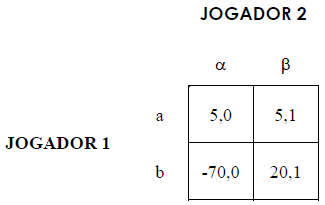
Item 4 - Com relação à teoria dos jogos, pode-se dizer que o problema da não cooperação que ocorre no dilema dos prisioneiros desaparece caso o jogo seja repetido por um número finito de vezes, porque introduz considerações sobre reputação.
Provas
Caderno Container