Foram encontradas 395 questões.
A economia brasileira gerou saldos positivos na balança comercial durante toda a década de 1980. É correto afirmar que tais saldos:
Item 3 - foram favorecidos pela maturação dos projetos substituidores de importação do II PND;
Provas
Questão presente nas seguintes provas

Com relação à variáveis aleatórias discretas é correto afirmar que:
Item 4 - a distribuição binomial pode ser aproximada pela distribuição de Poisson para valores grandes de n (tamanho da amostra) e pequenos de p (probabilidade de sucesso).
Provas
Questão presente nas seguintes provas
Com relação à variáveis aleatórias discretas é correto afirmar que:
Item 1 - uma variável aleatória com distribuição binomial representa o número de sucessos em !$ n !$ experimentos de Bernoulli;
Provas
Questão presente nas seguintes provas
Unfortunately, there has been little attempt to design the generation, selection, or availability of techniques supplied by international agricultural research in ways that increase the likelihood of resource-preserving outcomes as rural populations grow. This is partly because the problem of technology generation in agriculture remains exogenous to most of the developing countries and is not driven significantly by their resource-saving, or other, requirements.
On a global scale, agricultural research responds not to the needs of workers or small-holders experiencing rapid growth of person-land ratios (and degrading food growing resources), but to those of large farmers seeking to save labor and of research scientists seeking intellectual satisfaction and security by catering to the better-endowed and better-understood problems, environments, and crops of such farmers.
When focussing on the available set of technological options to farmers in developing countries, the text
Item 4 - blames the smallholders for being unable to make the right choices.
Provas
Questão presente nas seguintes provas
Considere o seguinte jogo com 2 jogadores: jogador 1 e jogador 2.
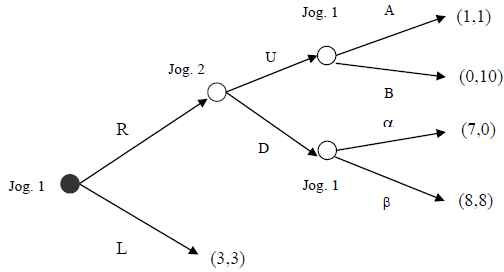
Analise o item :
Item 2 - Em qualquer equilíbrio perfeito em subjogos, a estratégia U não é jogada pelo jogador 2.
Provas
Questão presente nas seguintes provas
Sobre o comportamento da economia brasileira e a política econômica na primeira década republicana (1889-99) é correto afirmar que:
Item 2 - ao final da década, a renegociação da dívida pública externa (funding loan) impôs a execução de políticas fiscal e monetária contracionistas;
Provas
Questão presente nas seguintes provas
Public policy by the principal developed country (DC) governments since about 1979 has accepted, and probably caused, this interest upsurge. These governments, reacting against and inappropriately Keynesian response to the first (1973) oil price shock, decided to squeeze out inflation (and inflationary expectations) after the second (1978) shock. Around 1978-1984, this squeeze was attempted mainly by restraining the growth of the money supply, which led to increases in the nominal rate of interest. At the same time, the United States public sector deficits (and perhaps those in some other developed countries) added market-based upward pressure on interest rates. Rates charged by leading public institutions to borrowing governments – even on old loans – since the late 1970s have responded quickly to market conditions. There is no reason to doubt that these changes are passed on to final borrowers, especially in view of pressures by donors upon developing country governments to phase out interest rate subsidies.
After the second oil shock, principal developed country governments decided to fight inflation. According to the text, this was accomplished through
Item 3 - an increase in the interest rate caused by the tightening of the money supply;
Provas
Questão presente nas seguintes provas
Avalie o item abaixo sobre criação de base monetária, meios de pagamento e taxa de juros:
Item 0 - Empréstimos do Banco Central aos bancos comerciais determinam aumento de igual montante nos meios de pagamento.
Provas
Questão presente nas seguintes provas
Public policy by the principal developed country (DC) governments since about 1979 has accepted, and probably caused, this interest upsurge. These governments, reacting against and inappropriately Keynesian response to the first (1973) oil price shock, decided to squeeze out inflation (and inflationary expectations) after the second (1978) shock. Around 1978-1984, this squeeze was attempted mainly by restraining the growth of the money supply, which led to increases in the nominal rate of interest. At the same time, the United States public sector deficits (and perhaps those in some other developed countries) added market-based upward pressure on interest rates. Rates charged by leading public institutions to borrowing governments – even on old loans – since the late 1970s have responded quickly to market conditions. There is no reason to doubt that these changes are passed on to final borrowers, especially in view of pressures by donors upon developing country governments to phase out interest rate subsidies.
In its discussion of the interest rate upsurge from about 1979 onwards, the text
Item 0 - asserts that DC governments policy accepted the interest rate hike;
Provas
Questão presente nas seguintes provas
Assinale certo ou errado:
Item 2 - As coordenadas do vetor !$ (3,-1,1)∈ \Re^3 !$ na base ordenada !$ \{\underset{\nu}{I}_1=(1,0,0),\underset{\nu}{I}_2=(1,1,0),\underset{\nu}{I}_3=(1,1,1)\} !$ são !$ x_1=4,x_2=-2,x_3=-1 !$, em que !$ x_1 !$ é a coordenada em relação ao vetor !$ \underset{\nu}{I}_i !$, !$ i=1,2,3 !$.
Provas
Questão presente nas seguintes provas
Cadernos
Caderno Container