Foram encontradas 371 questões.
Considerando a função !$ f(x)=(x^2-1)\cdot (x-3) !$, assinale V (verdadeiro) ou F (falso):
Item 0 - a equação !$ f(x)=0 !$ tem no máximo duas raízes reais no intervalo [-3,3];
Provas

The Origins of Structuralism
H.W. Arndt. Modern Political Economy and Latin America. Eds. Jeffry Frieden,
Manuel Pastor Jr., and Michael Tomz. Westview Press, 2000: 5-9.
Introduction
In his recent book on economic development, I.M.D. Little distinguishes two broad categories of development economics. He calls them ‘neoclassical economics’ and ‘structuralism’.
“The structuralist sees the world as inflexible. Change is inhibited by obstacles, bottlenecks and constraints. People find it hard to move or adapt, and resources tend to be stuck. In economic terms, the supply of most things is inelastic. Such general inflexibility was thought to apply particularly to LDC’s.... Entrepreneurs were lacking; and communications were poor.... This alleged inflexibility was married to the evident fact that the production structure of developing countries was very different from that of developed countries. To achieve development, it had to be changed rapidly.... The structuralist view of the world provides a reason for distrusting the price mechanism and for trying to bring about change in other ways. If supplies and demands are very inelastic large price changes are needed to achieve small quantitative adjustments. Large price changes are disturbing, both directly and also because they result in changes in income distribution.... If the losers are powerful, they may... be able to resist the change through organized industrial or political action... Structuralism primarily seeks to provide a reason for managing change by administrative action.”
The purpose of this article is to explore further the origins of structuralism, both in the broader sense and the more specific context of Latin American structuralist theories of inflation, and the links between them.
According to the same author, structuralism rests on the following assumptions:
Item 3 - inelastic supply of factors of production,
Provas
Credit for the first formal statement of the structuralist theory of inflation is due to a Mexican economist, Juan Noyola Vazquez, who in an article published in a Mexican journal in 1956 argued that, especially in underdeveloped countries, inflation is not a monetary phenomenon but the result of interaction between two factors, 'basic inflationary pressures' due to structural rigidities and the 'propagating mechanism’ of competing income claims accommodated by monetary expansion.
After this initial Mexican contribution, the structuralist theory of inflation was developed in Santiago, at ECLA (the UN Economic Commission of Latin America of which Prebisch was Executive Secretary) and at the Institute of Economics of the University of Chile. The chapter on Chile in the ECLA Economic Survey of Latin America for 1957 contained a brief statement of the view that Chile’s inflation was a structural phenomenon, but what has been called the locus classicus of the structuralist theory of inflation is an article, first published in Spanish in December 1958 by Osvaldo Sunkel. He stated the central position of structuralism concisely:
“Basic Inflationary Pressures. These are fundamentally governed by the structural limitations, rigidity or inflexibility of the economic system. In fact, the inelasticity of some productive sectors to adjust to changes in demand – or, in short, the lack of mobility of productive resources and the defective functioning of the price system – are chiefly responsible for structural inflationary disequilibria.”
The intriguing fact is that both Sunkel and Noyola (to whom Sunkel expressed his indebteness) cited, as the authority for their statements about structural factors, an article by Kalecki published in Mexico in 1955. Noyola referred to ‘the analysis by Kalecki which stresses the importance of the rigidity of supply and the degree of monopoly in the economic system’. Sunkel cited both Kalecki’s article and the UN World Economic Survey 1956 written after Kalecki had ceased to be in charge of the Survey but no doubt still under his influence.
The chief point of Kalecki’s article, based on lectures he gave in Mexico in 1953, was to stress that in LDC’s ‘the supply of food may be fairly rigid’, and that the inelastic supply of food will, if aggregate demand increases and raises food prices, ‘cause a fall in real wages and will generate an inflationary price-wage spiral’. The UN World Economic Survey spelled out the structuralist doctrine more fully:
“An additional key element in inflationary pressure in underdeveloped countries is the high degree of immobility of resources..., which prevents the structure of production from adapting itself sufficiently to the pattern of demand.... Thus, in underdeveloped countries with limited supplies of food and other essential consumer goods, severe inflationary pressures may be generated even in the absence of budget deficits and with relatively low rates of investment.”
In its survey of “who is who” in the development of the structuralist theory of inflation, the text leads us to the following conclusions:
Item 1 - Noyola gives undue credit to Kalecki for his role in the elaboration of the structuralist theory.
Provas
The Origins of Structuralism
H.W. Arndt. Modern Political Economy and Latin America. Eds. Jeffry Frieden,
Manuel Pastor Jr., and Michael Tomz. Westview Press, 2000: 5-9.
Introduction
In his recent book on economic development, I.M.D. Little distinguishes two broad categories of development economics. He calls them ‘neoclassical economics’ and ‘structuralism’.
“The structuralist sees the world as inflexible. Change is inhibited by obstacles, bottlenecks and constraints. People find it hard to move or adapt, and resources tend to be stuck. In economic terms, the supply of most things is inelastic. Such general inflexibility was thought to apply particularly to LDC’s.... Entrepreneurs were lacking; and communications were poor.... This alleged inflexibility was married to the evident fact that the production structure of developing countries was very different from that of developed countries. To achieve development, it had to be changed rapidly.... The structuralist view of the world provides a reason for distrusting the price mechanism and for trying to bring about change in other ways. If supplies and demands are very inelastic large price changes are needed to achieve small quantitative adjustments. Large price changes are disturbing, both directly and also because they result in changes in income distribution.... If the losers are powerful, they may... be able to resist the change through organized industrial or political action... Structuralism primarily seeks to provide a reason for managing change by administrative action.”
The purpose of this article is to explore further the origins of structuralism, both in the broader sense and the more specific context of Latin American structuralist theories of inflation, and the links between them.
According to the same author, structuralism rests on the following assumptions:
Item 4 - absence of bottlenecks, constraints, and obstacles to change.
Provas
A figura abaixo mostra as curvas de indiferença de um consumidor e a direção na qual a utilidade deste consumidor aumenta.
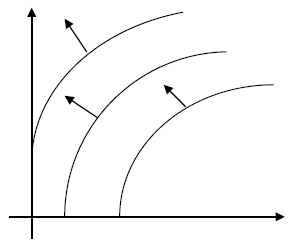
É correto afirmar:
Item 3 - No equilíbrio, o indivíduo só consome um tipo de bem.
Provas
Dadas as seguintes informações:
!$ \Sigma p_1q_0=21 \,\,\, \Sigma p_1q_1=48 !$
!$ \Sigma p_0q_0=25 \,\,\, \Sigma p_0q_1=41 !$
É correto afirmar que o valor dos índices especificados abaixo, para o período !$ t = 1 !$ (use duas decimais) é:
Item 0 - Laspeyres de preço: 1,64.
Provas
A year after the publication of Kalecki’s article, in 1956, Kaldor visited Santiago as a consultant to ECLA, commissioned to undertake a study of Chile’s economic problems. In his 1959 paper, which was also initially published in Mexico, Kaldor attributed many of Chile’s problems to over-regulation of the economy, but also restated Kalecki’s argument more formally: if productivity rises in nonagricultural sectors, but not in agriculture, then assuming that demand for food depends purely on the level of real wages and is inelastic with respect to the relative prices of food and non-food items, an expansion of money supply in step with rising GDP would raise money wages and ‘the rise in money wages would cause, by a series of steps, a sufficient rise in food prices (relative to both wages and non-food prices) to offset entirely the increase in real earnings in terms of non-food items’.
According to the text, Kaldor:
Item 1 - assumes the demand for food to be inelastic to both income and prices.
Provas
A year after the publication of Kalecki’s article, in 1956, Kaldor visited Santiago as a consultant to ECLA, commissioned to undertake a study of Chile’s economic problems. In his 1959 paper, which was also initially published in Mexico, Kaldor attributed many of Chile’s problems to over-regulation of the economy, but also restated Kalecki’s argument more formally: if productivity rises in nonagricultural sectors, but not in agriculture, then assuming that demand for food depends purely on the level of real wages and is inelastic with respect to the relative prices of food and non-food items, an expansion of money supply in step with rising GDP would raise money wages and ‘the rise in money wages would cause, by a series of steps, a sufficient rise in food prices (relative to both wages and non-food prices) to offset entirely the increase in real earnings in terms of non-food items’.
According to the text, Kaldor:
Item 2 - allows for money to have a role in causing inflation.
Provas
Considere um modelo de Agente-Principal em que o último contrata um vendedor para seu produto. Se o vendedor esforçar-se muito, a receita das vendas será R$ 100, com probabilidade 0,8; R$ 50, com probabilidade 0,2; e a utilidade do vendedor será !$ \sqrt{w}-4 !$. Caso o vendedor se esforce pouco, a receita de vendas será R$ 100, com probabilidade 0,4; R$ 50, com probabilidade 0,6; e a utilidade do vendedor será !$ \sqrt{w} !$ (w é o salário). O vendedor sempre pode ter a utilidade !$ u_0=1 !$ se for trabalhar numa outra profissão que não seja a de vendas. O Principal preocupa-se em maximizar seu lucro esperado, dado pela receita de vendas menos o custo. Assuma que o Principal não consiga observar o nível de esforço do vendedor, mas apenas as vendas. É correto afirmar:
Item 2 - O custo, para o Principal, de induzir o vendedor a esforçar-se mais é 90.
Provas
Structuralism in the broad sense of skepticism about the efficacy of the price mechanism and a conviction that government planning and controls must make up for ‘market failure’ was common to most, though not all, of the first generation of development economists. Some emphasized the inadequacy of prices as a guide to investment decisions. Others stressed what they believed to be the unacceptable social costs of the free play of market forces, especially its effects in aggravating inequality, nationally and internationally. All agreed that for various reasons all three components of the price mechanism work even less well in underdeveloped than in developed countries and that neoclassical economic theory was therefore largely inapplicable to LDCs.
What is the connection between structuralism in this broad sense and the Latin American ‘structuralist’ theory of inflation?
There is a consensus among the structuralists that:
Item 4 - Market prices are inadequate as guides to investment decisions.
Provas
Caderno Container