Foram encontradas 371 questões.
A year later, the American economist, Hollis Chenery, was invited to Santiago to give the ECLA Lectures. His main concern was to stimulate interest in input-output analysis and linear programming for investment planning in developing countries. But he also made a spirited plea for structuralism:
“A central problem of development policy is the adequacy of free market forces in allocating investment resources.... The traditional view of economic policy in Western countries is derived from the classical theory of competitive equilibrium.... The main policy implication of this model is that, under static conditions of perfect competition, market forces will tend to bring about the best of a country’s resources.”
He pointed out that the Keynesian revolution, while successfully challenging classical theory in relation to short-term fluctuations in income and employment, had left its conclusions on longer-term resource allocation virtually unaffected. He identified departures from competition, dynamic causes and equity considerations as the ‘three kinds of defect in the free price-mechanism as an instrument for achieving the maximum social welfare and listed, under the first heading, such obstacles as inadequate information, restrictions on entry into occupations and limited access to capital.
“Theses factors combine to produce a rigid market structure, prevalent monopoly positions, immobile labor and capital, and consequently great inequalities in the returns to labor and capital in different uses... Serious structural disequilibrium in the use of labor, natural resources or foreign exchange represents one of the situations justifying state intervention in investment decisions.”
According to Chenery:
Item 3 - State intervention should be limited to investment decisions
Provas

Em relação aos modelos de séries temporais, é correto afirmar:
Item 2 - O processo AR(1), !$ Z_t=0,8Z_{t-1}+a_t !$, em que !$ a_t !$ é um ruído branco, é estacionário.
Provas
Provas
Considerando a função !$ f(x)=(x^2-1)\cdot (x-3) !$, assinale V (verdadeiro) ou F (falso):
Item 2 - a equação !$ f"(x)=0 !$ tem no máximo uma raiz real no intervalo [-3,3];
Provas
Considere uma economia de troca pura com dois bens (x1 e x2) e dois indivíduos (A e B). Sejam: !$ u_A(x_1,x_2)=x_1^{1/3}x_2^{2/3},u_b(x_1,x_2)Min\{x_1,x_2\} !$ e as dotações !$ w_a=(10,20) !$ e !$ w_B=(20,5) !$. Avalie a afirmativa:
Item 2 - O conjunto das alocações eficientes satisfaz a !$ x_2^A=x_1^A-5 !$.
Provas
Provas
A year after the publication of Kalecki’s article, in 1956, Kaldor visited Santiago as a consultant to ECLA, commissioned to undertake a study of Chile’s economic problems. In his 1959 paper, which was also initially published in Mexico, Kaldor attributed many of Chile’s problems to over-regulation of the economy, but also restated Kalecki’s argument more formally: if productivity rises in nonagricultural sectors, but not in agriculture, then assuming that demand for food depends purely on the level of real wages and is inelastic with respect to the relative prices of food and non-food items, an expansion of money supply in step with rising GDP would raise money wages and ‘the rise in money wages would cause, by a series of steps, a sufficient rise in food prices (relative to both wages and non-food prices) to offset entirely the increase in real earnings in terms of non-food items’.
According to the text, Kaldor:
Item 4 - makes a two-sector analysis to explain structural disequilibrium.
Provas
Provas
The Latin American Structuralist Theory of Inflation
Inflation had bedeviled economic policy in most Latin American countries for many years, and structuralist-type arguments had been put forward by opponents of liberal economic policies from time to time, in Brazil as early as 1949. But it was primarily the experience of Chile, the most conspicuous case of chronic inflation, that gave rise to the formulation of a structuralist theory of inflation. The Chilean peso had depreciated externally and domestically in all but 15 of the preceding 80 years, at annual rates which rose from around 20% in the 1940s to well over 50% in the mid-1950s. In the latter half of 1955, the Chilean Government decided on yet another effort at stabilization and employed a group of American consultants, the Klein-Saks Mission, to prepare a stabilization program. It was this, reinforced by broadly ‘monetarist’ stabilization policies recommended by the IMF in Argentina and Chile in 1958/9, that sparked off the monetarist-structuralist controversy.
The crux of the argument (in the preceding paragraph) is that:
Item 0 - Inflation has bedeviled economic policy in Latin America
Provas
Uma variável aleatória continua x tem a sua função densidade de probabilidade dada pelo gráfico:
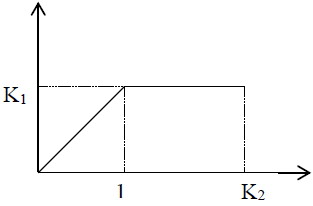
É correto afirmar:
Item 4 - Supondo que K2 =1, a esperança matemática de x, E(x), será 1/3.
Provas
Caderno Container