Foram encontradas 385 questões.
When Edwin Hubble, the astronomer after whom the space telescope is named, looked at the skies in the 1920s using what was then the world’s largest telescope, he found that there were galaxies outside the Milky Way, an observation that profoundly shocked his contemporaries. Max Planck founded quantum theory, and thus wrecked the Newtonian universe. And William Herschel discovered Uranus, the first planet unknown to the astrologers of old. If the new and refurbished instruments named after these scientific mould-breakers do as much in the next few years as their eponyms did, it will, indeed, be an exciting time for astronomy and physics.
According to the text
Item 1- Edwin Hubble could only see galaxies within the Milky Way;
Provas

More prosaically, Hubble will receive new protective blankets, gyroscopes and batteries, a unit that transmits data to Earth will be replaced, and two existing instruments will be repaired. The upgrade should keep it running until 2014 when its successor, the James Webb space telescope, is supposed to be launched. Meanwhile, on May 14th, the European Space Agency should have added its own contribution to the study of the infant universe. It was due, as The Economist went to press, to launch two satellites the more familiar way, aboard a disposable rocket.
(…)
According to the text
Item 1- Hubble's gyroscopes and batteries will not need to be replaced.
Provas
Considere o jogo conhecido como “caça ao cervo”, abaixo:
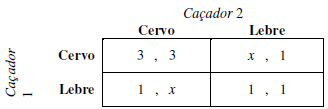
Em que !$ 0 \le x < 1 !$ é constante. Com base nesse jogo, avalie a afirmação abaixo:
Item 1 - Há dois equilíbrios de Nash;
Provas
Considere a seguinte função utilidade !$ u( x,y) = -{ \large 1 \over x} - { \large 1 \over y} !$ , em que x denota a quantidade do bem 1 e y a quantidade do bem 2. Denote por x p o preço do bem 1, por py o preço do bem 2 e por r a renda do consumidor. Responda V ou F à seguinte alternativa:
Item 2 - A função dispêndio tem a forma de Elasticidade de Substituição Constante;
Provas
Sejam !$ f: IR^2 \rightarrow IR\ !$ definida por !$ f(x,y) = x + y, g: IR^2 \rightarrow IR\ !$ definida por e definida por !$ g(x,y) = x^2 + y^2 !$ e !$ h: IR^2 \rightarrow IR\ !$ definida por !$ h(x,y) = x^3 y^3- x - y+ 1 !$ Julgue a afirmativa:
Item 0 - g possui ponto de máximo absoluto em !$ IR^2 !$;
Provas
A Constituição de 1988 trouxe importantes modificações institucionais que influenciaram o papel do Estado na economia, com repercussão em seus indicadores de desenvolvimento, principalmente no que concerne aos direitos sociais. Sobre isto, pode-se afirmar que:
Item 4 - embora tenha estendido o ensino público obrigatório a todas as idades, nada mencionou quanto a sua gratuidade.
Provas
Julgue a afirmativa:
Item 4 - !$ f(x,y) = 5x^{1/_2} y^{1/_2} - { \Large { 2x^3\over y}} !$ é homogênea de grau 2.
Provas
Considere os sistemas lineares abaixo e julgue a afirmativa:
!$ (I)= { \begin{cases} x+ y + Kz = 2\\3x + 4y + 2z =K\\2x + 3y - z =1 \end{cases}} !$
!$ (II)= { \begin{cases} a_{11} x_1 + a_{12} x_2 + \dots + a_{1n} x_n = b_1 \\ a_{21} x_1 + a_{22} x_2 + \cdots + a_{2n} X_n = b_2\\\,\,\,\,\,\,\,\,\,\,\,\,\,\,\,\,\,\,\,\,\,\,\,\,\,\,\,\,\,\,\,\,\,\,\,\,\,\,\,\,\,\, \vdots\\a_{m1} X_1 + a_{m2} X_2 + cdots + a_{mn} X_n = b_m \end{cases}} !$
Item 4 - Se !$ b_1 = b_2 = \cdots = b_m = 0 !$, então o sistema (II) tem sempre solução.
Provas
Julgue a afirmativa:
Item 0 - Se !$ u = 2e_1 + e_2 - 2e_3 !$ então !$ v = \left ( - { \Large { 2 \over 3}}, - { \Large { 1 \over 3}}, { \Large { 2 \over 3}} \right ) !$ , é um vetor unitário, paralelo a u, em que !$ e_1 = (1,0,0), e_2 = (0,1,0) !$ e !$ e_3 = (0,0,1) !$
Provas
Considere a curva de Phillips:
!$ \pi_t = \pi_t^e - 2 (u_t - 0,10) !$,
em que !$ \pi_t = \pi_t^e !$ e !$ u_t !$ são, respectivamente, a inflação no ano t, a inflação esperada para t e a taxa de desemprego em t. No ano 1, a economia encontra-se em uma situação em que !$ \pi_1 = \pi_1^e = 0,10 !$. O Banco Central, que controla diretamente a taxa de inflação, anuncia a implementação, a partir do ano 2, de uma política de desinflação visando trazer a inflação para 0,04 (isto é, 4%).
A razão de sacrifício (ou taxa de sacrifício) é o aumento na taxa de desemprego (acumulado ao longo do período de desinflação) dividido pela queda na taxa de inflação.
Com base nessas informações, julgue a seguinte afirmativa:
Item 3 - Se !$ \pi_t^e = (0,5) \pi_{t-1} + (0,5) (0,04) !$ e o Banco Central deseja reduzir imediatamente (no ano 2) a inflação para 4%, a razão de sacrifício é igual a 0,4;
Provas
Caderno Container