Foram encontradas 70 questões.
Em relação à orçamentação de obras e serviços públicos, de acordo com a legislação vigente, a taxa de benefício e despesas indiretas
Provas

Conforme a NR-10, constitui uma medida de proteção coletiva prioritária o(a)
Provas
A eficiência energética é parte da política estratégica de desenvolvimento em diversos países, incluindo o Brasil.
Nesse sentido, a eficiência energética pode ser promovida pela
Provas
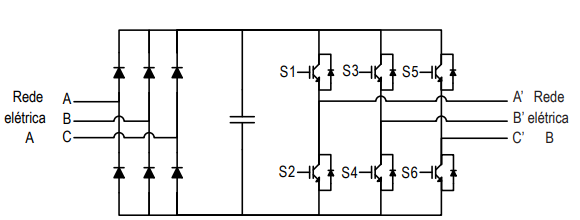
A Figura acima mostra duas redes elétricas distintas que estão conectadas a um conversor de potência formado por uma ponte a diodo trifásica, um filtro capacitivo no elo de corrente contínua e uma ponte trifásica de chaves semicondutoras IGBT. A rede A tem tensão nominal de 440 V, enquanto a rede B tem tensão nominal de 220V.
Devido à forma de ligação em cada rede e às características construtivas do conversor, sua operação permite o controle da(o)
Provas
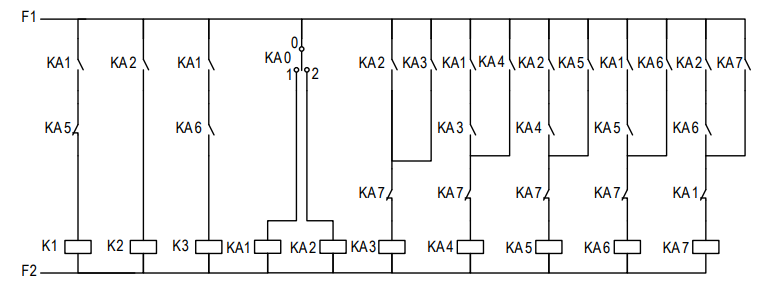
O diagrama da Figura acima é de um circuito de acionamento. As contatoras de força K1, K2 e K3 nunca são energizadas simultaneamente entre si. Já os relés auxiliares KA1 a KA7 e o contato KA0 formam o circuito auxiliar que propicia a energização das contatoras de força. O contato KA0 pertence a um dispositivo eletrônico que, quando acionado, dá início à comutação periódica do contato 0 com os contatos 1 e 2, iniciando pelo contato 1. Como consequência, os relés auxiliares KA1 e KA2 são acionados de forma complementar, com início de acionamento em KA1. O tempo entre cada comutação do contato KA0 é muito maior que o tempo de comutação (fechamento e abertura) dos contatos do circuito, que pode ser considerado desprezível.
O resultado do funcionamento circuito auxiliar é um ciclo periódico de energização das contatoras de força, que se repete após o fim da sequência
Provas
O emprego da eletrônica de potência nos controles elétricos contribuiu significativamente para o avanço tecnológico nessa área. O uso dos inversores de frequência associados aos motores de indução é um exemplo da utilização da eletrônica de potência no controle de velocidade de motores elétricos.
Nessa aplicação, o aumento da viabilidade econômica dos inversores favorece o emprego dos motores de indução na substituição dos motores
Provas
Considerando-se a estrutura institucional atual do setor elétrico brasileiro, o órgão que, dentre outras funções, tem a de definir as diretrizes para os procedimentos licitatórios e promover as licitações destinadas à contratação de concessionários de serviço público para produção, transmissão e distribuição de energia elétrica é
Provas
- Transformadores e Máquinas ElétricasPrincípios BásicosPerdas, rendimento, torque, potência, ângulo de potência e funcionamento geral
Um motor elétrico trifásico é alimentado por uma tensão cujo valor de linha é igual a 220 V. A corrente no motor em operação nominal é igual a 20 A, e o fator de potência indutivo é 0,9. Sabe-se que, para essa condição, o rendimento do motor é igual a 90%, e a velocidade de rotação do eixo é igual a 81 !$ \sqrt{3} !$ rad/s.
O valor, em N.m, do torque no eixo do motor é
Provas
- EscritórioMicrosoft OfficeExcelVersões do ExcelExcel 2010
- EscritórioMicrosoft OfficeExcelConceitos Avançados do Excel
Natural gas waits for its moment
Paul Stenquist
asdCars and trucks powered by natural gas make up
a significant portion of the vehicle fleet in many parts
of the world. Iran has more than two million natural gas
vehicles on the road. As of 2009, Argentina had more
5 than 1.8 million in operation and almost 2,000 natural
gas filling stations. Brazil was not far behind. Italy and
Germany have substantial natural gas vehicle fleets.
Is America next?
asdWith natural gas in plentiful supply at bargain
10 prices in the United States, issues that have limited its
use in cars are being rethought, and its market share
could increase, perhaps substantially.
asdAccording to Energy Department Price
Information from July, natural gas offers economic
15 advantages over gasoline and diesel fuels. If a
gasoline-engine vehicle can take you 40 miles on
one gallon, the same vehicle running on compressed
natural gas can do it for about $1.50 less at today’s
prices. To that savings add lower maintenance costs.
20A study of New York City cabs running on natural
gas found that oil changes need not be as frequent
because of the clean burn of the fuel, and exhaust-
system parts last longer because natural gas is less
corrosive than other fuels.
25asdToday, those economic benefits are nullified by
the initial cost of a natural gas vehicle — 20 to 30
percent more than a comparable gasoline-engine
vehicle. But were production to increase significantly,
economies of scale would bring prices down. In an
30 interview by phone, Jon Coleman, fleet sustainability
manager at the Ford Motor Company, said that given
sufficient volume, the selling price of natural gas
vehicles could be comparable to that of conventional
vehicles.
35asdIt may be years before the economic benefits
of natural gas vehicles can be realized, but the
environmental benefits appear to be immediate.
According to the Energy Department’s website,
natural gas vehicles have smaller carbon footprints than
40 gasoline or diesel automobiles, even when taking into
account the natural gas production process, which
releases carbon-rich methane into the atmosphere.
asdThe United States government appears to favor
natural gas as a motor vehicle fuel. To promote the
45 production of vehicles with fewer carbon emissions, it
has allowed automakers to count certain vehicle types
more than once when calculating their Corporate
Average Fuel Economy, under regulations mandating
a fleet average of 54.5 miles per gallon by 2025.
50 Plug-in hybrids and natural gas vehicles can be
counted 1.6 times under the CAFE standards, and
electric vehicles can be counted twice.
asdAdapting natural gas as a vehicle fuel introduces
engineering challenges. While the fuel burns clean, it
55 is less energy dense than gasoline, so if it is burned
in an engine designed to run on conventional fuel,
performance and efficiency are degraded.
asdBut since natural gas has an octane rating of 130,
compared with 93 for the best gasoline, an engine
60 designed for it can run with very high cylinder pressure,
which would cause a regular gasoline engine to knock
from premature ignition. More cylinder pressure yields
more power, and thus the energy-density advantage
of gasoline can be nullified.[...]
65dUntil the pressurized fuel tanks of natural gas
vehicles can be easily and quickly refueled, the fleet
cannot grow substantially. The number of commercial
refueling stations for compressed natural gas has been
increasing at a rate of 16 percent yearly, the Energy
70 Department says. And, while the total is still small,
advances in refueling equipment should increase
the rate of expansion. Much of the infrastructure is
already in place: America has millions of miles of
natural gas pipeline. Connecting that network to
75 refueling equipment is not difficult.
asdAlthough commercial refueling stations will be
necessary to support a substantial fleet of natural gas
vehicles, home refueling may be the magic bullet that
makes the vehicles practical. Electric vehicles depend
80 largely on home charging and most have less than half
the range of a fully fueled natural gas vehicle. Some
compressed natural gas home refueling products are
available, but they can cost as much as $5,000.
asdSeeking to change that, the Energy Department
85 has awarded grants to a number of companies in an
effort to develop affordable home-refueling equipment.
[...]
Available at: <https://www.nytimes.com/2013/10/30/au-tomobiles/natural-gas-waits-for-its-moment.html? :pagewantted=allemodule=SserchemabReward=relbias%3Ar%2C%7B%222%22%3A%22RI%3A18%22%7D%>
Retrieved on: Sept 3rd, 2014. Adapted.
Considere o trecho da planilha construída no aplicativo Excel 2010 (Português), apresentada abaixo, no qual a fórmula
=B1*(1+B2)^B3
foi digitada na célula B4
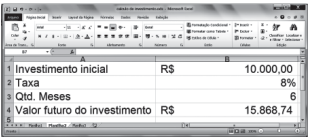
O usuário da planilha também deseja calcular a quantidade necessária de meses para obter um Valor futuro do investimento de R$ 30.000,00. Para fazer isso, pretende usar um recurso disponível entre as funcionalidades do Excel, que altera o valor lançado na célula B4, mas não por lançamento direto nessa célula. Opta, então, por calcular, automaticamente, um novo valor para a célula B3.
Qual é a funcionalidade do Excel 2010 (Português), que faz esse cálculo, automaticamente, mantendo a fórmula que está na célula B4?
Provas
Natural gas waits for its moment
Paul Stenquist
asdCars and trucks powered by natural gas make up
a significant portion of the vehicle fleet in many parts
of the world. Iran has more than two million natural gas
vehicles on the road. As of 2009, Argentina had more
5 than 1.8 million in operation and almost 2,000 natural
gas filling stations. Brazil was not far behind. Italy and
Germany have substantial natural gas vehicle fleets.
Is America next?
asdWith natural gas in plentiful supply at bargain
10 prices in the United States, issues that have limited its
use in cars are being rethought, and its market share
could increase, perhaps substantially.
asdAccording to Energy Department Price
Information from July, natural gas offers economic
15 advantages over gasoline and diesel fuels. If a
gasoline-engine vehicle can take you 40 miles on
one gallon, the same vehicle running on compressed
natural gas can do it for about $1.50 less at today’s
prices. To that savings add lower maintenance costs.
20A study of New York City cabs running on natural
gas found that oil changes need not be as frequent
because of the clean burn of the fuel, and exhaust-
system parts last longer because natural gas is less
corrosive than other fuels.
25asdToday, those economic benefits are nullified by
the initial cost of a natural gas vehicle — 20 to 30
percent more than a comparable gasoline-engine
vehicle. But were production to increase significantly,
economies of scale would bring prices down. In an
30 interview by phone, Jon Coleman, fleet sustainability
manager at the Ford Motor Company, said that given
sufficient volume, the selling price of natural gas
vehicles could be comparable to that of conventional
vehicles.
35asdIt may be years before the economic benefits
of natural gas vehicles can be realized, but the
environmental benefits appear to be immediate.
According to the Energy Department’s website,
natural gas vehicles have smaller carbon footprints than
40 gasoline or diesel automobiles, even when taking into
account the natural gas production process, which
releases carbon-rich methane into the atmosphere.
asdThe United States government appears to favor
natural gas as a motor vehicle fuel. To promote the
45 production of vehicles with fewer carbon emissions, it
has allowed automakers to count certain vehicle types
more than once when calculating their Corporate
Average Fuel Economy, under regulations mandating
a fleet average of 54.5 miles per gallon by 2025.
50 Plug-in hybrids and natural gas vehicles can be
counted 1.6 times under the CAFE standards, and
electric vehicles can be counted twice.
asdAdapting natural gas as a vehicle fuel introduces
engineering challenges. While the fuel burns clean, it
55 is less energy dense than gasoline, so if it is burned
in an engine designed to run on conventional fuel,
performance and efficiency are degraded.
asdBut since natural gas has an octane rating of 130,
compared with 93 for the best gasoline, an engine
60 designed for it can run with very high cylinder pressure,
which would cause a regular gasoline engine to knock
from premature ignition. More cylinder pressure yields
more power, and thus the energy-density advantage
of gasoline can be nullified.[...]
65dUntil the pressurized fuel tanks of natural gas
vehicles can be easily and quickly refueled, the fleet
cannot grow substantially. The number of commercial
refueling stations for compressed natural gas has been
increasing at a rate of 16 percent yearly, the Energy
70 Department says. And, while the total is still small,
advances in refueling equipment should increase
the rate of expansion. Much of the infrastructure is
already in place: America has millions of miles of
natural gas pipeline. Connecting that network to
75 refueling equipment is not difficult.
asdAlthough commercial refueling stations will be
necessary to support a substantial fleet of natural gas
vehicles, home refueling may be the magic bullet that
makes the vehicles practical. Electric vehicles depend
80 largely on home charging and most have less than half
the range of a fully fueled natural gas vehicle. Some
compressed natural gas home refueling products are
available, but they can cost as much as $5,000.
asdSeeking to change that, the Energy Department
85 has awarded grants to a number of companies in an
effort to develop affordable home-refueling equipment.
[...]
Available at: <https://www.nytimes.com/2013/10/30/au-tomobiles/natural-gas-waits-for-its-moment.html? :pagewantted=allemodule=SserchemabReward=relbias%3Ar%2C%7B%222%22%3A%22RI%3A18%22%7D%>
Retrieved on: Sept 3rd, 2014. Adapted.
Baseada nas melhores práticas para segurança da informação, uma instituição governamental visa à melhor gestão dos seus ativos e classificação das informações.
Três dentre os critérios mínimos aceitáveis para atingir esse objetivo são:
Provas
Caderno Container