Foram encontradas 70 questões.
Uma empresa tem diversos projetos e, por isso, agrupa aqueles que se relacionam a fim de gerenciá-los de modo coordenado. Assim, a empresa obtém benefícios e controle que não estariam disponíveis se tais projetos fossem gerenciados individualmente.
A esse grupo de projetos dá-se o nome de
Provas

Disciplina: Administração de Recursos Materiais
Banca: CESGRANRIO
Orgão: BR Distribuidora
Sistemas de planejamento de recursos da empresa (Enterprise Resource Planning – ERP) têm o potencial de aprimorar o desempenho de muitas empresas em muitos setores diferentes. Sobre o ERP, considere as afirmativas abaixo.
I – Os sistemas legados são melhores que o ERP, no que diz respeito à utilização de tecnologias como Internet, para o compartilhamento de informações.
II – A operação do ERP requer plataformas especiais, não sendo capaz de operar em plataformas comuns como o Windows, Linux e UNIX.
III – O ERP é baseado na arquitetura cliente/servidor, de modo que o acesso aos sistemas de informação é aberto a qualquer pessoa cujo computador esteja ligado aos computadores centrais (servidor).
Está correto o que se afirma em
Provas
Disciplina: Administração de Recursos Materiais
Banca: CESGRANRIO
Orgão: BR Distribuidora
Um sistema de informação foi implantado entre o sistema de negócio da companhia e os sistemas de chão de fábrica, que operam em tempo real. A finalidade desse sistema consiste em otimizar e sincronizar a utilização dos recursos, suportando o intercâmbio de informações entre o planejamento da produção e o controle do processo de produção através do monitoramento, acompanhamento e controle da matéria-prima, equipamento, pessoal, instruções e instalações de produção.
Tal sistema de informação é denominado
Provas
Disciplina: Administração de Recursos Materiais
Banca: CESGRANRIO
Orgão: BR Distribuidora
Uma empresa utiliza determinado componente cujo custo unitário é de R$ 50,00. A demanda anual para esse componente é estimada em 50.000 unidades. O custo para emitir e colocar um pedido de compra é de R$ 25,00, e o custo para manter o componente em estoque durante um ano é de 20% do valor do componente.
Considerando o horizonte de tempo de um ano, o lote econômico de compra é de
Provas
- EscritórioMicrosoft OfficeExcelVersões do ExcelExcel 2010
- EscritórioMicrosoft OfficeExcelConceitos Avançados do Excel
Natural gas waits for its moment
Paul Stenquist
asdCars and trucks powered by natural gas make up
a significant portion of the vehicle fleet in many parts
of the world. Iran has more than two million natural gas
vehicles on the road. As of 2009, Argentina had more
5 than 1.8 million in operation and almost 2,000 natural
gas filling stations. Brazil was not far behind. Italy and
Germany have substantial natural gas vehicle fleets.
Is America next?
asdWith natural gas in plentiful supply at bargain
10 prices in the United States, issues that have limited its
use in cars are being rethought, and its market share
could increase, perhaps substantially.
asdAccording to Energy Department Price
Information from July, natural gas offers economic
15 advantages over gasoline and diesel fuels. If a
gasoline-engine vehicle can take you 40 miles on
one gallon, the same vehicle running on compressed
natural gas can do it for about $1.50 less at today’s
prices. To that savings add lower maintenance costs.
20A study of New York City cabs running on natural
gas found that oil changes need not be as frequent
because of the clean burn of the fuel, and exhaust-
system parts last longer because natural gas is less
corrosive than other fuels.
25asdToday, those economic benefits are nullified by
the initial cost of a natural gas vehicle — 20 to 30
percent more than a comparable gasoline-engine
vehicle. But were production to increase significantly,
economies of scale would bring prices down. In an
30 interview by phone, Jon Coleman, fleet sustainability
manager at the Ford Motor Company, said that given
sufficient volume, the selling price of natural gas
vehicles could be comparable to that of conventional
vehicles.
35asdIt may be years before the economic benefits
of natural gas vehicles can be realized, but the
environmental benefits appear to be immediate.
According to the Energy Department’s website,
natural gas vehicles have smaller carbon footprints than
40 gasoline or diesel automobiles, even when taking into
account the natural gas production process, which
releases carbon-rich methane into the atmosphere.
asdThe United States government appears to favor
natural gas as a motor vehicle fuel. To promote the
45 production of vehicles with fewer carbon emissions, it
has allowed automakers to count certain vehicle types
more than once when calculating their Corporate
Average Fuel Economy, under regulations mandating
a fleet average of 54.5 miles per gallon by 2025.
50 Plug-in hybrids and natural gas vehicles can be
counted 1.6 times under the CAFE standards, and
electric vehicles can be counted twice.
asdAdapting natural gas as a vehicle fuel introduces
engineering challenges. While the fuel burns clean, it
55 is less energy dense than gasoline, so if it is burned
in an engine designed to run on conventional fuel,
performance and efficiency are degraded.
asdBut since natural gas has an octane rating of 130,
compared with 93 for the best gasoline, an engine
60 designed for it can run with very high cylinder pressure,
which would cause a regular gasoline engine to knock
from premature ignition. More cylinder pressure yields
more power, and thus the energy-density advantage
of gasoline can be nullified.[...]
65dUntil the pressurized fuel tanks of natural gas
vehicles can be easily and quickly refueled, the fleet
cannot grow substantially. The number of commercial
refueling stations for compressed natural gas has been
increasing at a rate of 16 percent yearly, the Energy
70 Department says. And, while the total is still small,
advances in refueling equipment should increase
the rate of expansion. Much of the infrastructure is
already in place: America has millions of miles of
natural gas pipeline. Connecting that network to
75 refueling equipment is not difficult.
asdAlthough commercial refueling stations will be
necessary to support a substantial fleet of natural gas
vehicles, home refueling may be the magic bullet that
makes the vehicles practical. Electric vehicles depend
80 largely on home charging and most have less than half
the range of a fully fueled natural gas vehicle. Some
compressed natural gas home refueling products are
available, but they can cost as much as $5,000.
asdSeeking to change that, the Energy Department
85 has awarded grants to a number of companies in an
effort to develop affordable home-refueling equipment.
[...]
Available at: <https://www.nytimes.com/2013/10/30/au-tomobiles/natural-gas-waits-for-its-moment.html? :pagewantted=allemodule=SserchemabReward=relbias%3Ar%2C%7B%222%22%3A%22RI%3A18%22%7D%>
Retrieved on: Sept 3rd, 2014. Adapted.
Considere o trecho da planilha construída no aplicativo Excel 2010 (Português), apresentada abaixo, no qual a fórmula
=B1*(1+B2)^B3
foi digitada na célula B4
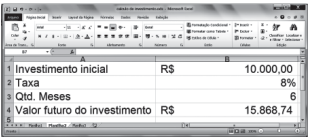
O usuário da planilha também deseja calcular a quantidade necessária de meses para obter um Valor futuro do investimento de R$ 30.000,00. Para fazer isso, pretende usar um recurso disponível entre as funcionalidades do Excel, que altera o valor lançado na célula B4, mas não por lançamento direto nessa célula. Opta, então, por calcular, automaticamente, um novo valor para a célula B3.
Qual é a funcionalidade do Excel 2010 (Português), que faz esse cálculo, automaticamente, mantendo a fórmula que está na célula B4?
Provas
Natural gas waits for its moment
Paul Stenquist
asdCars and trucks powered by natural gas make up
a significant portion of the vehicle fleet in many parts
of the world. Iran has more than two million natural gas
vehicles on the road. As of 2009, Argentina had more
5 than 1.8 million in operation and almost 2,000 natural
gas filling stations. Brazil was not far behind. Italy and
Germany have substantial natural gas vehicle fleets.
Is America next?
asdWith natural gas in plentiful supply at bargain
10 prices in the United States, issues that have limited its
use in cars are being rethought, and its market share
could increase, perhaps substantially.
asdAccording to Energy Department Price
Information from July, natural gas offers economic
15 advantages over gasoline and diesel fuels. If a
gasoline-engine vehicle can take you 40 miles on
one gallon, the same vehicle running on compressed
natural gas can do it for about $1.50 less at today’s
prices. To that savings add lower maintenance costs.
20A study of New York City cabs running on natural
gas found that oil changes need not be as frequent
because of the clean burn of the fuel, and exhaust-
system parts last longer because natural gas is less
corrosive than other fuels.
25asdToday, those economic benefits are nullified by
the initial cost of a natural gas vehicle — 20 to 30
percent more than a comparable gasoline-engine
vehicle. But were production to increase significantly,
economies of scale would bring prices down. In an
30 interview by phone, Jon Coleman, fleet sustainability
manager at the Ford Motor Company, said that given
sufficient volume, the selling price of natural gas
vehicles could be comparable to that of conventional
vehicles.
35asdIt may be years before the economic benefits
of natural gas vehicles can be realized, but the
environmental benefits appear to be immediate.
According to the Energy Department’s website,
natural gas vehicles have smaller carbon footprints than
40 gasoline or diesel automobiles, even when taking into
account the natural gas production process, which
releases carbon-rich methane into the atmosphere.
asdThe United States government appears to favor
natural gas as a motor vehicle fuel. To promote the
45 production of vehicles with fewer carbon emissions, it
has allowed automakers to count certain vehicle types
more than once when calculating their Corporate
Average Fuel Economy, under regulations mandating
a fleet average of 54.5 miles per gallon by 2025.
50 Plug-in hybrids and natural gas vehicles can be
counted 1.6 times under the CAFE standards, and
electric vehicles can be counted twice.
asdAdapting natural gas as a vehicle fuel introduces
engineering challenges. While the fuel burns clean, it
55 is less energy dense than gasoline, so if it is burned
in an engine designed to run on conventional fuel,
performance and efficiency are degraded.
asdBut since natural gas has an octane rating of 130,
compared with 93 for the best gasoline, an engine
60 designed for it can run with very high cylinder pressure,
which would cause a regular gasoline engine to knock
from premature ignition. More cylinder pressure yields
more power, and thus the energy-density advantage
of gasoline can be nullified.[...]
65dUntil the pressurized fuel tanks of natural gas
vehicles can be easily and quickly refueled, the fleet
cannot grow substantially. The number of commercial
refueling stations for compressed natural gas has been
increasing at a rate of 16 percent yearly, the Energy
70 Department says. And, while the total is still small,
advances in refueling equipment should increase
the rate of expansion. Much of the infrastructure is
already in place: America has millions of miles of
natural gas pipeline. Connecting that network to
75 refueling equipment is not difficult.
asdAlthough commercial refueling stations will be
necessary to support a substantial fleet of natural gas
vehicles, home refueling may be the magic bullet that
makes the vehicles practical. Electric vehicles depend
80 largely on home charging and most have less than half
the range of a fully fueled natural gas vehicle. Some
compressed natural gas home refueling products are
available, but they can cost as much as $5,000.
asdSeeking to change that, the Energy Department
85 has awarded grants to a number of companies in an
effort to develop affordable home-refueling equipment.
[...]
Available at: <https://www.nytimes.com/2013/10/30/au-tomobiles/natural-gas-waits-for-its-moment.html? :pagewantted=allemodule=SserchemabReward=relbias%3Ar%2C%7B%222%22%3A%22RI%3A18%22%7D%>
Retrieved on: Sept 3rd, 2014. Adapted.
Baseada nas melhores práticas para segurança da informação, uma instituição governamental visa à melhor gestão dos seus ativos e classificação das informações.
Três dentre os critérios mínimos aceitáveis para atingir esse objetivo são:
Provas
| TRIMESTRES | ||||
| 1 | 2 | 3 | 4 | |
| 2013 | 1.200 | 800 | ||
| 2014 | 1.300 | 1.000 | ||
Provas
Provas
Provas
Uma empresa, que está iniciando a sua operação, espera obter lucros, antes da depreciação e do imposto de renda, de R$ 100.000,00 em cada um dos próximos quatro anos. Ela está adquirindo uma máquina no valor de R$ 40.000,00 que requer R$ 10.000,00 para a instalação e tem um período de recuperação de três anos. As porcentagens da sua depreciação são dadas pelo Quadro abaixo, de acordo com a convenção de meio ano.
Ano de recuperação | Porcentagem (%) por ano de recuperação (3 anos) |
1 | 33 |
2 | 45 |
3 | 15 |
4 | 7 |
Total | 100 |
Considerando que essa máquina é o único ativo da empresa e que a alíquota de imposto de renda é de 30%, o valor do fluxo de caixa operacional, em reais, previsto para o último ano de recuperação é de
Provas
Caderno Container