Foram encontradas 49 questões.
A legislação administrativa emprega diferentes termos para categorizar as diversas formas de retorno ao cargo público.
Associe essas diferentes formas à respectiva descrição.
I - Reintegração
II - Aproveitamento
III - Reversão
P - Retorno do servidor posto em disponibilidade, em cargo de atribuições e vencimentos compatíveis com o cargo anterior.
Q - Retorno do servidor ao cargo anteriormente ocupado em virtude de inabilitação em estágio probatório para outro cargo ou por conta de reintegração do ocupante anterior.
R - Retorno do aposentado ao serviço público em razão, por exemplo, da cessação do motivo da sua aposentadoria.
S - Retorno do servidor após ter sido invalidada a sua demissão por decisão judicial.
A associação correta é:
Provas

Disciplina: Administração Financeira e Orçamentária
Banca: CESGRANRIO
Orgão: CHESF
O orçamento pode ser definido como a expressão quantitativa de um plano futuro de ação da administração para dado período. Nesse contexto, a teoria tipifica maneiras diferentes de constituir e utilizar essa ferramenta.
Associe os tipos de orçamento à sua descrição, apresentada a seguir.
I - Orçamento Base Zero
II - Orçamento Contínuo
III - Orçamento Kaizen
P - Está sempre disponível para um período futuro determinado, acrescentando mais um mês à frente e descartando o mês que se encerra.
Q - Considera, por exemplo, melhorias futuras ainda não implantadas que produzam reduções constantes dos custos orçados ao longo do período.
R - Concentra a atenção no custo das atividades necessárias à produção e à venda dos produtos e dos serviços da empresa.
S - É estruturado como se estivesse sendo preparado pela primeira vez, e o seu conceito surgiu em contraposição ao do orçamento de tendências.
As associações corretas são:
Provas
O quadro mostra as informações sobre os produtos 1 e 2, no mês de abril de 2012. Considere como base de rateio as horas máquinas.
abril de 2012
| Produto | Preço de venda unidade | Matéria-prima unidade | Hora máquina Total | Mão de obra unidade | Unidades mensais |
| Produto 1 | 10,00 | 3,00 | 700 | 1,00 | 10.000 |
| Produto 2 | 15,00 | 5,00 | 500 | 3,00 | 17.000 |
O valor total do custo indireto de fabricação, em reais, do produto 1, sabendo-se que o custo indireto total é de R$ 35.000,00, é
Provas
O gráfico a seguir apresenta o número de acidentes sofridos pelos empregados de uma empresa nos últimos 12 meses e a frequência relativa.
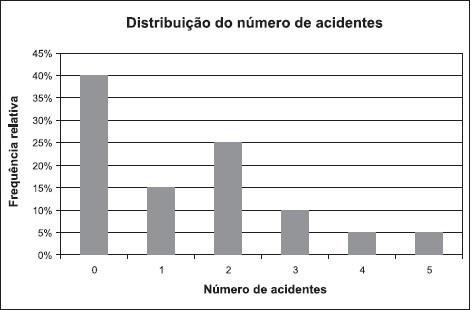
A mediana menos a média do número de acidentes é
Provas
Dentro da limitação da racionalidade da tomada de decisões, a solução final vai representar uma escolha satisfatória, e não a ideal.
ROBBINS, Stephen. Comportamento Organizacional. São Paulo: Pearson Prentice Hall, 2002.
Essa proposição constata que
Provas
Sejam P, Q e R conjuntos não vazios quaisquer para os quais são verdadeiras as seguintes premissas:
premissa 1: P ∩ Q = ⌀
premissa 2: Q !$ \subset !$ R
Se a notação !$ \bar{\text{X}} !$ indica o complementar do conjunto X, então tem-se que
Provas
Se A e B são conjuntos quaisquer e C(A, B) = A − (A ∩ B), então C(A, B) é igual ao conjunto
Provas
Water Wars May Lie Ahead
By Neena Rai
June 29, 2011, 9:20 AM GMT
There is a famous Chinese proverb that warns “not only can water float a boat, it can sink it also.”
And with global water shortages on the horizon, climate change supporters say an extreme response will be needed from international governments to stem the potential for conflict it will create around the world.
Professor Patricia Wouters at the IHP-HELP Centre for water law, policy and science at University of Dundee, said the world could face a future of “water wars” as deterioration in climatic patterns and global population growth leave people struggling to stake their claim to the natural resource.
The World Bank in a report said that 1.4 million people could be facing water scarcity by 2025. But the Organization for Economic Co-operation and Development (OECD) forecast is even more gloomy. It estimates that 47% of the world’s population could face water stress in the same period – equivalent to more than three billion people.
The issue isn’t restricted to countries that typically see temperatures soar, such as Cyprus, which in 2009 was forced to import water in tankers and ration its use. Northern hemisphere nations like the U.K. are also finding themselves in the midst of a drought in some regions, forcing governments to start to take action. The U.K. government, for instance, plans to issue a Water White Paper this December that will focus on the future challenges facing the water industry and measures to increase protection of river flows during summer months.
Parts of the U.K. are currently marked as having drought status and other areas of the country are deemed to be at risk of drought. The U.K.’s Department for Environment Food and Rural Affairs held a second drought summit Monday, at which Secretary of State Caroline Spelman warned the prospect of a dry summer and dry winter could have a serious impact on the country’s water reserves.
“We’re going to keep working with farmers, water companies and environmental groups to minimize the impacts of drought, because this year is sign of things to come,” she said. “The climate is changing and these extreme weather events will become more common. How we deal with that problem will be one of the key parts of our Water White Paper, which will be published later this year.”
This may be a far cry from a declaration of war on other more water-abundant nations, but reaching this stage in some countries isn’t beyond the realms of imagination. Egypt and Ethiopia have been battling the issue for the share of the Nile’s water reserves, and Israel – already fighting Palestine for territory that includes precious water reserves – has started to charge the agricultural sector high rates for using the resource.
Even in the U.K., the armed forces are being prepared for potential conflicts over water.
Professor Wouters said that military plans are being prepared on a 30-year horizon, but that the water security topic had somewhat fallen off the table since the financial crisis. Portugal and Spain are facing serious water scarcity issues but the agricultural sector there is having to shout loudly for its voice to be heard above the noise of the countries’ current financial woes.
Maybe Israel’s entrepreneurial approach to the issue is the way forward. Nevertheless, the fact remains that water scarcity is now firmly on the agenda of the world’s governments, and isn’t going to vanish overnight.
Available at:<www.http://blogs.wsj.com/source/2011/06/29/water-wars-may-lie-ahead/>. Retrieved on: March 11, 2012.
According to Professor Wouters, in the text, paragraph 10,
Provas
Water Wars May Lie Ahead
By Neena Rai
June 29, 2011, 9:20 AM GMT
There is a famous Chinese proverb that warns “not only can water float a boat, it can sink it also.”
And with global water shortages on the horizon, climate change supporters say an extreme response will be needed from international governments to stem the potential for conflict it will create around the world.
Professor Patricia Wouters at the IHP-HELP Centre for water law, policy and science at University of Dundee, said the world could face a future of “water wars” as deterioration in climatic patterns and global population growth leave people struggling to stake their claim to the natural resource.
The World Bank in a report said that 1.4 million [A] people could be facing water scarcity by 2025. But the Organization for Economic Co-operation and Development (OECD) forecast is even more gloomy. It estimates that 47% [B] of the world’s population could face water stress in the same period – equivalent to more than three billion people [C].
The issue isn’t restricted to countries that typically see temperatures soar, such as Cyprus, which in 2009 [D] was forced to import water in tankers and ration its use. Northern hemisphere nations like the U.K. are also finding themselves in the midst of a drought in some regions, forcing governments to start to take action. The U.K. government, for instance, plans to issue a Water White Paper this December that will focus on the future challenges facing the water industry and measures to increase protection of river flows during summer months.
Parts of the U.K. are currently marked as having drought status and other areas of the country are deemed to be at risk of drought. The U.K.’s Department for Environment Food and Rural Affairs held a second drought summit Monday, at which Secretary of State Caroline Spelman warned the prospect of a dry summer and dry winter could have a serious impact on the country’s water reserves.
“We’re going to keep working with farmers, water companies and environmental groups to minimize the impacts of drought, because this year is sign of things to come,” she said. “The climate is changing and these extreme weather events will become more common. How we deal with that problem will be one of the key parts of our Water White Paper, which will be published later this year.”
This may be a far cry from a declaration of war on other more water-abundant nations, but reaching this stage in some countries isn’t beyond the realms of imagination. Egypt and Ethiopia have been battling the issue for the share of the Nile’s water reserves, and Israel – already fighting Palestine for territory that includes precious water reserves – has started to charge the agricultural sector high rates for using the resource.
Even in the U.K., the armed forces are being prepared for potential conflicts over water.
Professor Wouters said that military plans are being prepared on a 30-year horizon [E], but that the water security topic had somewhat fallen off the table since the financial crisis. Portugal and Spain are facing serious water scarcity issues but the agricultural sector there is having to shout loudly for its voice to be heard above the noise of the countries’ current financial woes.
Maybe Israel’s entrepreneurial approach to the issue is the way forward. Nevertheless, the fact remains that water scarcity is now firmly on the agenda of the world’s governments, and isn’t going to vanish overnight.
Available at:<www.http://blogs.wsj.com/source/2011/06/29/water-wars-may-lie-ahead/>. Retrieved on: March 11, 2012.
In terms of numerical reference in the text,
Provas
Water Wars May Lie Ahead
By Neena Rai
June 29, 2011, 9:20 AM GMT
There is a famous Chinese proverb that warns “not only can water float a boat, it can sink it also.”
And with global water shortages on the horizon, climate change supporters say an extreme response will be needed from international governments to stem [A] the potential for conflict it will create around the world.
Professor Patricia Wouters at the IHP-HELP Centre for water law, policy and science at University of Dundee, said the world could face a future of “water wars” as deterioration in climatic patterns and global population growth leave people struggling to stake their claim to the natural resource.
The World Bank in a report said that 1.4 million people could be facing water scarcity by 2025. But the Organization for Economic Co-operation and Development (OECD) forecast is even more gloomy [B]. It estimates that 47% of the world’s population could face water stress in the same period – equivalent to more than three billion people.
The issue isn’t restricted to countries that typically see temperatures soar [C], such as Cyprus, which in 2009 was forced to import water in tankers and ration its use. Northern hemisphere nations like the U.K. are also finding themselves in the midst of a drought in some regions, forcing governments to start to take action. The U.K. government, for instance, plans to issue a Water White Paper this December that will focus on the future challenges facing the water industry and measures to increase protection of river flows during summer months.
Parts of the U.K. are currently marked as having drought status and other areas of the country are deemed to be at risk of drought. The U.K.’s Department for Environment Food and Rural Affairs held a second drought summit Monday, at which Secretary of State Caroline Spelman warned the prospect [D] of a dry summer and dry winter could have a serious impact on the country’s water reserves.
“We’re going to keep working with farmers, water companies and environmental groups to minimize the impacts of drought, because this year is sign of things to come,” she said. “The climate is changing and these extreme weather events will become more common. How we deal with that problem will be one of the key parts of our Water White Paper, which will be published later this year.”
This may be a far cry from a declaration of war on other more water-abundant nations, but reaching this stage in some countries isn’t beyond the realms of imagination. Egypt and Ethiopia have been battling the issue for the share of the Nile’s water reserves, and Israel – already fighting Palestine for territory that includes precious water reserves – has started to charge the agricultural sector high rates for using the resource.
Even in the U.K., the armed forces are being prepared for potential conflicts over water.
Professor Wouters said that military plans are being prepared on a 30-year horizon, but that the water security topic had somewhat fallen off the table since the financial crisis. Portugal and Spain are facing serious water scarcity issues but the agricultural sector there is having to shout loudly for its voice to be heard above the noise of the countries’ current financial woes.
Maybe Israel’s entrepreneurial approach to the issue is the way forward. Nevertheless, the fact remains that water scarcity is now firmly on the agenda of the world’s governments, and isn’t going to vanish [E] overnight.
Available at:<www.http://blogs.wsj.com/source/2011/06/29/water-wars-may-lie-ahead/>. Retrieved on: March 11, 2012.
Based on the meanings in the text, the two items are synonymous in
Provas
Caderno Container