Foram encontradas 50 questões.
A seguir, são apresentadas tabelas contendo as configurações de protocolo TCP/IP dos computadores CP1, CP2 e CP3, conectados a uma mesma sub-rede. Sabe-se que o computador CP1 consegue comunicar-se com os demais computadores da sub-rede e também consegue comunicar-se com outras redes, inclusive a internet. Além disso, considere que essa sub-rede contém apenas um único roteador para acessar a internet.
| CP1 | |
| Endereço IP | 187.142.16.15 |
| Máscara de Sub-rede | 255.255.255.192 |
| Gateway Padrão | 187.142.16.2 |
| CP2 | |
| Endereço IP | 187.142.16.45 |
| Máscara de Sub-rede | 255.255.255.224 |
| Gateway Padrão | 187.142.16.2 |
| CP3 | |
| Endereço IP | 187.142.16.8 |
| Máscara de Sub-rede | 255.255.255.192 |
| Gateway Padrão | 187.142.16.3 |
De acordo com as configurações apresentadas nas tabelas, o computador
Provas

O programa descrito a seguir foi executado em um microprocessador com arquitetura x86 de 32 bits:
| xor AH, BH and AL, DL sub AX, BX |
Na tabela abaixo, é apresentado o conteúdo dos registradores do microprocessador em questão antes da execução do programa acima. Os números estão em formato hexadecimal.
| Registrador | Conteúdo |
| AX | 0BA3 |
| BX | 15C9 |
| DX | 62DA |
Dessa forma, ao final da execução do programa acima, o conteúdo do registrador AX, em formato hexadecimal, é dado por
Provas
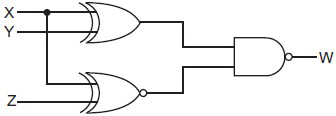
A função lógica booleana realizada pelo circuito lógico combinacional apresentado acima é dada por
Provas
Um sistema linear, discreto e causal tem seu modelo representado pela função de transferência G(z). A resposta ao impulso unitário discreto desse sistema, que é obtida pela transformada Z inversa da função G(z), é:
!$ \begin{cases} \text{g}(\text{n}) = 1 + (2)^\text{n} \text{ para } \text{n} \ge 0 \\ \text{g}(\text{n}) = 0 \text{ para } \text{n} < 0 \end{cases} !$
A expressão de G(z) é
Provas
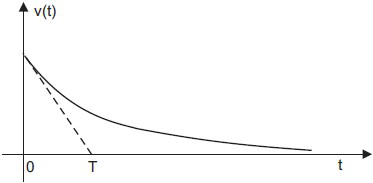
A figura mostra um sinal oriundo de uma descarga de capacitor, onde:
!$ \begin{cases} \text{v} (\text{t}) = \text{Ke}^{-\beta \text{t}} \text{ para } \text{t} \ge 0 \\ \text{v}(\text{t}) = 0 \text{ para } \text{t} \ge 0 \end{cases} !$
Onde β é uma constante positiva. A tangente à curva no ponto em que t = 0 está representada pela reta pontilhada. O valor da constante T, mostrada no gráfico, é
Provas
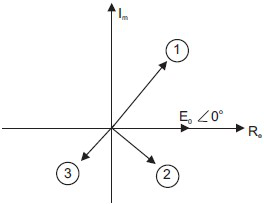
A figura mostra o esboço do diagrama fasorial de tensões de um circuito RLC série, alimentado por uma fonte senoidal de valor eficaz E0 !$ \angle !$ 0ºV.
Identificam-se, no diagrama, as tensões, em V, no resistor, no indutor e no capacitor, respectivamente, VR, VL e VC, da seguinte maneira:
 |  |  |
Provas
Sejam P, Q e R conjuntos não vazios quaisquer para os quais são verdadeiras as seguintes premissas:
premissa 1: P ∩ Q = ⌀
premissa 2: Q !$ \subset !$ R
Se a notação !$ \bar{\text{X}} !$ indica o complementar do conjunto X, então tem-se que
Provas
Se A e B são conjuntos quaisquer e C(A, B) = A − (A ∩ B), então C(A, B) é igual ao conjunto
Provas
Water Wars May Lie Ahead
By Neena Rai
June 29, 2011, 9:20 AM GMT
There is a famous Chinese proverb that warns “not only can water float a boat, it can sink it also.”
And with global water shortages on the horizon, climate change supporters say an extreme response will be needed from international governments to stem the potential for conflict it will create around the world.
Professor Patricia Wouters at the IHP-HELP Centre for water law, policy and science at University of Dundee, said the world could face a future of “water wars” as deterioration in climatic patterns and global population growth leave people struggling to stake their claim to the natural resource.
The World Bank in a report said that 1.4 million people could be facing water scarcity by 2025. But the Organization for Economic Co-operation and Development (OECD) forecast is even more gloomy. It estimates that 47% of the world’s population could face water stress in the same period – equivalent to more than three billion people.
The issue isn’t restricted to countries that typically see temperatures soar, such as Cyprus, which in 2009 was forced to import water in tankers and ration its use. Northern hemisphere nations like the U.K. are also finding themselves in the midst of a drought in some regions, forcing governments to start to take action. The U.K. government, for instance, plans to issue a Water White Paper this December that will focus on the future challenges facing the water industry and measures to increase protection of river flows during summer months.
Parts of the U.K. are currently marked as having drought status and other areas of the country are deemed to be at risk of drought. The U.K.’s Department for Environment Food and Rural Affairs held a second drought summit Monday, at which Secretary of State Caroline Spelman warned the prospect of a dry summer and dry winter could have a serious impact on the country’s water reserves.
“We’re going to keep working with farmers, water companies and environmental groups to minimize the impacts of drought, because this year is sign of things to come,” she said. “The climate is changing and these extreme weather events will become more common. How we deal with that problem will be one of the key parts of our Water White Paper, which will be published later this year.”
This may be a far cry from a declaration of war on other more water-abundant nations, but reaching this stage in some countries isn’t beyond the realms of imagination. Egypt and Ethiopia have been battling the issue for the share of the Nile’s water reserves, and Israel – already fighting Palestine for territory that includes precious water reserves – has started to charge the agricultural sector high rates for using the resource.
Even in the U.K., the armed forces are being prepared for potential conflicts over water.
Professor Wouters said that military plans are being prepared on a 30-year horizon, but that the water security topic had somewhat fallen off the table since the financial crisis. Portugal and Spain are facing serious water scarcity issues but the agricultural sector there is having to shout loudly for its voice to be heard above the noise of the countries’ current financial woes.
Maybe Israel’s entrepreneurial approach to the issue is the way forward. Nevertheless, the fact remains that water scarcity is now firmly on the agenda of the world’s governments, and isn’t going to vanish overnight.
Available at:<www.http://blogs.wsj.com/source/2011/06/29/water-wars-may-lie-ahead/>. Retrieved on: March 11, 2012.
According to Professor Wouters, in the text, paragraph 10,
Provas
Water Wars May Lie Ahead
By Neena Rai
June 29, 2011, 9:20 AM GMT
There is a famous Chinese proverb that warns “not only can water float a boat, it can sink it also.”
And with global water shortages on the horizon, climate change supporters say an extreme response will be needed from international governments to stem the potential for conflict it will create around the world.
Professor Patricia Wouters at the IHP-HELP Centre for water law, policy and science at University of Dundee, said the world could face a future of “water wars” as deterioration in climatic patterns and global population growth leave people struggling to stake their claim to the natural resource.
The World Bank in a report said that 1.4 million [A] people could be facing water scarcity by 2025. But the Organization for Economic Co-operation and Development (OECD) forecast is even more gloomy. It estimates that 47% [B] of the world’s population could face water stress in the same period – equivalent to more than three billion people [C].
The issue isn’t restricted to countries that typically see temperatures soar, such as Cyprus, which in 2009 [D] was forced to import water in tankers and ration its use. Northern hemisphere nations like the U.K. are also finding themselves in the midst of a drought in some regions, forcing governments to start to take action. The U.K. government, for instance, plans to issue a Water White Paper this December that will focus on the future challenges facing the water industry and measures to increase protection of river flows during summer months.
Parts of the U.K. are currently marked as having drought status and other areas of the country are deemed to be at risk of drought. The U.K.’s Department for Environment Food and Rural Affairs held a second drought summit Monday, at which Secretary of State Caroline Spelman warned the prospect of a dry summer and dry winter could have a serious impact on the country’s water reserves.
“We’re going to keep working with farmers, water companies and environmental groups to minimize the impacts of drought, because this year is sign of things to come,” she said. “The climate is changing and these extreme weather events will become more common. How we deal with that problem will be one of the key parts of our Water White Paper, which will be published later this year.”
This may be a far cry from a declaration of war on other more water-abundant nations, but reaching this stage in some countries isn’t beyond the realms of imagination. Egypt and Ethiopia have been battling the issue for the share of the Nile’s water reserves, and Israel – already fighting Palestine for territory that includes precious water reserves – has started to charge the agricultural sector high rates for using the resource.
Even in the U.K., the armed forces are being prepared for potential conflicts over water.
Professor Wouters said that military plans are being prepared on a 30-year horizon [E], but that the water security topic had somewhat fallen off the table since the financial crisis. Portugal and Spain are facing serious water scarcity issues but the agricultural sector there is having to shout loudly for its voice to be heard above the noise of the countries’ current financial woes.
Maybe Israel’s entrepreneurial approach to the issue is the way forward. Nevertheless, the fact remains that water scarcity is now firmly on the agenda of the world’s governments, and isn’t going to vanish overnight.
Available at:<www.http://blogs.wsj.com/source/2011/06/29/water-wars-may-lie-ahead/>. Retrieved on: March 11, 2012.
In terms of numerical reference in the text,
Provas
Caderno Container