Foram encontradas 120 questões.
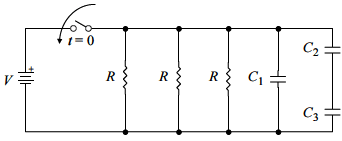
Considerando que o circuito ilustrado na figura acima seja alimentado por uma fonte contínua (c.c.) de valor nominal V e esteja fechado no instante t = 0, e que os capacitores desse circuito estejam inicialmente descarregados, julgue o item que se segue.
Em regime permanente, a potência suprida pela fonte é !$ P_S = { \large 3 V^2 \over R} !$.
Provas

Considerando que um sinal senoidal representado pela função v(t) = 5cos(Tt + 45º) [mV], em que T é a frequência angular e t é o tempo, seja aplicado na entrada de um osciloscópio, e considerando, ainda, que a frequência linear deste sinal seja f = 1 kHz, julgue o item a seguir.
O nível DC desse sinal é vDC = 5cos(45º) !$ \approx !$. 3,5 [mV].
Provas
Considerando que um sinal senoidal representado pela função v(t) = 5cos(Tt + 45º) [mV], em que T é a frequência angular e t é o tempo, seja aplicado na entrada de um osciloscópio, e considerando, ainda, que a frequência linear deste sinal seja f = 1 kHz, julgue o item a seguir.
O sinal em questão também pode ser representado por v(t) = 5sen(Tt + 135º) [mV].
Provas
Considerando que um sinal senoidal representado pela função v(t) = 5cos(Tt + 45º) [mV], em que T é a frequência angular e t é o tempo, seja aplicado na entrada de um osciloscópio, e considerando, ainda, que a frequência linear deste sinal seja f = 1 kHz, julgue o item a seguir.
No instante t = 125:!$ \mu !$s, a amplitude do sinal é nula.
Provas
Considerando que um sinal senoidal representado pela função v(t) = 5cos(Tt + 45º) [mV], em que T é a frequência angular e t é o tempo, seja aplicado na entrada de um osciloscópio, e considerando, ainda, que a frequência linear deste sinal seja f = 1 kHz, julgue o item a seguir.
O valor eficaz (valor RMS) do sinal é de aproximadamente 7,1 mV.
Provas
Considerando que um sinal senoidal representado pela função v(t) = 5cos(Tt + 45º) [mV], em que T é a frequência angular e t é o tempo, seja aplicado na entrada de um osciloscópio, e considerando, ainda, que a frequência linear deste sinal seja f = 1 kHz, julgue o item a seguir.
A amplitude média desse sinal é vMÉDIO = 2,5 mV.
Provas
An important advance in electronic test equipment was the incorporation of circuits that directly converted the analog signal to be measured into a digital reading. The most significant impact of these converters was to enable a computer interface to the equipment to be set up allowing direct computer monitoring and control of the instrument. Other equipments were designed with embedded computers, which provided very sophisticated analysis of the data within the instrument itself.
The complexity and sophistication of electronic components and subassemblies became more complicated. Multiple test instruments were integrated to form rack-and13 stack automatic test equipment, where the individual instruments were connected to a control computer by a common bus. These computer-controlled testers were very efficient at providing the input stimulus to the unit under test and monitoring the output response.
The ability of automatic test equipment to sort out good from bad units is only the first requirement of modern production test equipment. Since the repair of defective units can be costly, the design and program development of test equipment frequently must include special provisions to provide failure-mode analysis. Information such as the probable defective component on a printed circuit board or the probable defective board in a system is of great value in efficient repair. Some test systems include fault dictionaries, supplemental tests after first failure, or even artificial intelligence features to assist in repair.
Internet: <www.answers.com/topic/electronic-test-equipment> (adapted).
According to the text, it can be concluded that
“to assist” is the same as to watch
Provas
An important advance in electronic test equipment was the incorporation of circuits that directly converted the analog signal to be measured into a digital reading. The most significant impact of these converters was to enable a computer interface to the equipment to be set up allowing direct computer monitoring and control of the instrument. Other equipments were designed with embedded computers, which provided very sophisticated analysis of the data within the instrument itself.
The complexity and sophistication of electronic components and subassemblies became more complicated. Multiple test instruments were integrated to form rack-and13 stack automatic test equipment, where the individual instruments were connected to a control computer by a common bus. These computer-controlled testers were very efficient at providing the input stimulus to the unit under test and monitoring the output response.
The ability of automatic test equipment to sort out good from bad units is only the first requirement of modern production test equipment. Since the repair of defective units can be costly, the design and program development of test equipment frequently must include special provisions to provide failure-mode analysis. Information such as the probable defective component on a printed circuit board or the probable defective board in a system is of great value in efficient repair. Some test systems include fault dictionaries, supplemental tests after first failure, or even artificial intelligence features to assist in repair.
Internet: <www.answers.com/topic/electronic-test-equipment> (adapted).
According to the text, it can be concluded that
“to sort out” means to put out.
Provas
An important advance in electronic test equipment was the incorporation of circuits that directly converted the analog signal to be measured into a digital reading. The most significant impact of these converters was to enable a computer interface to the equipment to be set up allowing direct computer monitoring and control of the instrument. Other equipments were designed with embedded computers, which provided very sophisticated analysis of the data within the instrument itself.
The complexity and sophistication of electronic components and subassemblies became more complicated. Multiple test instruments were integrated to form rack-and13 stack automatic test equipment, where the individual instruments were connected to a control computer by a common bus. These computer-controlled testers were very efficient at providing the input stimulus to the unit under test and monitoring the output response.
The ability of automatic test equipment to sort out good from bad units is only the first requirement of modern production test equipment. Since the repair of defective units can be costly, the design and program development of test equipment frequently must include special provisions to provide failure-mode analysis. Information such as the probable defective component on a printed circuit board or the probable defective board in a system is of great value in efficient repair. Some test systems include fault dictionaries, supplemental tests after first failure, or even artificial intelligence features to assist in repair.
Internet: <www.answers.com/topic/electronic-test-equipment> (adapted).
According to the text, it can be concluded that
information about the possible defective component on a printed circuit board or the probable defective board in a system is all that is needed to get an effective repair.
Provas
An important advance in electronic test equipment was the incorporation of circuits that directly converted the analog signal to be measured into a digital reading. The most significant impact of these converters was to enable a computer interface to the equipment to be set up allowing direct computer monitoring and control of the instrument. Other equipments were designed with embedded computers, which provided very sophisticated analysis of the data within the instrument itself.
The complexity and sophistication of electronic components and subassemblies became more complicated. Multiple test instruments were integrated to form rack-and13 stack automatic test equipment, where the individual instruments were connected to a control computer by a common bus. These computer-controlled testers were very efficient at providing the input stimulus to the unit under test and monitoring the output response.
The ability of automatic test equipment to sort out good from bad units is only the first requirement of modern production test equipment. Since the repair of defective units can be costly, the design and program development of test equipment frequently must include special provisions to provide failure-mode analysis. Information such as the probable defective component on a printed circuit board or the probable defective board in a system is of great value in efficient repair. Some test systems include fault dictionaries, supplemental tests after first failure, or even artificial intelligence features to assist in repair.
Internet: <www.answers.com/topic/electronic-test-equipment> (adapted).
According to the text, it can be concluded that
as mending faulty units can be expensive, the design and program development of test equipment must often include conditions so as to furnish failure-mode analysis.
Provas
Caderno Container