Foram encontradas 50 questões.
Em uma obra de fundações, o técnico solicitou que sua equipe verificasse o nível da cota de arrasamento, tendo apresentado o seguinte desenho:
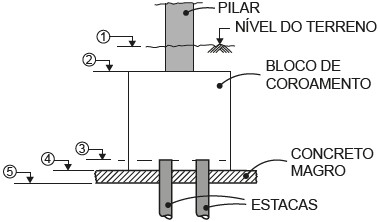
Pelo desenho esquematizado, ele estava se referindo ao nível indicado pelo número
Provas

Na manutenção de um telhado de telhas cerâmicas, serão necessárias intervenções em um ou mais rincões e em uma ou mais cumeeiras, dentre as quais algumas sofrerão reparos, e outras serão substituídas. Para facilitar a identificação, o técnico fez um croqui e numerou todas as peças, conforme mostrado a seguir:
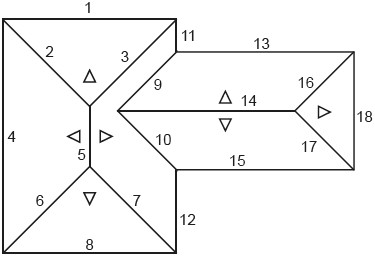
As peças que estão sendo analisadas são as de números:
| Rincão | Cumeeira |
Provas
Para a construção de 10 paredes de tijolos de 10,00 m de comprimento e 3,00 m de altura, uma equipe de sete pedreiros e dez serventes trabalhou durante 60 horas.
A produtividade dos pedreiros nessa obra, em h/m2, foi
Provas
Um supervisor de obra pediu ao técnico o orçamento para a construção de uma parede de tijolos para ser divisória em um ambiente. Como base para o cálculo dos índices de produtividade dos operários envolvidos, ele entregou ao técnico o relatório de uma apropriação de custos que foi realizada em obra semelhante e do qual foram extraídas as seguintes informações:
Relatório da construção de alvenaria de lajotas cerâmicas:
- Medidas da parede:
- Comprimento: 40,00 m
- Altura: 2,50 m
- Equipe:
- 7 pedreiros
- 10 serventes
- Tempo de trabalho: 20 horas
A parede a ser construída tem 18 m de comprimento e 3,0 m de altura.
Considerando-se os dados do relatório da obra anterior, a produtividade, em h/m2, de cada servente e o pagamento de R$ 5,00/h para cada um desses operários, qual será o gasto com eles, em reais, para a execução da nova parede?
Provas
Em uma instalação predial de esgoto sanitário, a tubulação com DN40, que serve de ramal de descarga do lavatório até o ralo sifonado, segundo a NBR 8160:1995 (Sistemas prediais de esgoto sanitário – Projeto e execução), deve apresentar caimento percentual, no mínimo, de
Provas
U.S. domestic air conditioning use could exceed electric capacity in next decade due to climate change
Climate change will provoke an increase in summer air conditioning use in the United States that will probably cause prolonged blackouts during peak summer heat if states do not expand capacity or improve efficiency, according to a new study of domestic-level demand.
Human emissions have put the global climate on a trajectory to exceed 1.5 degrees Celsius of warming by the early 2030s, the IPCC reported in its 2021 evaluation. Without significant alleviation, global temperatures will probably exceed the 2.0-degree Celsius limit by the end of the century.
Previous research has examined the impacts of higher future temperatures on annual electricity consumption for specific cities or states. The new study is the first to project residential air conditioning demand on a domestic basis at a wide scale. It incorporates observed and predicted air temperature and heat, humidity and discomfort indices with air conditioning use by statistically representative domiciles across the contiguous United States, collected by the U.S. Energy Information Administration (EIA) in 2005-2019.
“It’s a pretty clear warning to all of us that we can’t keep doing what we are doing or our energy system will fail completely in the next few decades, simply because of the summertime air conditioning,” said Susanne Benz, a geographer and climate scientist at Dalhousie University in Halifax, Nova Scotia.
The heaviest air conditioning use with the greatest risk for overcharging the transmission lines comes during heat waves, which also present the highest risk to health. Electricity generation tends to be below peak during heat waves as well, reducing capacity to even lower levels, said Renee Obringer, an environmental engineer at Penn State University. Without enough capacity to satisfy demand, energy companies may have to adopt systematic blackouts during heat waves to avoid network failure, like California’s energy organizations did in August 2020 during an extended period of record heat sometimes topping 117 degrees Fahrenheit. “We’ve seen this in California already -- state power companies had to institute blackouts because they couldn’t provide the needed electricity,” Obringer said. The state attributed 599 deaths to the heat, but the true number may have been closer to 3,900.
The new study predicted the largest increases in kilowatt-hours of electricity demand in the already hot south and southwest. If all Arizona houses were to increase air conditioning use by the estimated 6% needed at 1.5 degrees Celsius of global warming, for example, amounting to 30 kilowatt-hours per month, this would place an additional 54.5 million kilowatthours of demand on the electrical network monthly.
Available at: www.sciencedaily.com/releases/2022/02/ 220204093124.htm. Retrieved on: Feb. 9, 2022. Adapted.
In the fragment of paragraph 5 “the heaviest air conditioning use”, the term heaviest could be replaced, with no change in meaning, by
Provas
U.S. domestic air conditioning use could exceed electric capacity in next decade due to climate change
Climate change will provoke an increase in summer air conditioning use in the United States that will probably cause prolonged blackouts during peak summer heat if states do not expand capacity or improve efficiency, according to a new study of domestic-level demand.
Human emissions have put the global climate on a trajectory to exceed 1.5 degrees Celsius of warming by the early 2030s, the IPCC reported in its 2021 evaluation. Without significant alleviation, global temperatures will probably exceed the 2.0-degree Celsius limit by the end of the century.
Previous research has examined the impacts of higher future temperatures on annual electricity consumption for specific cities or states. The new study is the first to project residential air conditioning demand on a domestic basis at a wide scale. It incorporates observed and predicted air temperature and heat, humidity and discomfort indices with air conditioning use by statistically representative domiciles across the contiguous United States, collected by the U.S. Energy Information Administration (EIA) in 2005-2019.
“It’s a pretty clear warning to all of us that we can’t keep doing what we are doing or our energy system will fail completely in the next few decades, simply because of the summertime air conditioning,” said Susanne Benz, a geographer and climate scientist at Dalhousie University in Halifax, Nova Scotia.
The heaviest air conditioning use with the greatest risk for overcharging the transmission lines comes during heat waves, which also present the highest risk to health. Electricity generation tends to be below peak during heat waves as well, reducing capacity to even lower levels, said Renee Obringer, an environmental engineer at Penn State University. Without enough capacity to satisfy demand, energy companies may have to adopt systematic blackouts during heat waves to avoid network failure, like California’s energy organizations did in August 2020 during an extended period of record heat sometimes topping 117 degrees Fahrenheit. “We’ve seen this in California already -- state power companies had to institute blackouts because they couldn’t provide the needed electricity,” Obringer said. The state attributed 599 deaths to the heat, but the true number may have been closer to 3,900.
The new study predicted the largest increases in kilowatt-hours of electricity demand in the already hot south and southwest. If all Arizona houses were to increase air conditioning use by the estimated 6% needed at 1.5 degrees Celsius of global warming, for example, amounting to 30 kilowatt-hours per month, this would place an additional 54.5 million kilowatthours of demand on the electrical network monthly.
Available at: www.sciencedaily.com/releases/2022/02/ 220204093124.htm. Retrieved on: Feb. 9, 2022. Adapted.
In the fragment of paragraph 6 “If all Arizona houses were to increase air conditioning use”, if signals a(n)
Provas
U.S. domestic air conditioning use could exceed electric capacity in next decade due to climate change
Climate change will provoke an increase in summer air conditioning use in the United States that will probably cause prolonged blackouts during peak summer heat if states do not expand capacity or improve efficiency, according to a new study of domestic-level demand.
Human emissions have put the global climate on a trajectory to exceed 1.5 degrees Celsius of warming by the early 2030s, the IPCC reported in its 2021 evaluation. Without significant alleviation, global temperatures will probably exceed the 2.0-degree Celsius limit by the end of the century.
Previous research has examined the impacts of higher future temperatures on annual electricity consumption for specific cities or states. The new study is the first to project residential air conditioning demand on a domestic basis at a wide scale. It incorporates observed and predicted air temperature and heat, humidity and discomfort indices with air conditioning use by statistically representative domiciles across the contiguous United States, collected by the U.S. Energy Information Administration (EIA) in 2005-2019.
“It’s a pretty clear warning to all of us that we can’t keep doing what we are doing or our energy system will fail completely in the next few decades, simply because of the summertime air conditioning,” said Susanne Benz, a geographer and climate scientist at Dalhousie University in Halifax, Nova Scotia.
The heaviest air conditioning use with the greatest risk for overcharging the transmission lines comes during heat waves, which also present the highest risk to health. Electricity generation tends to be below peak during heat waves as well, reducing capacity to even lower levels, said Renee Obringer, an environmental engineer at Penn State University. Without enough capacity to satisfy demand, energy companies may have to adopt systematic blackouts during heat waves to avoid network failure, like California’s energy organizations did in August 2020 during an extended period of record heat sometimes topping 117 degrees Fahrenheit. “We’ve seen this in California already -- state power companies had to institute blackouts because they couldn’t provide the needed electricity,” Obringer said. The state attributed 599 deaths to the heat, but the true number may have been closer to 3,900.
The new study predicted the largest increases in kilowatt-hours of electricity demand in the already hot south and southwest. If all Arizona houses were to increase air conditioning use by the estimated 6% needed at 1.5 degrees Celsius of global warming, for example, amounting to 30 kilowatt-hours per month, this would place an additional 54.5 million kilowatthours of demand on the electrical network monthly.
Available at: www.sciencedaily.com/releases/2022/02/ 220204093124.htm. Retrieved on: Feb. 9, 2022. Adapted.
The fragment in paragraph 5 “an extended period of record heat sometimes topping 117 degrees Fahrenheit” describes a climate condition characterized by
Provas
U.S. domestic air conditioning use could exceed electric capacity in next decade due to climate change
Climate change will provoke an increase in summer air conditioning use in the United States that will probably cause prolonged blackouts during peak summer heat if states do not expand capacity or improve efficiency, according to a new study of domestic-level demand.
Human emissions have put the global climate on a trajectory to exceed 1.5 degrees Celsius of warming by the early 2030s, the IPCC reported in its 2021 evaluation. Without significant alleviation, global temperatures will probably exceed the 2.0-degree Celsius limit by the end of the century.
Previous research has examined the impacts of higher future temperatures on annual electricity consumption for specific cities or states. The new study is the first to project residential air conditioning demand on a domestic basis at a wide scale. It incorporates observed and predicted air temperature and heat, humidity and discomfort indices with air conditioning use by statistically representative domiciles across the contiguous United States, collected by the U.S. Energy Information Administration (EIA) in 2005-2019.
“It’s a pretty clear warning to all of us that we can’t keep doing what we are doing or our energy system will fail completely in the next few decades, simply because of the summertime air conditioning,” said Susanne Benz, a geographer and climate scientist at Dalhousie University in Halifax, Nova Scotia.
The heaviest air conditioning use with the greatest risk for overcharging the transmission lines comes during heat waves, which also present the highest risk to health. Electricity generation tends to be below peak during heat waves as well, reducing capacity to even lower levels, said Renee Obringer, an environmental engineer at Penn State University. Without enough capacity to satisfy demand, energy companies may have to adopt systematic blackouts during heat waves to avoid network failure, like California’s energy organizations did in August 2020 during an extended period of record heat sometimes topping 117 degrees Fahrenheit. “We’ve seen this in California already -- state power companies had to institute blackouts because they couldn’t provide the needed electricity,” Obringer said. The state attributed 599 deaths to the heat, but the true number may have been closer to 3,900.
The new study predicted the largest increases in kilowatt-hours of electricity demand in the already hot south and southwest. If all Arizona houses were to increase air conditioning use by the estimated 6% needed at 1.5 degrees Celsius of global warming, for example, amounting to 30 kilowatt-hours per month, this would place an additional 54.5 million kilowatthours of demand on the electrical network monthly.
Available at: www.sciencedaily.com/releases/2022/02/ 220204093124.htm. Retrieved on: Feb. 9, 2022. Adapted.
In the sentence of paragraph 5, “The heaviest air conditioning use with the greatest risk for overcharging the transmission lines comes during heat waves, which also present the highest risk to health”, the word which makes reference to
Provas
U.S. domestic air conditioning use could exceed electric capacity in next decade due to climate change
Climate change will provoke an increase in summer air conditioning use in the United States that will probably cause prolonged blackouts during peak summer heat if states do not expand capacity or improve efficiency, according to a new study of domestic-level demand.
Human emissions have put the global climate on a trajectory to exceed 1.5 degrees Celsius of warming by the early 2030s, the IPCC reported in its 2021 evaluation. Without significant alleviation, global temperatures will probably exceed the 2.0-degree Celsius limit by the end of the century.
Previous research has examined the impacts of higher future temperatures on annual electricity consumption for specific cities or states. The new study is the first to project residential air conditioning demand on a domestic basis at a wide scale. It incorporates observed and predicted air temperature and heat, humidity and discomfort indices with air conditioning use by statistically representative domiciles across the contiguous United States, collected by the U.S. Energy Information Administration (EIA) in 2005-2019.
“It’s a pretty clear warning to all of us that we can’t keep doing what we are doing or our energy system will fail completely in the next few decades, simply because of the summertime air conditioning,” said Susanne Benz, a geographer and climate scientist at Dalhousie University in Halifax, Nova Scotia.
The heaviest air conditioning use with the greatest risk for overcharging the transmission lines comes during heat waves, which also present the highest risk to health. Electricity generation tends to be below peak during heat waves as well, reducing capacity to even lower levels, said Renee Obringer, an environmental engineer at Penn State University. Without enough capacity to satisfy demand, energy companies may have to adopt systematic blackouts during heat waves to avoid network failure, like California’s energy organizations did in August 2020 during an extended period of record heat sometimes topping 117 degrees Fahrenheit. “We’ve seen this in California already -- state power companies had to institute blackouts because they couldn’t provide the needed electricity,” Obringer said. The state attributed 599 deaths to the heat, but the true number may have been closer to 3,900.
The new study predicted the largest increases in kilowatt-hours of electricity demand in the already hot south and southwest. If all Arizona houses were to increase air conditioning use by the estimated 6% needed at 1.5 degrees Celsius of global warming, for example, amounting to 30 kilowatt-hours per month, this would place an additional 54.5 million kilowatthours of demand on the electrical network monthly.
Available at: www.sciencedaily.com/releases/2022/02/ 220204093124.htm. Retrieved on: Feb. 9, 2022. Adapted.
The fragment in paragraph 5 “Electricity generation tends to be below peak” means that
Provas
Caderno Container