Foram encontradas 120 questões.
- Gramática - Língua InglesaAdjetivos | AdjectivesComparativo e superlativo de adjetivos | Comparative and superlative
- Gramática - Língua InglesaAdvérbios e conjunções | Adverbs and conjunctions
Read the sentences, fill in the blanks with the correct collocation and match the columns. Then,
choose the correct alternative.
1. Our high turnover rate has been a growing for us. 2. A rose in full bloom had been allowed to grow one of the walls. 3. The company is growing all the time. 4. Opposition to the latest proposals is growing . 5. The Catholic community in Edinburgh began to grow in the mid-19th Century.
( ) considerably ( ) steadily ( ) concern ( ) bigger ( ) unchecked up
1. Our high turnover rate has been a growing for us. 2. A rose in full bloom had been allowed to grow one of the walls. 3. The company is growing all the time. 4. Opposition to the latest proposals is growing . 5. The Catholic community in Edinburgh began to grow in the mid-19th Century.
( ) considerably ( ) steadily ( ) concern ( ) bigger ( ) unchecked up
Provas
Questão presente nas seguintes provas

Read the poem I too below to answer QUESTION.
I, Too
Langston Hughes - 1901-1967
I, too, sing America.
I am the darker brother.
They send me to eat in the kitchen
When company comes,
But I laugh,
And eat well,
And grow strong.
Tomorrow,
I'll be at the table
When company comes.
Nobody'll dare
Say to me,
“Eat in the kitchen,”
Then.
Besides,
They'll see how beautiful I am
And be ashamed —
I, too, am America.
Source: The Collected Poems of Langston Hughes, published by Knopf and Vintage Books.
Copyright © 1994 by the Estate of Langston Hughes. All rights reserved. Used by permission of
Harold Ober Associates Incorporated.
A collocation, as one of the units of formulaic language, is a series of words or terms that cooccur more often than would be expected by chance. In phraseology, a collocation is a type of compositional phraseme, meaning that it can be understood from the words that make it up. This contrasts with an idiom, where the meaning of the whole cannot be inferred from its parts, and may be completely unrelated (WARD, 2007; SCHMITT, 2007; 2012). B. Refer to the poem line “But I laugh, And eat well, And grow strong”. Which is the best definition for the collocation grow strong?
Provas
Questão presente nas seguintes provas
- Gramática - Língua InglesaVerbos | VerbsInfinitivo e gerúndio | Infinitive and gerund
- Gramática - Língua InglesaVerbos | VerbsPresente perfeito | Present perfect
- Gramática - Língua InglesaVerbos | VerbsPresente simples | Simple present
- Gramática - Língua InglesaVerbos | VerbsFuturo simples | Simple future
Read the poem I too below to answer QUESTION.
I, Too
Langston Hughes - 1901-1967
I, too, sing America.
I am the darker brother.
They send me to eat in the kitchen
When company comes,
But I laugh,
And eat well,
And grow strong.
Tomorrow,
I'll be at the table
When company comes.
Nobody'll dare
Say to me,
“Eat in the kitchen,”
Then.
Besides,
They'll see how beautiful I am
And be ashamed —
I, too, am America.
Source: The Collected Poems of Langston Hughes, published by Knopf and Vintage Books.
Copyright © 1994 by the Estate of Langston Hughes. All rights reserved. Used by permission of
Harold Ober Associates Incorporated.
“Besides, They'll see how beautiful I am And be ashamed”
B. Which are the verb tenses of the underlined words, respectively? Check the alternative which presents the verb tenses of the underlined words.
Provas
Questão presente nas seguintes provas
Read the poem I too below to answer QUESTION.
I, Too
Langston Hughes - 1901-1967
I, too, sing America.
I am the darker brother.
They send me to eat in the kitchen
When company comes,
But I laugh,
And eat well,
And grow strong.
Tomorrow,
I'll be at the table
When company comes.
Nobody'll dare
Say to me,
“Eat in the kitchen,”
Then.
Besides,
They'll see how beautiful I am
And be ashamed —
I, too, am America.
Source: The Collected Poems of Langston Hughes, published by Knopf and Vintage Books.
Copyright © 1994 by the Estate of Langston Hughes. All rights reserved. Used by permission of
Harold Ober Associates Incorporated.
It´s possible to observe a multi-dimensional meaning in the title, “I, too” in the lines that open and close the poem. If you hear the word as the number “two”, it can be inferred to someone who:
Provas
Questão presente nas seguintes provas
Read the poem I too below to answer QUESTION.
I, Too
Langston Hughes - 1901-1967
I, too, sing America.
I am the darker brother.
They send me to eat in the kitchen
When company comes,
But I laugh,
And eat well,
And grow strong.
Tomorrow,
I'll be at the table
When company comes.
Nobody'll dare
Say to me,
“Eat in the kitchen,”
Then.
Besides,
They'll see how beautiful I am
And be ashamed —
I, too, am America.
Source: The Collected Poems of Langston Hughes, published by Knopf and Vintage Books.
Copyright © 1994 by the Estate of Langston Hughes. All rights reserved. Used by permission of
Harold Ober Associates Incorporated.
I. The poem expresses how he felt like an unforgotten American citizen because of his skin color. ( )
II. Hughes proclaims that he, too, is an American, even though the dominant members of society are constantly pushing him aside and hiding him away because he is an African American. ( ) III. Even though Hughes feels ostracized because of his job in the kitchen, he still sings like an American.( )
IV. Although short in length, it delivers a powerful message about how many African Americans have been working in America.( )
V. He hopes white people will be ashamed of the way they have treated African Americans, and they will realize they are also a part of the country. ( )
B. Now, choose the correct alternative.
Provas
Questão presente nas seguintes provas
- Gramática - Língua InglesaSubstantivos e compostos | Nouns and compoundsSubstantivos contáveis e incontáveis | Countable and uncountable
Read the excerpt of the chapter “Decolonization” from the book Post-Colonial Studies:
The Key Concepts below to answer QUESTION.
“Decolonization is the process of revealing and dismantling colonialist power in all its forms.
This includes dismantling the hidden aspects of those institutional and cultural forces that had
maintained the colonialist power and that remain even after political independence is achieved.
Initially, in many places in the colonized world, the process of resistance was conducted in
terms or institutions appropriated from the colonizing culture itself. This was only to be
expected, since early nationalists had been educated to perceive themselves as potential heirs
to European political systems and models of culture. This occurred not only in settler colonies
where the white colonial élite was a direct product of the system, but even in colonies of
occupation. Macaulay’s infamous 1835 Minute on Indian Education had proposed the
deliberate creation in India of just such a class of ‘brown white men’, educated to value
European culture above their own. This is the locus classicus of this hegemonic process of
control, but there are numerous other examples in the practices of other colonies. […]
As well as direct and indirect economic control, the continuing influence of Eurocentric cultural
models privileged the imported over the indigenous: colonial languages over local languages;
writing over orality and linguistic culture over inscriptive cultures of other kinds (dance, graphic
arts, which had often been designated ‘folk culture’). Against all these occlusions and
overwritings of pre-colonial cultural practices, a number of programmes of decolonization have
been attempted. Notable among these have been those that seek to revive and revalue local
languages. The pressure of the global economy means that élite communication is dominated
by the use of the ex-colonial languages, notably the new ‘world language’ of English, whose
power derives from its historical use across the largest of the modern empires and from its use
by the United States.” (ASHCROFT, et al., 2007, p. 56-57)
I – nationalist, example, world, empire, program. II – process, culture, power, product, information. III – decolonization, information, power, education, advice. IV – institution, decolonization, advice, system, model.
B. Considering the classification between countable and uncountable nouns, in which groups do all the words share the same type of nouns?
Provas
Questão presente nas seguintes provas
Read the excerpt of the chapter “Decolonization” from the book Post-Colonial Studies:
The Key Concepts below to answer QUESTION.
“Decolonization is the process of revealing and dismantling colonialist power in all its forms.
This includes dismantling the hidden aspects of those institutional and cultural forces that had
maintained the colonialist power and that remain even after political independence is achieved.
Initially, in many places in the colonized world, the process of resistance was conducted in
terms or institutions appropriated from the colonizing culture itself. This was only to be
expected, since early nationalists had been educated to perceive themselves as potential heirs
to European political systems and models of culture. This occurred not only in settler colonies
where the white colonial élite was a direct product of the system, but even in colonies of
occupation. Macaulay’s infamous 1835 Minute on Indian Education had proposed the
deliberate creation in India of just such a class of ‘brown white men’, educated to value
European culture above their own. This is the locus classicus of this hegemonic process of
control, but there are numerous other examples in the practices of other colonies. […]
As well as direct and indirect economic control, the continuing influence of Eurocentric cultural
models privileged the imported over the indigenous: colonial languages over local languages;
writing over orality and linguistic culture over inscriptive cultures of other kinds (dance, graphic
arts, which had often been designated ‘folk culture’). Against all these occlusions and
overwritings of pre-colonial cultural practices, a number of programmes of decolonization have
been attempted. Notable among these have been those that seek to revive and revalue local
languages. The pressure of the global economy means that élite communication is dominated
by the use of the ex-colonial languages, notably the new ‘world language’ of English, whose
power derives from its historical use across the largest of the modern empires and from its use
by the United States.” (ASHCROFT, et al., 2007, p. 56-57)
“Initially, in many places in the colonized world, the process of resistance was conducted in terms or institutions appropriated from the colonizing culture itself” (ASHCROFT, et al., 2007, p. 56).
B. The word “colonized” in this excerpt shares the same word class with the word in bold in:
Provas
Questão presente nas seguintes provas
Read the excerpt of the chapter “Decolonization” from the book Post-Colonial Studies:
The Key Concepts below to answer QUESTION.
“Decolonization is the process of revealing and dismantling colonialist power in all its forms.
This includes dismantling the hidden aspects of those institutional and cultural forces that had
maintained the colonialist power and that remain even after political independence is achieved.
Initially, in many places in the colonized world, the process of resistance was conducted in
terms or institutions appropriated from the colonizing culture itself. This was only to be
expected, since early nationalists had been educated to perceive themselves as potential heirs
to European political systems and models of culture. This occurred not only in settler colonies
where the white colonial élite was a direct product of the system, but even in colonies of
occupation. Macaulay’s infamous 1835 Minute on Indian Education had proposed the
deliberate creation in India of just such a class of ‘brown white men’, educated to value
European culture above their own. This is the locus classicus of this hegemonic process of
control, but there are numerous other examples in the practices of other colonies. […]
As well as direct and indirect economic control, the continuing influence of Eurocentric cultural
models privileged the imported over the indigenous: colonial languages over local languages;
writing over orality and linguistic culture over inscriptive cultures of other kinds (dance, graphic
arts, which had often been designated ‘folk culture’). Against all these occlusions and
overwritings of pre-colonial cultural practices, a number of programmes of decolonization have
been attempted. Notable among these have been those that seek to revive and revalue local
languages. The pressure of the global economy means that élite communication is dominated
by the use of the ex-colonial languages, notably the new ‘world language’ of English, whose
power derives from its historical use across the largest of the modern empires and from its use
by the United States.” (ASHCROFT, et al., 2007, p. 56-57)
“Decolonization is the process of revealing and dismantling colonialist power in all its forms. This includes dismantling the hidden aspects of those institutional and cultural forces that had maintained the colonialist power and that remain even after political independence is achieved.” (ASHCROFT, et al., 2007, p. 56).
B. Considering this discussion, how could a teacher follow a decolonial approach while teaching English as a Foreign Language?
Provas
Questão presente nas seguintes provas
Sequência didática é um conjunto de atividades escolares organizadas, de maneira sistemática, em torno de um gênero textual oral ou escrito. (SCHNEUWLY; DOLZ, 2004).
Marcuschi (2008, p. 214) apresenta a estrutura base de uma sequência didática conforme a imagem.
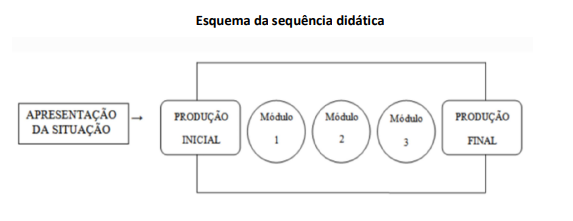
Agora, analise as afirmativas e indique aquela que NÃO se adequa à proposta de ensino de gêneros baseado em sequências didáticas.
Marcuschi (2008, p. 214) apresenta a estrutura base de uma sequência didática conforme a imagem.
Agora, analise as afirmativas e indique aquela que NÃO se adequa à proposta de ensino de gêneros baseado em sequências didáticas.
Provas
Questão presente nas seguintes provas
ENEM 2022: aluno nota 1.000 na redação elogia tema e dá dicas de estudo para prova
"Os desafios para a valorização de comunidades e povos tradicionais no Brasil". Esse foi o tema da redação do ENEM 2022. Rodrigo Junqueira Santiago Simões, de 18 anos, um dos estudantes que tiraram nota mil na redação, elogia o assunto escolhido pelo Instituto Nacional de Pesquisas Educacionais Anísio Teixeira (Inep). Segundo o aluno […], a redação trouxe à tona um tema essencial para o debate público no país, tratando da desvalorização das comunidades e povos tradicionais. "Por mais que haja uma invisibilização sistêmica desses grupos, acredito que grande parte dos estudantes tenham acesso a algum tipo de bagagem de conhecimento sobre esse tema, sobretudo pela experiência cotidiana em um país que é culturalmente marcado pela influência indígena, quilombola, ribeirinha etc.". acredita. Rodrigo avalia que várias perspectivas poderiam ser abordadas na redação, seja do ponto de vista ambiental, econômico, legal ou epistemológico, o que é essencial em um tema abrangente como esse.
ENEM 2022: aluno nota 1.000 na redação elogia tema e dá dicas de estudo para prova. Disponível em: https://vestibular.brasilescola.uol.com.br/enem/enem-2022-aluno-nota-1000-na-redacao-elogia-tema-daprova-e-da-dicas-de-estudo/354182.html. Acesso em: 16mar. 2023.
Qual destas análises sobre o texto está adequada?
"Os desafios para a valorização de comunidades e povos tradicionais no Brasil". Esse foi o tema da redação do ENEM 2022. Rodrigo Junqueira Santiago Simões, de 18 anos, um dos estudantes que tiraram nota mil na redação, elogia o assunto escolhido pelo Instituto Nacional de Pesquisas Educacionais Anísio Teixeira (Inep). Segundo o aluno […], a redação trouxe à tona um tema essencial para o debate público no país, tratando da desvalorização das comunidades e povos tradicionais. "Por mais que haja uma invisibilização sistêmica desses grupos, acredito que grande parte dos estudantes tenham acesso a algum tipo de bagagem de conhecimento sobre esse tema, sobretudo pela experiência cotidiana em um país que é culturalmente marcado pela influência indígena, quilombola, ribeirinha etc.". acredita. Rodrigo avalia que várias perspectivas poderiam ser abordadas na redação, seja do ponto de vista ambiental, econômico, legal ou epistemológico, o que é essencial em um tema abrangente como esse.
ENEM 2022: aluno nota 1.000 na redação elogia tema e dá dicas de estudo para prova. Disponível em: https://vestibular.brasilescola.uol.com.br/enem/enem-2022-aluno-nota-1000-na-redacao-elogia-tema-daprova-e-da-dicas-de-estudo/354182.html. Acesso em: 16mar. 2023.
Qual destas análises sobre o texto está adequada?
Provas
Questão presente nas seguintes provas
Cadernos
Caderno Container